

Key Takeaways
- Every dollar of income is assigned to a category before the month starts, leaving a balance of zero.
- Savings and debt payments are treated as budget line items, not afterthoughts.
- The method requires a monthly reset, which keeps the budget aligned with changing expenses.
- Zero-based budgeting works best when you have a consistent, predictable income.
- Tracking throughout the month is essential — the plan only works if you follow it.
Zero-Based Budgeting
Zero-based budgeting (ZBB) is a method where you assign every dollar of your income to a specific category — expenses, savings, or debt payments — until the total left over equals zero. The goal isn't to spend everything; it's to give every dollar a deliberate purpose so nothing is unaccounted for. By doing this before each budget period begins, you stay in control of where your money goes rather than wondering where it went.
The term 'zero-based' means income minus all assigned allocations equals zero — not that your bank account reaches zero. A dollar moved to savings counts as a full assignment.
How Zero-Based Budgeting Works
The mechanics are straightforward: add up all income expected for the month, then create spending and saving categories until every dollar is assigned. When you subtract all assignments from total income and reach zero, the budget is complete.
The key distinction from other methods is that you start fresh each month rather than rolling forward last month's numbers. A grocery budget that worked in July may not fit August when school supplies compete for the same dollars. Rebuilding from zero forces that recalibration.
Savings and debt payments appear in the budget as explicit line items — not whatever is left over after spending. This is what makes zero-based budgeting a reliable tool for making progress on goals. When an emergency fund contribution sits alongside the electric bill as a named assignment, it's far less likely to be skipped.
Start With Last Month's Bank Statement
Before assigning any dollars, pull your last one or two months of bank and credit card statements. Real spending data produces far more accurate category estimates than memory alone. This step also surfaces subscriptions or recurring charges you may have forgotten — making it easier to assign or cancel them deliberately.
If you're new to building a spending plan altogether, the household budget walkthrough is a useful starting point before adding the zero-based structure.
Building Your Zero-Based Budget Step by Step
Follow this sequence at the start of each budget period:
- Calculate take-home income. Use net pay — what actually lands in your account after taxes and deductions. Include all reliable sources.
- List fixed obligations first. Rent or mortgage, loan minimums, insurance premiums, and any subscriptions with fixed amounts go in first because they don't flex.
- Estimate variable necessities. Groceries, utilities, gas, and similar categories vary month to month. Use recent bank statements to anchor your estimates rather than guessing.
- Assign savings and debt goals. Treat these as non-negotiable line items. Decide the dollar amount for your emergency fund contribution, retirement account transfer, or extra debt payment before allocating discretionary spending.
- Distribute remaining dollars to discretionary categories. Dining out, entertainment, clothing, and personal care each get a specific dollar amount — not a vague intention.
- Verify the balance is zero. If income minus all assignments doesn't equal zero, adjust category amounts until it does.
Unfamiliar with terms like discretionary income or sinking fund? The budgeting terms reference covers the core vocabulary in plain language.
~33%
Americans with a written monthly budget
Gallup polling has consistently found that fewer than one in three U.S. adults maintains a detailed monthly budget, suggesting most households lack a structured spending plan.
$1,000
Common emergency fund starting target
Many personal finance educators cite a $1,000 starter emergency fund as a foundational milestone — the type of explicit savings goal zero-based budgeting is designed to fund deliberately.
30–60 min
Typical monthly budget setup time
Financial planning practitioners generally estimate that a zero-based monthly budget takes 30 to 60 minutes to build, with the process becoming faster as category patterns become established.
Who Benefits Most — and Where It Gets Challenging
Zero-based budgeting tends to work especially well for people with a consistent monthly paycheck, those paying down high-interest debt, and anyone who has noticed money disappearing without explanation. Because every dollar is named, spending leaks — small recurring charges, impulse purchases, accumulated subscriptions — become visible quickly.
The method has real friction points too. People with variable or seasonal income need to budget conservatively and adjust when earnings differ from projections. The monthly rebuild requires 30–60 minutes of focused attention, which not everyone sustains. And if you're tracking manually, category overruns require prompt rebalancing to keep the budget valid.
For comparison, percentage-based approaches like the 50/30/20 guideline require less ongoing maintenance. The comparison of zero-based and percentage-based budgeting walks through the tradeoffs side by side so you can evaluate which structure fits your habits. The envelope budgeting method shares ZBB's category-first logic but applies it differently.
Tracking and Adjusting Throughout the Month
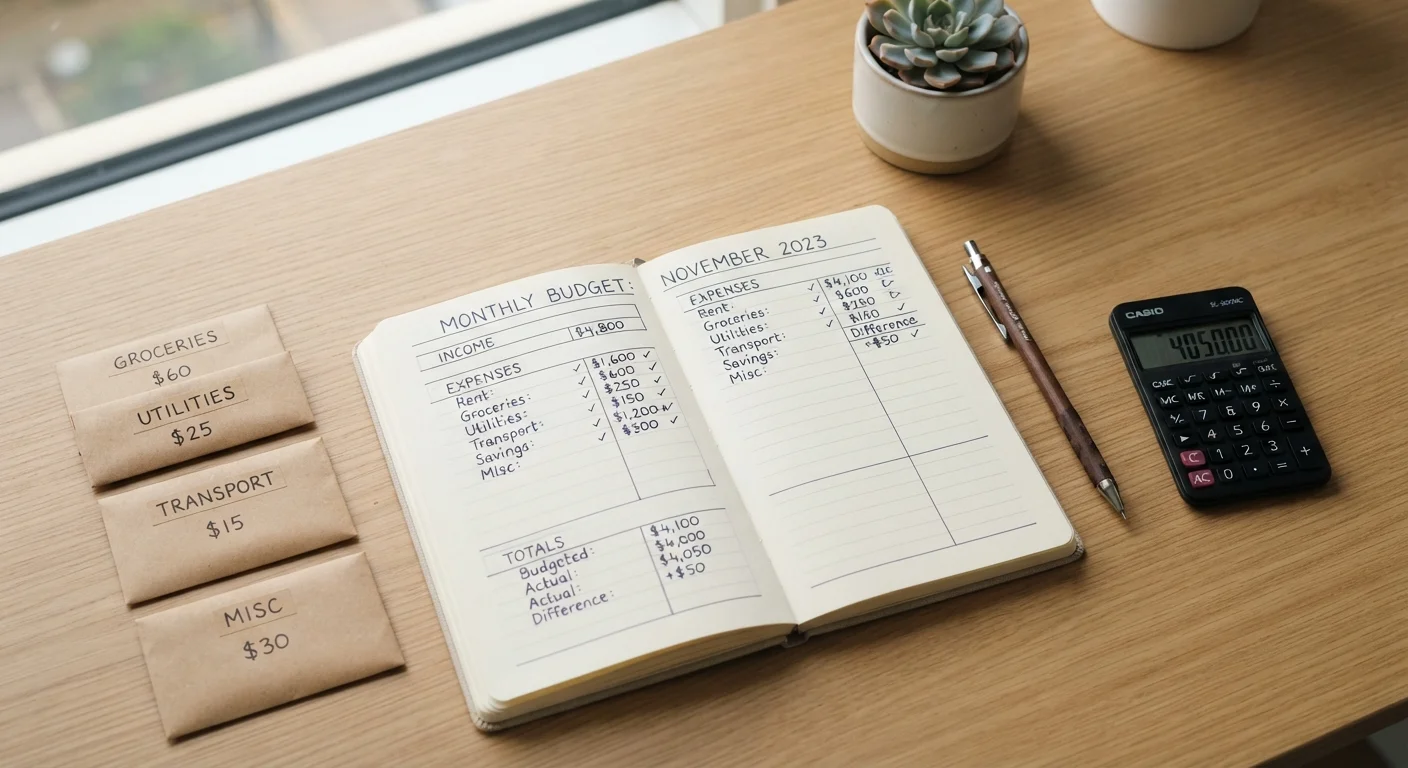
A zero-based budget built at the start of the month only works if spending is tracked against it in real time. When you spend $47 at the grocery store, that amount reduces the grocery allocation — not a general pool. Tracking can happen in a spreadsheet, a dedicated notebook, or a budgeting app.
Mid-month adjustments are normal and expected. If the car needs an unplanned repair, you move dollars from a lower-priority category — perhaps dining out or entertainment — to cover it. This rebalancing keeps total allocations equal to income without discarding the budget entirely.
The manual versus app-based budgeting comparison can help you decide which tracking approach matches your routine. Both options are compatible with zero-based budgeting — the method is tool-agnostic.
At month's end, review which categories ran over or under. Those patterns inform next month's allocations and make each successive budget more accurate than the last. Over time, the monthly rebuild becomes faster and the budget becomes a reliable financial tool rather than an exercise in estimation.
This article provides general financial education and is not personalized financial advice. For guidance specific to your situation, consider consulting a qualified financial professional.