
Zero-Based Budgeting vs. Percentage-Based Budgeting: Which Structure Fits Your Life?

Key Takeaways
- Zero-based budgeting requires assigning every dollar of income to a specific category until nothing is left unallocated.
- Percentage-based budgeting divides income into broad proportional buckets, such as the 50/30/20 rule.
- Zero-based budgeting demands more monthly effort but offers granular spending control.
- Percentage-based budgeting is easier to maintain and scales automatically when income rises or falls.
- Neither method is universally superior — the best fit depends on your income stability, financial goals, and time available.
Option A
Zero-Based Budgeting
The precise, dollar-by-dollar control method.
Best for: People who want complete accountability over every dollar they earn each month.
Option B
Percentage-Based Budgeting
The flexible, proportion-driven framework.
Best for: People who want a simple, adaptable structure that scales with income changes.
If you're working to eliminate debt or hit a specific savings target quickly
Zero-Based Budgeting
Assigning every dollar deliberately makes it harder for money to drift toward low-priority spending, keeping you focused on your goal.
If your income varies month to month or you have irregular pay
Percentage-Based Budgeting
Proportional allocations automatically adjust to what you actually earned, so you don't have to rebuild the budget from scratch each month.
If you're new to budgeting and want a manageable starting point
Percentage-Based Budgeting
Broad categories like needs, wants, and savings are easier to track and less time-consuming than line-by-line zero-based planning.
If you have a stable salary and want to know exactly where your money goes
Zero-Based Budgeting
Consistent income makes it practical to map out every spending category in advance each month without recalculating proportions repeatedly.
If you want a system that requires minimal upkeep once it's set up
Percentage-Based Budgeting
Once your target percentages are established, the framework largely runs itself — you only revisit it when your financial situation changes significantly.
How Each Method Is Built
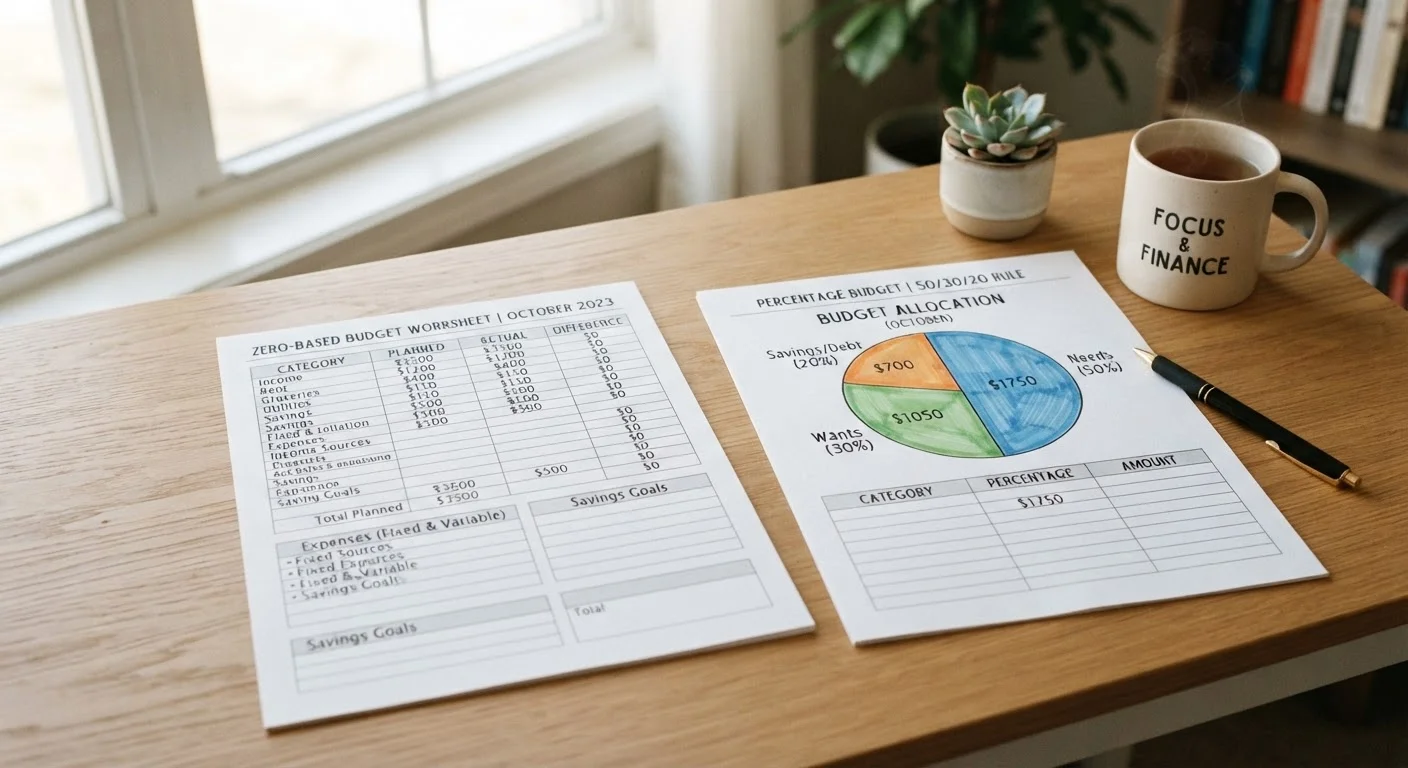
The two approaches start from opposite design philosophies. Zero-based budgeting begins with your total monthly income and assigns every dollar to a category — housing, groceries, transportation, savings, debt payments, entertainment — until the remaining balance reaches zero. That doesn't mean spending everything; it means every dollar has a designated purpose, including dollars directed to savings or an emergency fund. For a deeper look at the method in practice, see how zero-based budgeting works in everyday practice.
Percentage-based budgeting works differently. Rather than itemizing individual categories, it divides income into broad proportional buckets. The widely referenced 50/30/20 rule — 50% to needs, 30% to wants, 20% to savings and debt — is one example of this structure. The 50/30/20 rule explained covers exactly how those splits work and where they fall short. Other percentage frameworks use different ratios, but the principle is the same: allocate by proportion, not by line item.
Understanding how your expenses behave within either system matters. Fixed and variable expenses respond differently to each method — fixed costs fit neatly into zero-based line items, while variable spending is often easier to manage within a percentage cap.
| Criterion | Zero-Based Budgeting | Percentage-Based Budgeting |
|---|---|---|
| Core principle | Every dollar assigned a job | Income split by proportion |
| Monthly setup time | Higher — rebuilt each month | Lower — percentages stay fixed |
| Spending visibility | Granular, category by category | Broad, bucket by bucket |
| Adapts to income changes | Requires full rebuild | Scales automatically |
| Best income type | Stable, predictable salary | Variable or irregular income |
| Beginner-friendliness | Moderate learning curve | Easy to start immediately |
| Debt payoff focus | High — explicit line item | Moderate — within savings bucket |
The Real-World Tradeoffs
Zero-based budgeting's chief advantage is precision. Because every dollar is assigned intentionally, it is harder for spending to drift unnoticed. That accountability is particularly valuable when paying down debt or building an emergency fund on a tight timeline. The tradeoff is time: rebuilding a detailed budget from scratch each month — especially when expenses shift — requires consistent effort and attention to detail.
Percentage-based budgeting trades some precision for simplicity. If your income rises by $500, your need, want, and savings buckets each grow proportionally without recalculation. That scalability makes it well-suited to irregular earners, those new to budgeting, or anyone whose lifestyle doesn't lend itself to meticulous monthly planning. The downside is reduced visibility: broad categories can obscure where money actually goes within each bucket.
~33%
Americans with a formal monthly budget
Gallup polling has historically found that only about one-third of U.S. adults follow a detailed household budget each month.
6 months
Recommended emergency fund target
The Consumer Financial Protection Bureau (CFPB) generally advises households to aim for three to six months of essential expenses in an accessible savings account.
It's also worth noting that both methods depend on knowing your baseline numbers. If you're still getting familiar with budgeting vocabulary, key budgeting terms every American should know provides a plain-language foundation. And if you're deciding how to track either approach, manual budgeting vs. app-based budgeting compares the tools available.
Hybrid Approaches Are Common
Many people find that a hybrid works best in practice — using percentage targets as guardrails while tracking individual categories within each bucket. For example, you might cap wants at 30% of income, then use zero-based logic to allocate that 30% across dining, entertainment, and hobbies. There's no rule requiring you to adopt either method in its purest form. What matters most is that your system is consistent and honest about where your money is actually going.
This article provides general financial education and is not personalized financial advice. Consult a licensed financial professional for guidance specific to your situation.