

Key Takeaways
- Fixed expenses stay the same each month and are generally harder to eliminate quickly.
- Variable expenses change month to month and are where most budgeting flexibility lives.
- Knowing which category each cost belongs to helps you build a more realistic spending plan.
- Reducing fixed expenses often requires lifestyle changes; trimming variable costs can happen immediately.
- Both types of expenses must be tracked to avoid overspending or leaving goals underfunded.
Option A
Fixed Expenses
The predictable, non-negotiable foundation of your budget.
Best for: Anchoring your monthly spending plan with costs you can count on to stay the same.
Option B
Variable Expenses
The flexible, fluctuating costs that require active management.
Best for: Identifying where you have real room to cut spending or redirect money toward goals.
If you want to identify where you can cut spending this month
Variable Expenses
Variable costs like dining out, subscriptions, and entertainment are the fastest category to trim without major lifestyle disruption.
If you're building a baseline monthly budget for the first time
Fixed Expenses
Start by listing all fixed expenses first — they form a reliable floor below which your spending cannot drop without major changes.
If your income changes month to month
Variable Expenses
Variable expenses can flex up or down with your income, making them the key lever for freelancers and contractors managing cash flow.
If you're trying to reduce financial stress long-term
Fixed Expenses
Lowering recurring fixed costs — through refinancing, downsizing, or renegotiating — creates lasting, automatic savings with no monthly effort.
What Makes an Expense Fixed or Variable?
Every dollar you spend each month falls into one of two broad categories: fixed or variable. Understanding the difference is foundational to any budgeting approach — including the structured methods explored in our comparison of zero-based and percentage-based budgeting.
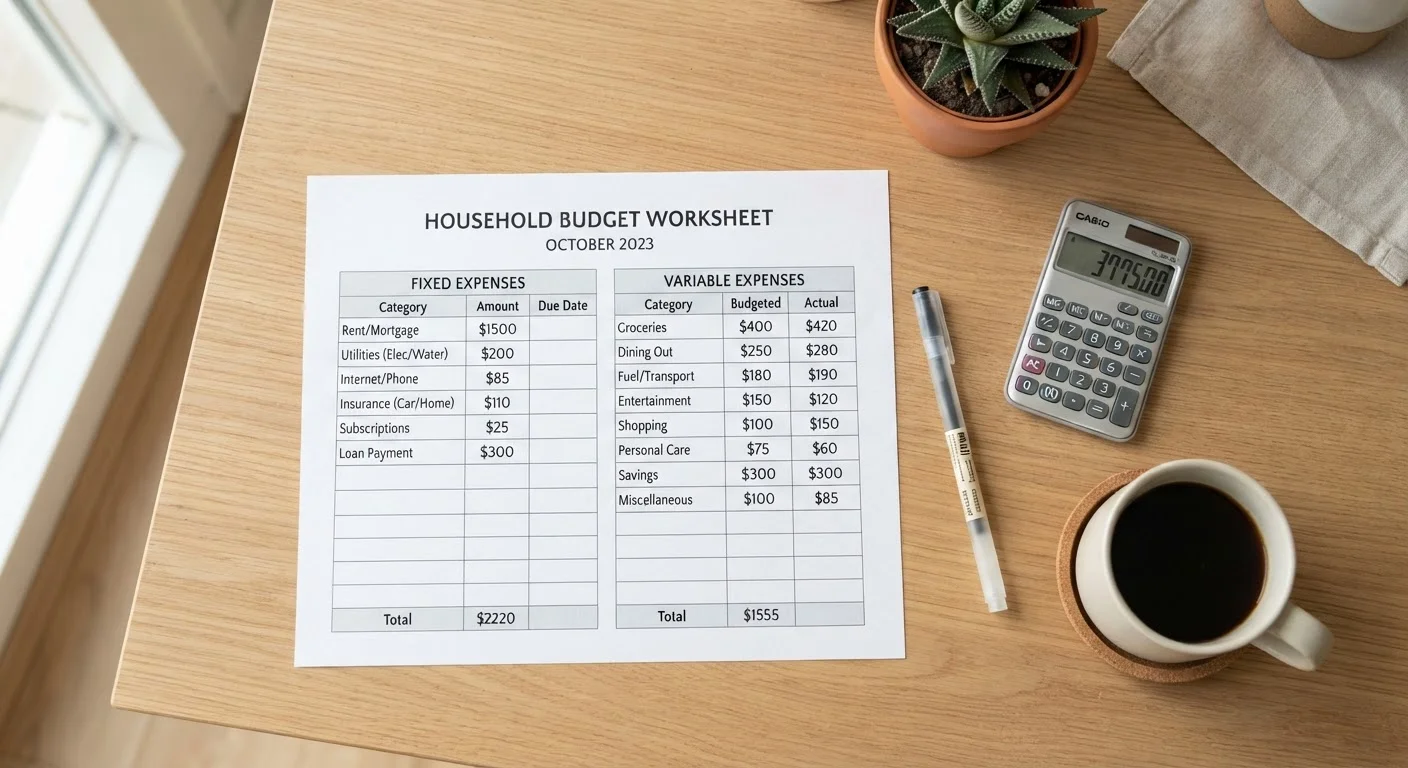
Fixed expenses are costs that remain the same from month to month regardless of how you spend your time or money. Your rent or mortgage payment, car loan installment, insurance premiums, and any fixed-rate loan payments all qualify. You know the exact dollar amount before the month begins.
Variable expenses, by contrast, fluctuate based on your behavior and circumstances. Grocery bills, gas, utility usage, dining out, clothing, and household supplies are common examples. The category exists, but the amount changes — sometimes dramatically.
A helpful rule of thumb: if you can predict the exact amount without checking a statement, it's likely fixed. If you need to look back at last month's spending to estimate it, it's likely variable.
| Criterion | Fixed Expenses | Variable Expenses |
|---|---|---|
| Amount each month | Stays the same | Changes based on behavior |
| Predictability | High — known in advance | Low to moderate — must be estimated |
| Common examples | Rent, car loan, insurance premiums | Groceries, gas, dining, utilities |
| Ease of immediate reduction | Difficult — requires major decisions | Easier — adjustable month to month |
| Long-term savings impact | High — changes persist automatically | Moderate — requires ongoing discipline |
| Budget planning role | Sets the spending floor | Determines spending flexibility |
How Each Type Shapes Your Budget Strategy
Fixed expenses give your budget a stable foundation. Because these amounts don't change, you can subtract them from your monthly income immediately and know exactly how much is left to allocate. This predictability is useful — but it also means fixed costs create financial commitments that are difficult to unwind quickly. Signing a lease or taking on a loan locks in that obligation for months or years.
Variable expenses are where active budget management actually happens. These costs respond directly to choices you make — how often you eat out, how aggressively you heat your home, how many subscriptions you maintain. That responsiveness is a feature, not a flaw: it means variable spending is also where you have the most immediate control.
Semi-Variable Expenses: A Third Category to Know
Some expenses don't fit neatly into either box. Utility bills, for example, arrive every month (fixed in timing) but vary with usage (variable in amount). These are sometimes called semi-variable or mixed expenses. It's useful to budget a conservative estimate for these — slightly higher than your average — to avoid being caught short in high-usage months like January or August.
For those with income that shifts from paycheck to paycheck, variable expenses become especially important. Our guide on budgeting on an irregular income covers how to build a system that holds even when your earnings fluctuate.
Reducing Each Type: What's Realistic
Cutting fixed expenses almost always requires a significant decision: refinancing a mortgage, negotiating a lower insurance rate, moving to a less expensive home, or eliminating a recurring service contract. These changes take time and effort, but the payoff is lasting — once done, the savings repeat automatically each month without further action.
Cutting variable expenses is faster but requires ongoing discipline. You can spend less on groceries this week simply by planning meals or skipping a convenience purchase. The challenge is consistency — variable reductions can reverse just as quickly as they were made if habits drift.
~30%
Typical share of income spent on housing
The U.S. Bureau of Labor Statistics Consumer Expenditure Survey consistently shows housing — a predominantly fixed cost — consuming roughly 30% of average household spending.
~15%
Average share spent on food (combined)
Food — a variable expense split between groceries and dining out — represents roughly 12–15% of average U.S. household expenditure, according to BLS data.
A practical approach is to tackle both in parallel: work toward one meaningful fixed-cost reduction over the next few months while using monthly variable spending reviews to find immediate savings. Together, these efforts compound over time into meaningfully more financial breathing room.
Vehicle ownership is a useful lens here — fixed costs like your car payment and insurance sit alongside variable costs like fuel and maintenance. Understanding both is essential to seeing the full picture, as outlined in our overview of car ownership costs.
This article is for general informational and educational purposes only. It does not constitute personalized financial advice. For guidance specific to your financial situation, consult a qualified financial professional.