

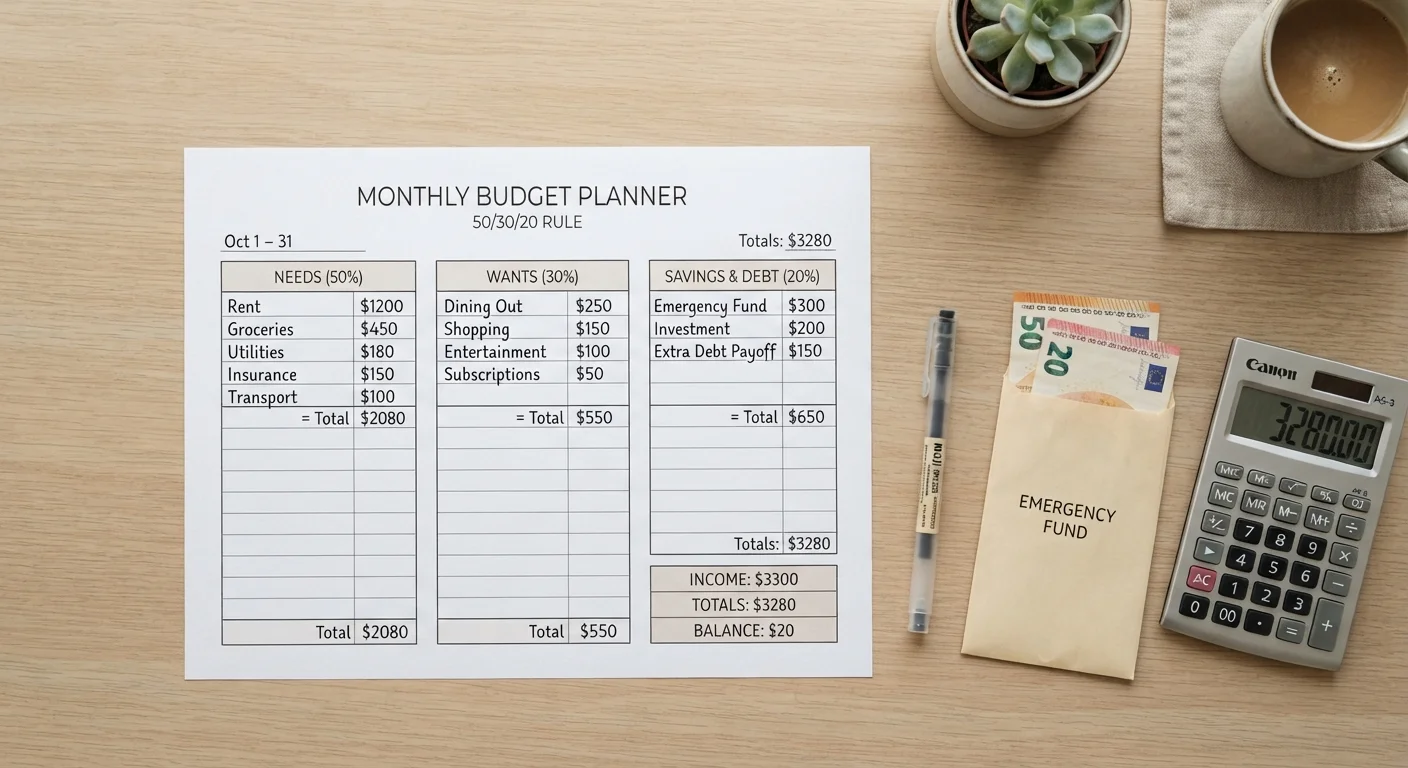
Key Takeaways
- The 50/30/20 rule splits after-tax income into needs, wants, and savings or debt payoff.
- Needs cover essentials like housing, groceries, utilities, and minimum debt payments.
- Wants are discretionary spending — dining out, subscriptions, entertainment, and hobbies.
- The 20% savings category includes emergency funds, retirement contributions, and extra debt payments.
- The rule works best as a starting point; adjusting percentages to your situation is both normal and encouraged.
- High housing costs in many US cities may require modifying the 50% needs allocation.
The 50/30/20 Rule
The 50/30/20 rule is a percentage-based budgeting framework that divides your after-tax income into three categories: 50% for needs, 30% for wants, and 20% for savings and debt repayment. It gives households a simple, memorable structure for allocating money without tracking every individual transaction. The rule is designed to balance present-day living costs with long-term financial security.
The framework is commonly attributed to the work of Senator Elizabeth Warren and her daughter Amelia Warren Tyagi, outlined in their book 'All Your Worth' (2005). It applies to net income — your take-home pay after taxes and other mandatory withholdings.
How the Three Categories Work
The 50/30/20 rule converts a single paycheck into three clear buckets. Understanding what belongs in each category is the most important step to making the framework usable.
50% — Needs
Needs are recurring, non-negotiable expenses. Examples include:
- Rent or mortgage payments
- Groceries and household essentials
- Utilities (electricity, gas, water, internet)
- Health insurance premiums and required medications
- Minimum monthly payments on credit cards and loans
- Basic transportation costs (car payment, insurance, or transit pass)
Notice that the minimum payment is a need — any extra payment toward debt is a savings decision that belongs in the 20% bucket.
30% — Wants
Wants are lifestyle choices. These are real expenses you may pay regularly, but they aren't survival necessities. Common examples include dining out, streaming services, gym memberships, travel, hobbies, and upgraded phone plans. The 30% category is also where discretionary shopping lives.
20% — Savings and Debt Repayment
This slice builds your financial foundation. It covers emergency fund contributions, retirement account deposits (such as a 401(k) or IRA), and extra debt payments beyond minimums. Prioritizing an emergency fund before aggressive investing is a widely recommended sequence — the Consumer Financial Protection Bureau (CFPB) generally suggests having three to six months of essential expenses set aside before directing significant funds elsewhere.
For a broader view of how savings fits into long-term planning, see our financial planning hub.
~33%
Median share of income spent on housing
According to U.S. Census Bureau data, many American renters spend roughly a third or more of their income on housing costs alone, often pushing the needs category well past 50%.
~56%
Americans living paycheck to paycheck
Surveys conducted by financial research organizations consistently estimate that more than half of US adults have little to no buffer between income and monthly expenses, underscoring the need for structured budgeting.
$1,000
Median emergency fund goal for new savers
The CFPB and many financial educators suggest starting with a $1,000 starter emergency fund before tackling other savings goals, giving households a practical first milestone within the 20% savings allocation.
Putting the Rule Into Practice
Applying the 50/30/20 rule starts with one number: your monthly take-home pay. If you're paid biweekly, multiply one paycheck by 26, then divide by 12 to get a reliable monthly figure. Once you have that base, multiply it by 0.50, 0.30, and 0.20 to set your three spending targets.
From there, compare your current spending to each target. Most people find the needs category is close to or over 50%, and the 20% savings goal has been underfunded. That gap is the practical problem the rule helps you see clearly.
Start With a One-Month Spending Audit
Before adjusting your budget to fit the 50/30/20 ratios, spend one month categorizing every expense as a need, want, or savings contribution. Most people discover their actual splits differ significantly from the target — and that awareness alone is a powerful motivator for change.
If you find the monthly view too abstract, a paycheck-by-paycheck approach may give you better day-to-day control. Our paycheck-aligned budgeting guide explains how to sync spending decisions to when money actually arrives.
When you're ready to formalize your setup, the monthly budget setup checklist walks through every step from gathering income figures to reviewing gaps.
Where the 50/30/20 Rule Falls Short
The rule's simplicity is its strength and its limitation. Three areas where it commonly runs into friction:
High Cost-of-Living Areas
In cities where median rent consumes a large share of median income, hitting 50% for needs is genuinely difficult. The framework doesn't break — it just needs to be recalibrated. Shifting to a 60/20/20 or even 65/15/20 split acknowledges reality while preserving the savings priority.
Variable or Irregular Income
The rule assumes a stable, predictable paycheck. Freelancers, contractors, and gig workers often find the percentages shift month to month. If your income varies, consider using a budgeting approach built for irregular income rather than forcing a fixed-ratio model onto unpredictable cash flow.
High Debt Loads
If significant debt payments consume much of the needs category, the 20% savings slice may feel impossible to reach. In these cases, temporarily shifting the split — say, 50/10/40 — to accelerate debt payoff can be a deliberate, goal-driven choice rather than a failure of the framework.
The 50/30/20 rule is one of several percentage-based approaches. To compare it against a more granular method, see our comparison of zero-based and percentage-based budgeting.
This article provides general financial education and is not personalized financial, tax, or investment advice. Consider consulting a qualified financial professional for guidance specific to your circumstances.