
Envelope Budgeting in a Digital World: How the Old Cash Method Still Holds Up

Key Takeaways
- Envelope budgeting assigns every dollar to a named spending category before the month begins.
- Physical cash envelopes create a hard spending limit that digital payments naturally lack.
- The system works equally well with virtual categories in a spreadsheet or budgeting app.
- It is especially effective for variable, discretionary spending like groceries and entertainment.
- Moving money between envelopes mid-month is allowed but should be a conscious, deliberate choice.
- Envelope budgeting is general financial education — consult a qualified adviser for personalized guidance.
Envelope Budgeting
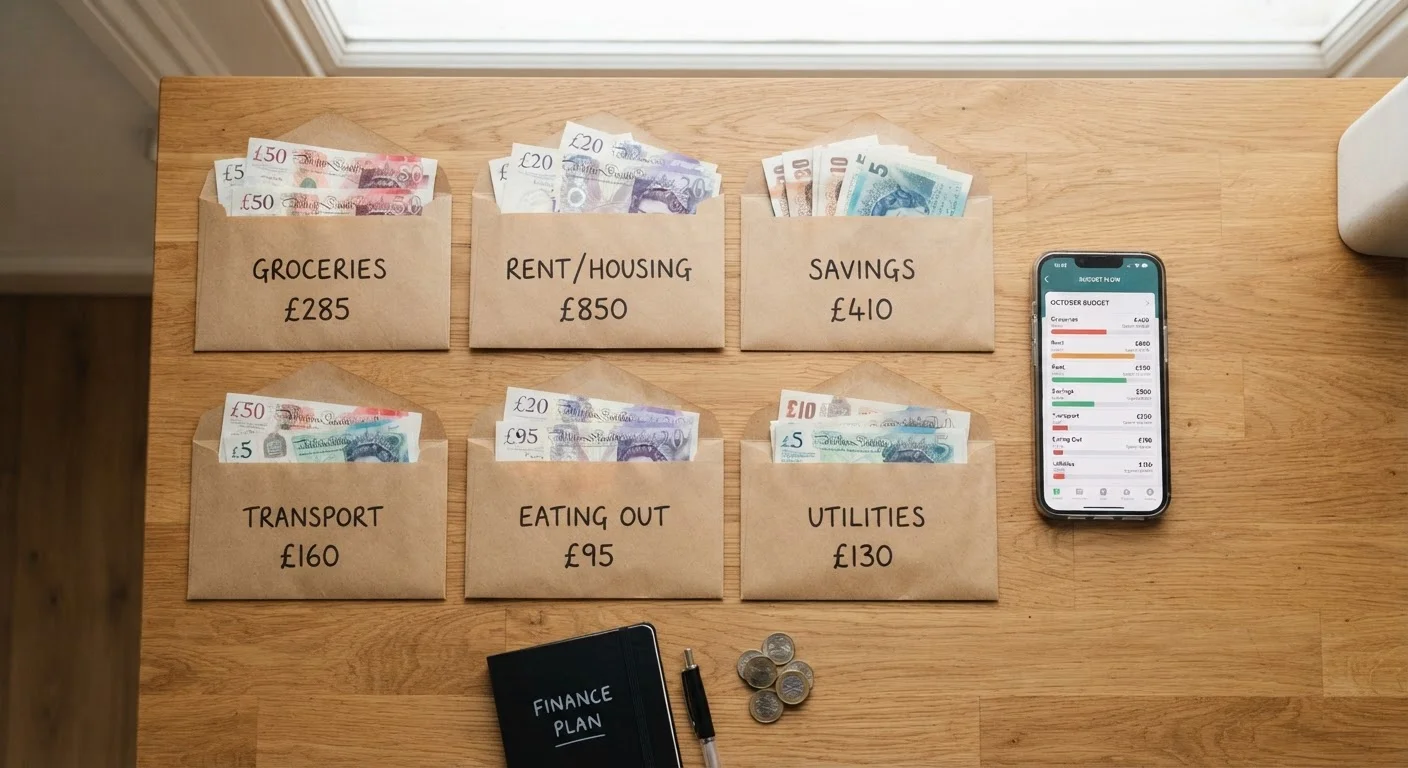
Envelope budgeting is a cash-based spending system where you divide your take-home pay into labeled envelopes — one for each spending category, such as groceries, gas, or dining out. You spend only what's in each envelope for that period. When an envelope is empty, spending in that category stops until the next budget cycle. The physical constraint is the point: it makes overspending tangible and deliberate.
In personal finance, this method is a subset of zero-based budgeting — every dollar of income is preassigned to a category, leaving no unallocated funds. Digital adaptations replicate the same logic using virtual 'envelopes' or category buckets rather than physical cash.
How the Envelope System Works
The mechanics are straightforward. At the start of each budget period — typically a month — you calculate your expected take-home pay, list every spending category, and assign a dollar amount to each. Traditionally, you'd withdraw that total in cash, sort bills into labeled envelopes, and spend only from the relevant envelope throughout the month.
Groceries get $400. Dining out gets $150. Gas gets $120. Each envelope is a hard ceiling. When the dining envelope reaches zero on the 22nd, you cook at home for the rest of the month — full stop.
This isn't a punishment system. It's a visibility tool. Most people who overspend don't do so intentionally; they simply lose track of cumulative small purchases. Envelopes eliminate that ambiguity by making the running balance physical and impossible to ignore.
To understand the vocabulary involved — terms like discretionary income, net pay, and sinking funds — the budgeting terms reference is a useful starting point before building your first envelope plan.
~33%
Americans who use a formal household budget
Gallup polling has consistently found that fewer than one-third of U.S. households maintain a detailed budget, suggesting most spending is tracked reactively rather than planned in advance.
$1,000+
Average monthly discretionary spending per household
According to U.S. Bureau of Labor Statistics Consumer Expenditure data, the average household spends a substantial share of income on variable categories — precisely where envelope budgeting provides the most control.
Why It Still Works in a Cashless Era
Credit and debit cards make overspending frictionless. A tap at the register doesn't feel like spending the way handing over a $20 bill does. Behavioral economics research consistently shows that psychological distance from money correlates with higher spending — which is precisely what envelope budgeting collapses.
The digital adaptation is straightforward: instead of paper envelopes, use named columns in a spreadsheet, labeled sub-accounts at your bank, or category buckets in a budgeting app. The mechanism is the same — you preassign money before spending it and track the balance in real time.
Start with Just Three or Four Envelopes
Beginners often get overwhelmed trying to create an envelope for every possible expense. Start with the two or three categories where you know you overspend — groceries, dining, and entertainment are common culprits. Once those are under control, you can add more categories gradually. Complexity grows better when the habit is already established.
This preassignment logic is the envelope method's core advantage over reactive tracking. Rather than reviewing what you spent at month-end, you decide in advance what each category gets. That single shift — from reflection to intention — is what makes the system effective for people who have tried and abandoned simple expense-tracking apps.
For a comparison of how manual and app-based approaches each support this kind of intentional spending, see manual vs. app-based budgeting.
Real Limitations to Understand
Envelope budgeting isn't a universal solution. It requires consistent upkeep: funding envelopes at the start of each period, tracking spending as it happens, and reconciling at the end of the month. For people who dislike administrative tasks, this friction is a genuine barrier.
It also works best for variable, discretionary spending. Fixed obligations — mortgage or rent, insurance premiums, loan payments — don't benefit from the envelope model because their amounts don't change. Mixing fixed bills into the same envelope framework can create unnecessary complexity.
A second limitation: the system is period-based, which can create tension if your income arrives irregularly or biweekly. If you fund envelopes monthly but get paid every two weeks, you'll need a bridging strategy for the months when three paychecks land. Budgeting by paycheck addresses exactly this challenge.
Comparing Envelope Budgeting to Other Frameworks
Envelope budgeting is one structure among several. It shares DNA with zero-based budgeting — both require that every dollar of income be assigned a purpose. The difference is implementation: zero-based budgeting is often done on paper or in a spreadsheet as a monthly plan, while envelopes (physical or digital) enforce that plan in real time at the point of spending.
Percentage-based approaches, such as the 50/30/20 framework, work differently. They assign broad shares of income to needs, wants, and savings without naming individual categories. That simplicity is appealing, but it offers less granular control. For households trying to rein in specific problem areas — say, a restaurant habit — the envelope system's category-level precision is often more effective.
For a structured comparison of how zero-based and percentage-based models differ, see zero-based vs. percentage-based budgeting. If you want to explore the zero-based approach in depth before layering in envelopes, zero-based budgeting in practice walks through the method step by step.
“A budget is telling your money where to go instead of wondering where it went.”
— Dave Ramsey, Personal finance author and radio host, widely credited with popularizing the cash envelope system for American households
This article is for general informational and educational purposes only and does not constitute personalized financial advice. Consult a qualified financial professional before making decisions about your own budget or financial situation.