

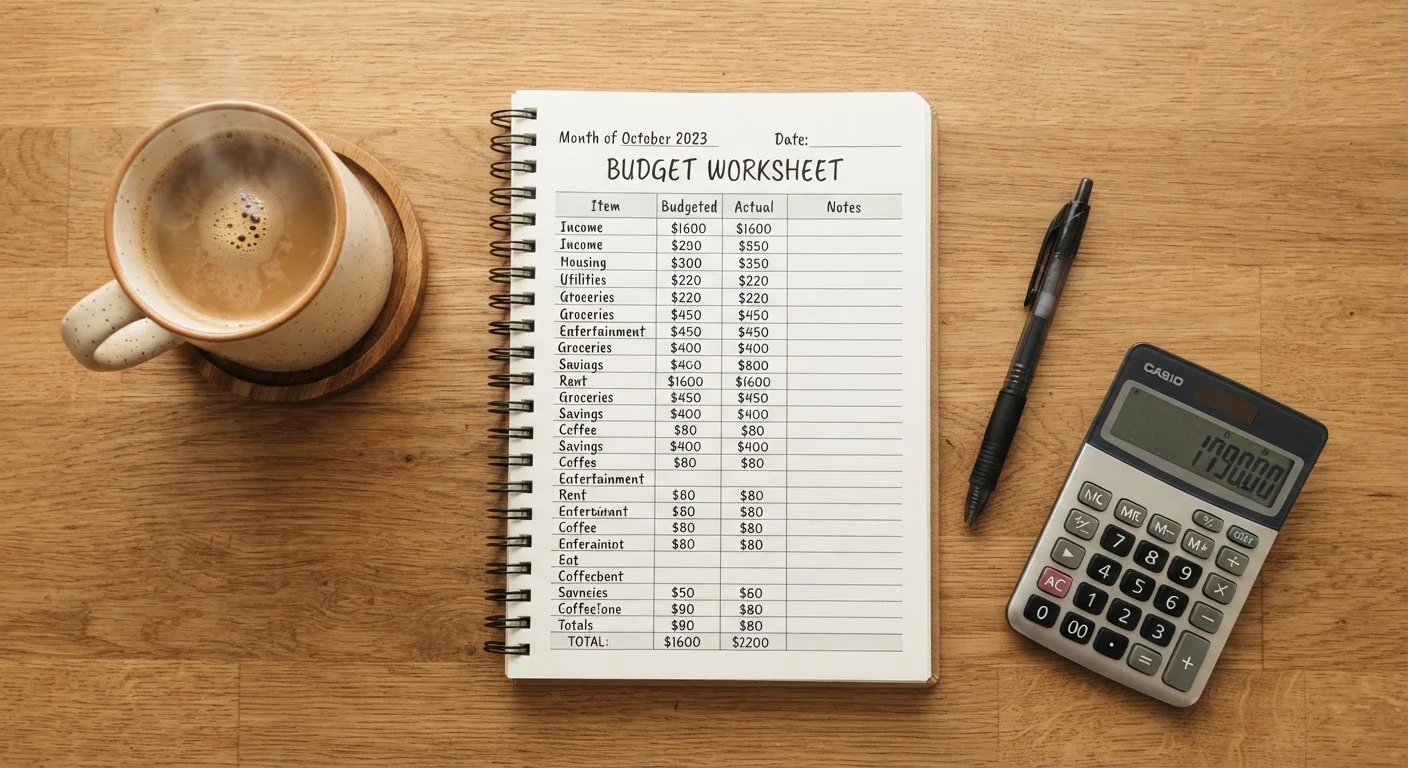
Key Takeaways
- A budget works by comparing what comes in each month to what goes out.
- Start with take-home pay, not gross salary — that's the money you actually control.
- Expenses fall into fixed, variable, and periodic categories, each requiring a different approach.
- A simple framework like 50/30/20 gives first-time budgeters a clear starting point.
- Review your budget monthly — small adjustments prevent small gaps from becoming big problems.
Start here
Why a Household Budget Matters
Next
Step 1 — Add Up Your Monthly Income
Then
Step 2 — Map Every Expense
Apply a system
Step 3 — Choose a Budgeting Framework
Make it stick
Step 4 — Review, Adjust, and Keep Going
Why a Household Budget Matters
A budget is not a punishment — it's a map. Without one, money tends to disappear in ways that are hard to explain and even harder to change. With one, you can see exactly where your dollars go, make deliberate decisions, and build toward goals that actually matter to you.
Research from the Consumer Financial Protection Bureau (CFPB) consistently shows that people who track their income and spending feel more in control of their finances and are better prepared for unexpected expenses. The first budget you build doesn't need to be perfect; it needs to be honest. That's the entire standard for success at this stage.
For a practical monthly companion to this guide, see the monthly budget setup checklist once you've worked through the steps below.
This article provides general financial education and is not personalized financial advice. Consult a qualified financial professional for guidance specific to your situation.
Step 1 — Add Up Your Monthly Income
The foundation of any budget is knowing exactly how much money arrives each month. Use your take-home pay — the amount deposited after taxes, Social Security, and any payroll deductions — not your gross salary. Gross figures include money you never actually receive.
List every income source:
- Primary employment (use a typical month, or average three months if hours vary)
- Side work or freelance income — be conservative if it fluctuates
- Rental income, alimony, or child support received
- Any regular government benefits
Add these together. That single number — your net monthly income — is the ceiling. Every dollar you plan to spend or save must fit beneath it.
Use a Three-Month Average for Variable Income
If your income varies — due to hourly work, commissions, or self-employment — use the lowest of your past three months rather than the average. Budgeting from a conservative baseline means you're covered in slow months and simply have extra in stronger ones.
Step 2 — Map Every Expense
Pull three months of bank and credit card statements. Go line by line and sort each charge into one of three categories:
- Fixed expenses
- Same amount every month — rent or mortgage, car payment, insurance premiums, loan minimums. These are non-negotiable in the short term.
- Variable expenses
- Amounts that change — groceries, utilities, fuel, dining out. These are where most budget flexibility lives.
- Periodic expenses
- Infrequent but predictable — car registration, annual subscriptions, holiday gifts, medical deductibles. Divide each by 12 and treat it as a monthly line item.
Vehicle costs are a common area where people underestimate periodic expenses. For a fuller picture of what car ownership actually costs month to month, the Car Ownership Costs hub is worth reviewing alongside your statements.
Once categorized, total each group. Subtract the grand total from your net monthly income. A positive number means you have room to save or pay down debt. A negative number means expenses exceed income — and that's important information, not a reason to abandon the process.
Take-home pay
The amount of money you actually receive after taxes and payroll deductions are withheld. This is the figure to use when building a budget, not your gross salary.
Fixed expense
A cost that stays the same each month, such as rent or a loan payment. These are typically non-negotiable in the short term.
Variable expense
A cost that changes from month to month, such as groceries or utility bills. These offer the most flexibility when adjusting a budget.
Periodic expense
An expense that occurs irregularly but predictably, such as annual insurance premiums or holiday spending. Converting these to a monthly reserve prevents budget surprises.
Zero-based budgeting
A method where every dollar of income is assigned to a specific category — expenses, savings, or debt — so the total budget balances to zero each month.
Emergency fund
Money set aside specifically to cover unexpected costs, such as medical bills or car repairs, without disrupting the rest of your budget.
Step 3 — Choose a Budgeting Framework
A framework turns a list of numbers into a plan. Two approaches work well for beginners:
The 50/30/20 Rule
Allocate after-tax income as follows: 50% to needs (housing, food, utilities, transportation), 30% to wants (entertainment, dining out, hobbies), and 20% to savings and debt repayment beyond minimums. These percentages are a starting point — adjust them based on your actual obligations.
Zero-Based Budgeting
Assign every dollar of income to a specific category until the balance reaches zero. Nothing is unaccounted for. This method requires more initial effort but leaves no money in a vague, untracked category. For a detailed walkthrough of this approach, see the guide on zero-based budgeting.
Either framework is a valid starting point. The best one is the one you'll actually use consistently. Once your budget is stable, the natural next step is formalizing a savings strategy — the first savings plan guide covers that progression clearly.
Step 4 — Review, Adjust, and Keep Going
A budget built once and never revisited is just a document. The value comes from the monthly habit of comparing what you planned to what actually happened.
At the end of each month, answer three questions:
- Which categories came in over budget, and why?
- Which categories had money left over that could be redirected?
- Did any new irregular expenses appear that need a monthly reserve going forward?
Adjust your category targets based on real-world data, not optimistic guesses. A budget becomes more accurate over time — the first version is always a rough draft. Keeping records also makes spending tracking much easier, since the categories already exist.
If you want to go further — reducing debt, building an emergency fund, or planning for large expenses — the Saving & Debt hub offers practical next steps once your monthly budget is stable.