

Key Takeaways
- A savings plan gives your money direction — without one, spending tends to fill whatever space is left.
- Specific, time-bound goals are more actionable than vague intentions like 'save more.'
- Your budget tells you how much you can realistically set aside each month.
- Different savings goals often benefit from separate, dedicated accounts.
- Automating contributions is one of the most reliable ways to build savings over time.
Start here
Why a Savings Plan Matters Before Anything Else
Next
Setting Clear, Specific Savings Goals
Then
Understanding Your Starting Point
After that
Choosing the Right Account for Your Goals
Finally
Making Progress Consistently
Why a Savings Plan Matters Before Anything Else
Most people intend to save money. Far fewer actually do it with any regularity — not because they lack discipline, but because intention without structure rarely survives contact with monthly expenses. A savings plan converts a vague goal into a concrete habit.
Without a plan, spending tends to absorb whatever income remains after bills. A plan reverses that sequence: you decide how much to save first, then manage the rest. This principle — often called paying yourself first — is foundational to building financial stability over time.
If you're new to formal financial planning, consider pairing this guide with a look at building your first household budget. Understanding your cash flow is the prerequisite to saving effectively.
Savings plan
A structured approach to setting aside money regularly, tied to specific goals and a realistic budget.
Pay yourself first
A savings strategy where you set aside a designated amount of income before spending on anything else.
Emergency fund
A reserve of liquid savings kept specifically to cover unexpected expenses like job loss or a medical bill.
Savings rate
The percentage of your income that goes toward savings, used as a simple measure of financial progress.
High-yield savings account
A savings account that typically pays a higher interest rate than a standard bank savings account, while keeping your money accessible.
Tax-advantaged account
An account type — such as a 401(k) or IRA — that offers tax benefits to encourage long-term saving for goals like retirement.
Setting Clear, Specific Savings Goals
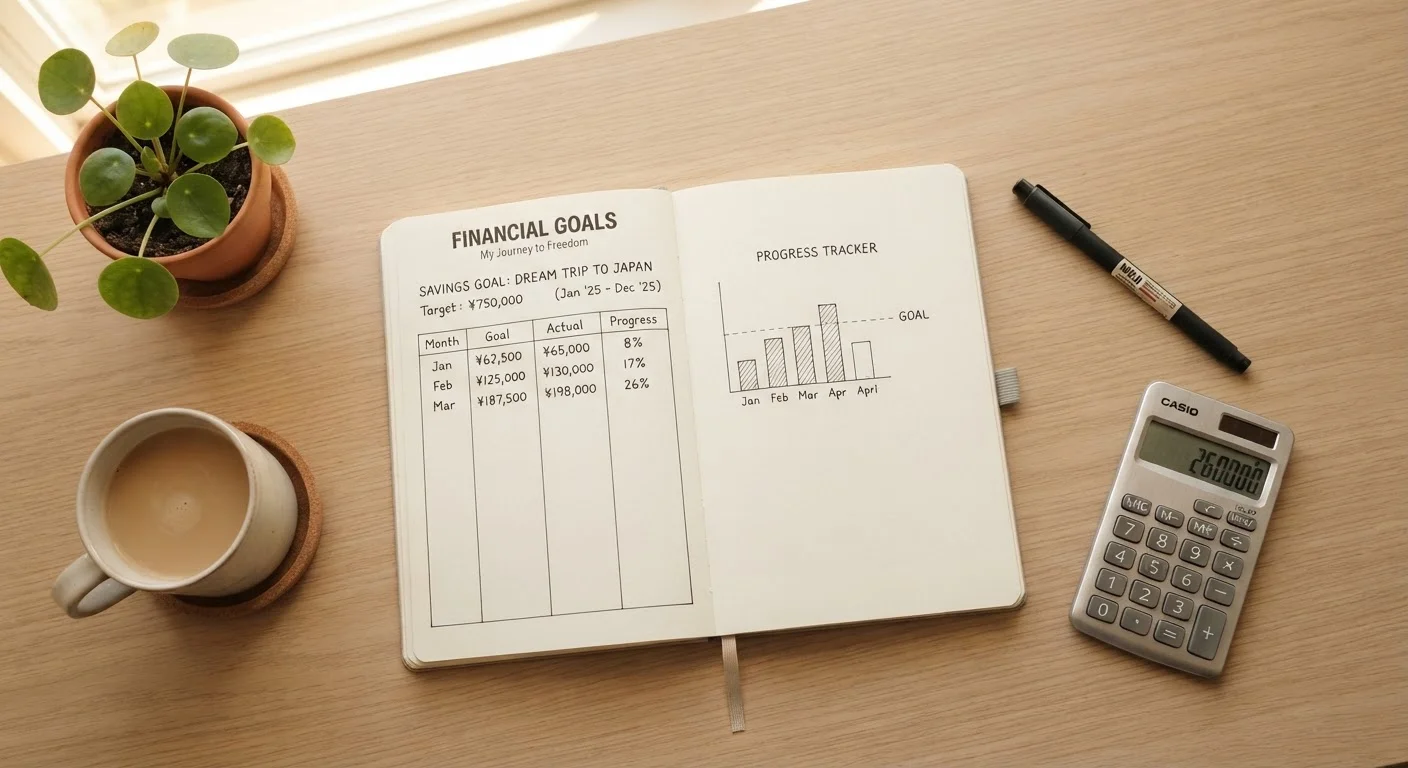
Saving with a specific target in mind is measurably more effective than saving in general. Goals give you an amount to work toward, a timeline to plan around, and a clear sense of progress.
Useful savings goals have three qualities: they are specific (a dollar amount), time-bound (a target date), and grounded in a real purpose. For example, "save $1,200 for a car repair fund by the end of the year" is far more actionable than "save more money."
Categorize your goals by time horizon:
- Short-term (under 1 year): An emergency fund, a home repair buffer, or a planned purchase.
- Medium-term (1–5 years): A down payment on a vehicle or a home renovation fund.
- Long-term (5+ years): Retirement contributions or a college savings fund.
Your savings rate — the percentage of your income you set aside — is a useful metric for tracking whether you're on pace with these goals over time.
Give Each Goal Its Own Account
Opening a separate savings account for each major goal — emergency fund, vacation, down payment — makes it easier to track progress and reduces the temptation to borrow from one goal to cover another. Many banks allow you to label or nickname accounts for exactly this purpose.
Understanding Your Starting Point
Before you can save with intention, you need to know what's available to save. That means calculating your monthly cash flow: total take-home income minus all fixed and variable expenses.
Fixed expenses — rent or mortgage, utilities, insurance, loan payments — are generally predictable. Variable expenses — groceries, dining, transportation, entertainment — require some estimation based on recent spending. Many people are surprised to find that discretionary spending is higher than they realized once they add it up.
The gap between your income and your total expenses is your potential savings margin. If that margin is thin or negative, the Budgeting Basics hub covers practical approaches to reducing spending and reallocating cash toward savings.
Also review any existing debt obligations. High-interest debt — such as credit card balances — can erode your financial position faster than low-yield savings can build it. For a practical framework on managing both at the same time, see our guide to savings and debt reduction.
Choosing the Right Account for Your Goals
Not every savings goal belongs in the same account. Matching the account type to the goal's time horizon and purpose helps your money work appropriately while staying accessible when needed.
- Emergency fund
- Keep this in a liquid account you can access quickly without penalty. A dedicated savings account — separate from your checking — reduces the temptation to spend it casually. Our article on emergency funds explains how to size this buffer for your household.
- Short- and medium-term goals
- A high-yield savings account typically offers better interest than a standard savings account while keeping funds accessible. See how high-yield and traditional savings accounts compare for a side-by-side breakdown.
- Long-term goals
- Retirement savings often benefit from tax-advantaged accounts such as a 401(k) or IRA. Contributions to these accounts may reduce taxable income or grow tax-free depending on the account type — consult a qualified financial adviser about which structure fits your situation.
Making Progress Consistently
Consistency, not perfection, drives savings growth over time. A modest amount saved reliably every month outperforms irregular large contributions that depend on willpower alone.
The most practical tool for consistency is automation. Scheduling a transfer from checking to savings immediately after each paycheck removes the decision from your routine — and the money doesn't linger where it can be spent. Automating your savings walks through the specific methods people use to build this discipline into their financial lives.
Review your savings plan every three to six months. Life changes — a raise, a new expense, a completed goal — are natural prompts to adjust your contribution amounts and targets. Progress doesn't have to be linear; what matters is that the habit stays intact.
For a broader view of how savings fits into your overall financial life — including retirement and insurance planning — the financial planning roadmap offers a helpful end-to-end framework.
This article is for general informational and educational purposes only and does not constitute personalized financial, tax, or investment advice. Consult a licensed financial professional for guidance tailored to your specific circumstances.