

Key Takeaways
- R-value measures insulation's resistance to heat flow — higher numbers mean better thermal performance.
- Different insulation materials suit different locations; no single type is ideal everywhere.
- Attics are usually the highest-priority area for insulation upgrades in most US climates.
- Air sealing before adding insulation significantly improves overall thermal efficiency.
- Some insulation work is safe for DIY; spray foam and enclosed-cavity jobs typically require professionals.
Start here
What R-Value Actually Means
Next
Common Insulation Types at a Glance
Then
Where Insulation Matters Most in a Home
After that
Evaluating What You Already Have
Final step
When to DIY and When to Call a Professional
What R-Value Actually Means
R-value is the single most important number in any insulation conversation. It measures a material's resistance to heat flow — specifically, how well it slows the transfer of heat through a given thickness. The higher the R-value, the greater the insulating power.
A few clarifications that often trip up homeowners:
- R-value is additive. Adding a second layer of insulation with the same R-value doubles the effective resistance of that assembly.
- R-value per inch varies by material. Spray foam may deliver R-6 or more per inch, while fiberglass batts typically land around R-3 to R-4 per inch.
- Recommended levels differ by climate zone. The U.S. Department of Energy publishes recommended R-values by zone — what's appropriate in Minnesota differs significantly from what's needed in Florida.
R-value
A number that measures how well an insulation material resists heat flow. Higher R-values mean more resistance and better insulating performance.
Thermal bridging
When heat bypasses insulation by traveling through more conductive materials like wood studs or metal framing, reducing the overall effectiveness of the insulated assembly.
Air sealing
The process of closing gaps, cracks, and penetrations in a home's envelope to prevent conditioned air from escaping and outside air from entering.
Building envelope
The physical barrier between the conditioned interior of a home and the outdoors — including walls, roof, foundation, windows, and doors.
Vapor barrier
A material installed to slow the movement of moisture vapor through walls or floors, helping prevent condensation and moisture damage within the assembly.
Climate zone
A geographic classification system used by the U.S. Department of Energy to group areas with similar weather patterns, used to set recommended R-values for insulation.
Understanding R-value lets you compare insulation options on an apples-to-apples basis rather than guessing based on thickness alone.
Common Insulation Types at a Glance
Each insulation material has distinct strengths, limitations, and installation methods. Here's a practical overview of the types you're most likely to encounter:
- Fiberglass batts
- Pre-cut blankets that fit between standard wall studs and floor joists. Widely available, relatively affordable, and suitable for DIY installation in open cavities. Effective R-value depends on proper fit — gaps and compression reduce performance.
- Mineral wool (rock wool) batts
- Similar in form to fiberglass but denser, with better fire resistance and soundproofing properties. Slightly higher cost per square foot.
- Blown-in cellulose
- Made from recycled paper treated with fire retardant. Excellent for attic floors and retrofitting existing wall cavities. Settles slightly over time, which factors into initial depth calculations.
- Blown-in fiberglass
- Loose-fill version of fiberglass. Works well in attics and can be blown into enclosed cavities through small holes — useful in retrofit situations.
- Closed-cell spray foam
- Expands to fill gaps, creating both insulation and an air barrier. High R-value per inch (approximately R-6 to R-7). Requires professional installation due to chemical handling requirements.
- Open-cell spray foam
- Less dense than closed-cell, with a lower R-value per inch (approximately R-3.5 to R-4). Good for interior applications where moisture vapor permeability is desired.
- Rigid foam board
- Panels of polystyrene, polyisocyanurate, or polyurethane. Common on exterior walls, basement walls, and under slabs. Must be covered with a fire-rated material (such as drywall) in living spaces.
For guidance on how insulation fits into a broader renovation plan, see the framework for prioritizing home improvement projects.
Where Insulation Matters Most in a Home
Not every square foot of your home loses heat equally. Concentrating improvements on the highest-impact areas first is the most practical approach for most homeowners.
Attic
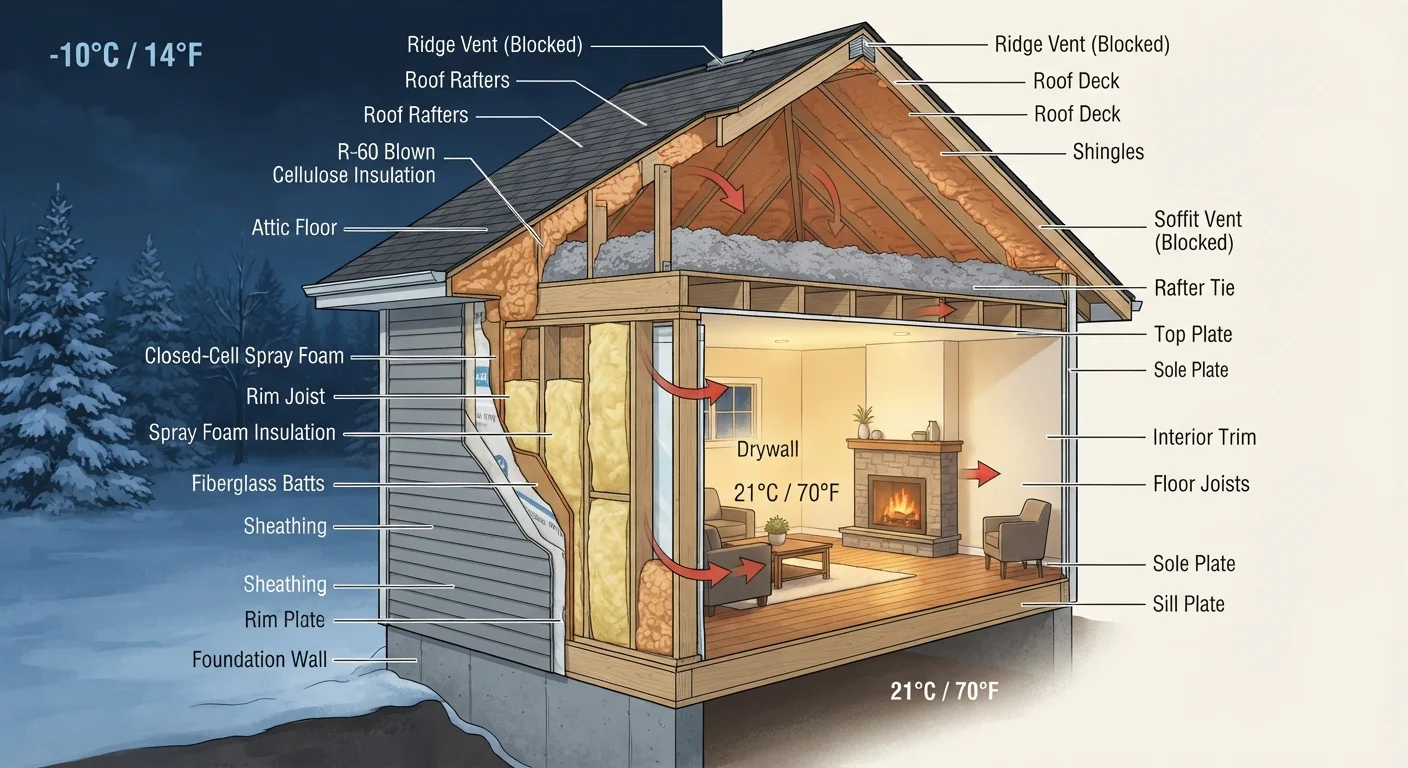
Heat rises, making the attic the single most impactful area in most US homes. An under-insulated attic can account for a significant portion of a home's overall heating and cooling load. Most older homes benefit from bringing attic insulation up to the R-38 to R-60 range recommended for their climate zone.
Exterior Walls
Walls represent the largest surface area separating conditioned living space from the outdoors. In existing homes, retrofitting wall insulation typically involves blown-in material through small drilled holes — a job suited to experienced contractors.
Floors Over Unconditioned Spaces
Floors above unheated garages, crawl spaces, or vented basements are major sources of discomfort. Insulating between floor joists or along the crawl space perimeter (depending on the crawl space design) can dramatically improve comfort in rooms above.
Basement Walls
In climates where basements are used as living or storage space, insulating basement walls with rigid foam or batt insulation reduces heat loss through foundation walls and helps manage moisture.
Rim Joists
The band of wood framing at the top of foundation walls is one of the leakiest spots in many homes. Spray foam or cut-and-cobble rigid foam pieces are commonly used here because the geometry is irregular.
For a room-by-room perspective on heat loss and air leaks, the winter weatherproofing guide covers complementary sealing strategies.
Seal Before You Insulate
Adding more insulation on top of existing air leaks delivers diminishing returns. Before increasing insulation depth in your attic, use caulk or foam sealant to close gaps around light fixtures, plumbing stacks, and the attic hatch. This step costs relatively little and meaningfully improves the performance of whatever insulation follows.
Evaluating What You Already Have
Before investing in new insulation, it's worth understanding what's already in place. A few accessible starting points:
- Attic visual check: In an accessible attic, look at the depth of insulation between joists. If you can see the tops of the joists, you almost certainly need more material.
- Utility company energy audit: Many US utilities offer free or subsidized home energy audits. A trained auditor can use a blower door test and thermal imaging to identify where conditioned air is escaping — including spots hidden inside finished walls.
- Home inspection report: If you've recently purchased a home, your inspection report may flag insulation deficiencies. The guide to reading home inspection reports can help you interpret those findings accurately.
Air sealing is also worth addressing before or alongside insulation upgrades. Gaps around recessed lights, plumbing penetrations, and attic hatches allow conditioned air to escape regardless of how much insulation surrounds them. Sealing these first makes any insulation investment more effective. Your HVAC system's efficiency is closely tied to the building envelope — the HVAC maintenance guide explains how the two systems interact.
When to DIY and When to Call a Professional
Insulation projects span a wide range of complexity and risk. A clear-eyed assessment prevents both unnecessary expense and unsafe shortcuts.
Reasonable DIY territory
- Adding batt insulation to an open, accessible attic floor
- Installing batt insulation in an open basement ceiling or crawl space (with appropriate protective gear)
- Cutting and fitting rigid foam board in a basement or rim joist area
- Renting a blower machine to install loose-fill insulation in an attic (many home centers offer equipment rental alongside material purchase)
Work that typically requires a professional
- Spray foam installation — requires proper mixing ratios, ventilation, and protective equipment
- Dense-pack blown-in insulation into enclosed wall cavities
- Any work involving suspected asbestos-containing insulation materials (common in homes built before 1980)
- Projects requiring permits or inspections under local building codes
When hiring a contractor, ask for proof of license and insurance, a written scope of work specifying R-values and materials, and references from similar projects. If you're considering converting an attic or basement as part of a larger renovation, the analysis of room additions versus finishing existing space addresses how insulation fits into those decisions.
Insulation is not glamorous, but it is foundational. Addressing it systematically — starting with the attic and air sealing, then moving to walls and floors — gives homeowners one of the more durable comfort and efficiency improvements available in any home.