

| Basic fiberglass filter lifespan | ~30 days |
| Mid-range pleated filter lifespan | 60–90 days |
| High-efficiency / 4-inch media filter lifespan | 6–12 months |
| Recommended furnace tune-up frequency | Once per year (early fall) |
| Best time to schedule AC tune-up | Early spring, before high demand |
| Tasks safe for DIY | Filter changes, thermostat adjustments, accessible vent cleaning |
| Tasks requiring a licensed technician | Combustion analysis, heat exchanger inspection, refrigerant service, gas line work |
Air Filters: The One Task Most Homeowners Under-Do or Overdo
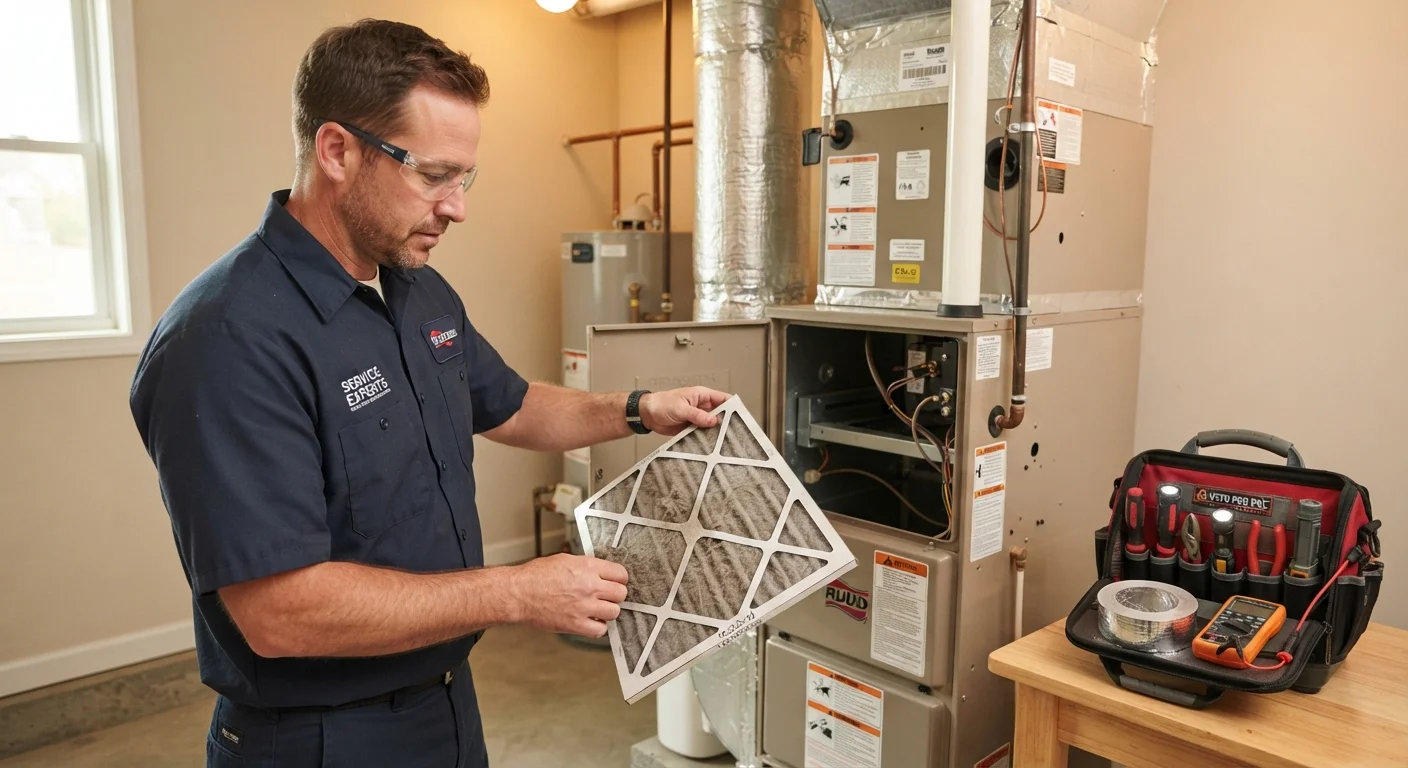
Replacing your HVAC air filter is the single most accessible maintenance task a homeowner can handle — no tools, no training, no license required. Yet it's also one of the most commonly mismanaged: some households let filters run for a year or more, while others swap them out monthly regardless of actual condition.
The right interval depends on three things: filter type, household conditions, and system runtime. A basic fiberglass filter (MERV 1–4) typically needs replacement every 30 days. A mid-range pleated filter (MERV 8–11) generally lasts 60–90 days. A thicker high-efficiency filter (MERV 13 or a 4-inch media filter) can often go 6–12 months under normal conditions.
Household factors that shorten filter life include pets, allergies, recent renovation dust, multiple occupants, and running the system year-round. A single-occupant home with no pets and a moderate climate may get the full rated life from a filter; a family of five with two dogs may not.
| Basic fiberglass filter lifespan | ~30 days |
| Mid-range pleated filter lifespan | 60–90 days |
| High-efficiency / 4-inch media filter lifespan | 6–12 months |
| Recommended furnace tune-up frequency | Once per year (early fall) |
| Best time to schedule AC tune-up | Early spring, before high demand |
| Tasks safe for DIY | Filter changes, thermostat adjustments, accessible vent cleaning |
| Tasks requiring a licensed technician | Combustion analysis, heat exchanger inspection, refrigerant service, gas line work |
To check your filter without guessing: hold it up to a light source. If you can't see light through it, it's time to change it. Also note that an overly clogged filter strains the blower motor, restricts airflow, and can cause the system to overheat — so erring on the side of more frequent changes is rarely harmful, while waiting too long has real consequences. For a broader look at upkeep tasks that tend to get skipped, see tasks homeowners routinely skip.
Furnace Tune-Ups: What a Professional Actually Does and Why It Matters
A furnace tune-up — sometimes called a preventive maintenance visit — is not the same as a repair call. It's a systematic inspection and cleaning performed before a problem develops, ideally once a year in early fall before heating season begins.
During a typical tune-up, a licensed HVAC technician will:
- Inspect and clean the heat exchanger (a cracked heat exchanger can allow carbon monoxide to enter living spaces)
- Test and adjust burner operation and ignition
- Check and clean the blower assembly
- Inspect flue venting for obstructions and proper draft
- Test safety controls and limit switches
- Measure temperature rise and airflow
- Lubricate moving parts where applicable
Most homeowners should not attempt these tasks themselves. Work involving gas lines, heat exchangers, electrical components, and combustion analysis requires calibrated instruments and carries genuine safety risk. This is one of those clear-cut cases where professional service is the appropriate choice — similar to how the DIY vs. shop decision in car ownership hinges on the same hazard threshold.
Carbon Monoxide and Heat Exchanger Inspections
A cracked heat exchanger is one of the most serious furnace defects a technician can find — and one that produces no visible symptoms until it's a safety emergency. Carbon monoxide is odorless and colorless. Ensure your home has working CO detectors on every level, and do not skip the annual heat exchanger inspection as part of your furnace tune-up.
Tune-up costs vary by region and system type, but a single annual visit is generally far less expensive than an emergency repair call in January or a premature system replacement. Factor it into your year-round maintenance calendar alongside other seasonal tasks.
Matching the Task to the Right Person and the Right Time
The simplest framework for HVAC upkeep: if it involves combustion, gas, refrigerant, or electrical components inside the unit, call a licensed technician. If it involves the filter, accessible vents, or the thermostat, you can handle it yourself.
MERV Rating
Minimum Efficiency Reporting Value — a standardized scale (1–16 for residential use) measuring how effectively a filter captures airborne particles. Higher MERV ratings trap smaller particles but can also restrict airflow if the system isn't designed for them.
Heat Exchanger
A metal component inside a gas furnace that separates combustion gases from the air circulated through your home. Cracks or holes in the heat exchanger are a serious safety concern because they can allow carbon monoxide to enter living spaces.
Preventive Maintenance Visit
A scheduled inspection performed by a licensed HVAC technician to clean, test, and adjust system components before problems develop. Distinct from a repair or diagnostic call.
Blower Motor
The fan component that moves conditioned air through your ductwork and into living spaces. A restricted or dirty filter can overwork the blower motor, shortening its lifespan.
AFUE
Annual Fuel Utilization Efficiency — a percentage rating indicating how much of the fuel consumed by a furnace is converted into usable heat. A higher AFUE means less energy waste.
Timing also matters. Schedule furnace tune-ups in late summer or early fall, before technicians are fully booked for heating-season emergencies. Air conditioning tune-ups belong in early spring, before the first hot stretch. Filter changes should be tied to a recurring reminder — many homeowners connect it to a bill payment date or the change of seasons.
First-time homeowners often underestimate how much HVAC maintenance affects comfort and energy costs. If you're new to managing a home's systems, a foundational upkeep guide can help you prioritize without feeling overwhelmed. Good insulation also works hand-in-hand with your HVAC system — see Home Insulation 101 for how the two interact.