

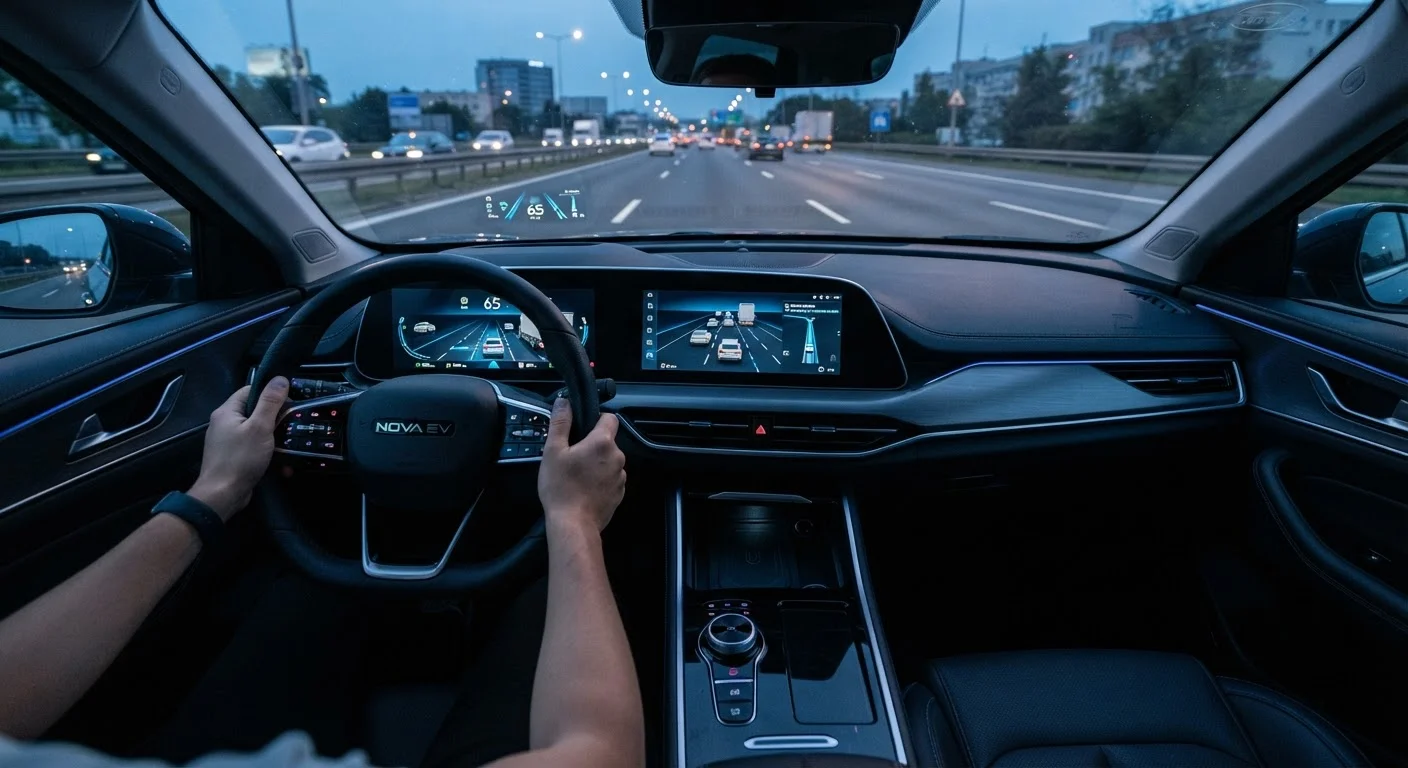
Key Takeaways
- Lane Keeping Assist reacts only when you approach a lane boundary, while Lane Centering works continuously to keep you centered.
- LKA applies a single corrective steering nudge or braking input; Lane Centering makes dozens of small adjustments per minute.
- Both systems require the driver to remain attentive and hands-on - neither is autonomous driving.
- Lane Centering typically requires clearly visible lane markings and works best at highway speeds.
- The two systems are often available simultaneously, but they serve genuinely different purposes.
- Misunderstanding which system is active can lead drivers to over-rely on automation in ways the technology cannot support.
Option A
Lane Keeping Assist (LKA)
The reactive safety net that catches you at the edge.
Best for: Drivers who want a last-resort correction when they begin drifting out of their lane unintentionally.
Option B
Lane Centering (LC)
The continuous co-pilot that keeps you in the middle.
Best for: Drivers using highway cruise control who want the system to actively manage lateral position throughout the drive.
If you want a safety backstop during regular daily driving
Lane Keeping Assist (LKA)
LKA is unobtrusive and intervenes only when you're close to an unintended departure - it doesn't interfere with deliberate lane changes or normal steering.
If you use adaptive cruise control on long highway stretches
Lane Centering (LC)
Paired with adaptive cruise control, Lane Centering manages lateral position continuously so the vehicle handles both speed and lane placement - a meaningful reduction in sustained steering effort.
If you drive on roads with faded or absent lane markings
Lane Keeping Assist (LKA)
LKA generally handles brief marking gaps better than Lane Centering, which requires reliable continuous lane detection to function safely.
What Each System Actually Does
Both features live under the broad umbrella of lane-assistance technology, but their operating logic is fundamentally different. Understanding that difference is the key to using them safely.
Lane Keeping Assist (LKA) is a reactive system. It monitors lane markings using a forward-facing camera and sits idle unless you drift toward or across a line without signaling. At that point it delivers a brief corrective input - usually a steering torque nudge, sometimes a gentle brake application on one side - then steps back. Think of it as a guardrail rather than a guide.
Lane Centering (LC) - sometimes called Lane Centering Assist or Active Lane Control depending on the manufacturer - is a continuous system. It actively steers the vehicle to maintain position near the center of the lane at all times, making dozens of small micro-corrections per minute. It doesn't wait for you to drift; it prevents the drift from building in the first place.
See our overview of modern car safety systems for broader context on how these technologies fit into today's vehicle architecture.
| Criterion | Lane Keeping Assist | Lane Centering |
|---|---|---|
| Operating mode | Reactive - triggers at lane boundary | Continuous - always adjusting |
| Typical intervention frequency | Occasional, only when drifting | Constant micro-corrections |
| Driver feel | Brief, firm steering nudge | Persistent, gentle steering bias |
| Best speed range | Works at most road speeds | Optimized for highway speeds |
| Marking dependency | Needs lane markings; tolerates brief gaps | Needs clear, continuous markings |
| Common pairing | Standalone or with blind-spot monitoring | Paired with adaptive cruise control |
| Automation level (SAE) | Level 1 | Level 2 |
How Intervention Feels From the Driver's Seat
With LKA, most drivers barely notice the system until it fires. Normal driving feels identical to a car without it. When intervention does occur, you'll feel a firm but brief resistance in the steering wheel, or sense a slight pull in one direction. Some systems also sound a chime or display a dashboard warning simultaneously. The correction is designed to be unmistakable - it needs to wake an inattentive driver.
Lane Centering, by contrast, is felt as a gentle, persistent steering bias. On a sweeping highway curve, the wheel will move in your hands even if you're barely touching it. Many drivers describe the sensation as the car "knowing" where it wants to go. That constant activity is intentional, but it can feel unusual at first and may prompt some drivers to question whether the system is working correctly.
Both systems are classified as active safety features - they intervene before a crash rather than mitigating harm after one.
~26,000
US lane-departure crash fatalities annually
The NHTSA estimates that roadway departure crashes - a category that includes unintended lane departures - account for roughly half of all US traffic fatalities each year.
Level 1 / Level 2
SAE automation classification
Under the SAE J3016 standard, Lane Keeping Assist is typically Level 1 (single-function automation) and Lane Centering paired with adaptive cruise control reaches Level 2 (multi-function, driver still supervises).
Conditions, Limitations, and What Can Trip Them Up
Neither system works under all conditions, and both share a common dependency: visible lane markings. Camera-based lane detection can struggle with heavy rain, bright sun glare, snow covering road lines, construction zones with temporary markings, or roads that simply haven't been re-striped recently.
Lane Centering has a higher bar. Because it's steering continuously, it needs a stable, confident read of both lane boundaries. Many implementations will automatically suspend and hand control back to the driver when marking confidence drops below a threshold. Expect a warning chime and a prompt to take over.
LKA, intervening only at the boundary, can tolerate brief marking gaps somewhat better - but it too will disengage when it can't see what it needs. Neither system handles merges, construction detours, or unmarked roads with any reliability.
A critical point for highway use: Lane Centering pairs naturally with adaptive cruise control, and the combination is what most manufacturers mean when they describe a "hands-free highway" feature. Even then, the driver must remain ready to take over immediately. These are assistance tools, not autonomous driving systems.
Understanding lane discipline itself - how to position your vehicle deliberately - remains a foundational skill. Our guide on highway driving safety covers that ground in detail.
Using These Systems Responsibly
The NHTSA and industry safety researchers consistently note that overreliance on driver-assistance technology is an emerging concern. Both LKA and Lane Centering are Level 1 or Level 2 driver-assistance features under SAE's automation classification - meaning the driver remains fully responsible for the vehicle at all times.
Using Lane Centering as a reason to reduce steering attention is a misuse of the system, even if it feels capable of managing longer stretches without input. All current implementations monitor whether the driver's hands are in contact with the wheel and will escalate alerts - then disengage - if contact is absent for too long.
Similarly, LKA should not replace the habit of checking mirrors and using turn signals before lane changes. The system cannot distinguish between an intentional, signaled maneuver and an unintentional drift on its own in all situations - and the consequences of a missed departure on a highway are significant. Pairing these features with good fundamentals, rather than substituting for them, is how they deliver real safety value.
This article is for general informational purposes. Always consult your vehicle's owner's manual for specific guidance on how driver-assistance systems function in your car, and follow all applicable traffic laws.