

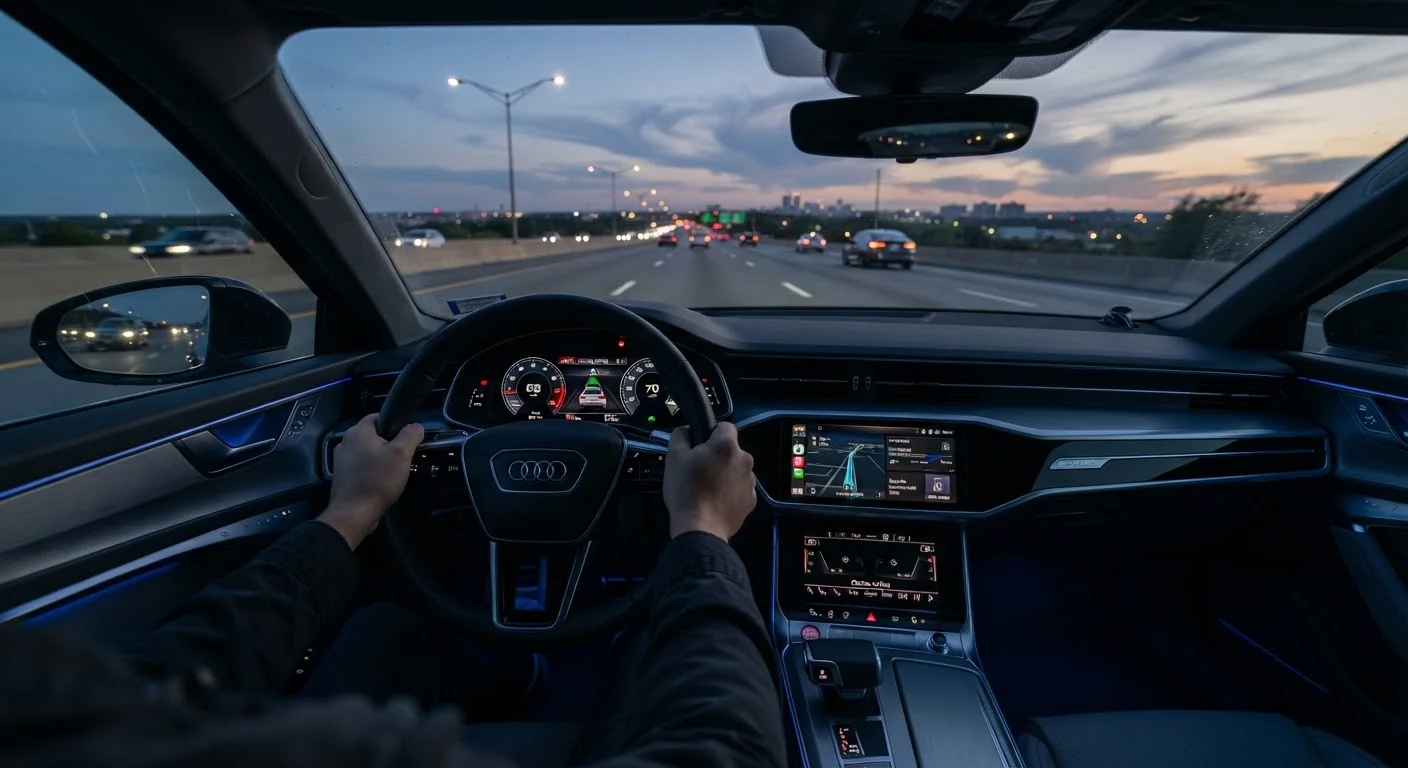
Key Takeaways
- ACC automatically modulates speed to maintain a driver-selected following gap behind the vehicle ahead.
- The system does not steer - the driver must remain engaged and in control of the wheel at all times.
- ACC has significant limitations in poor weather, construction zones, and sharp curves.
- Most ACC systems cannot reliably detect stationary objects or stopped vehicles at highway speeds.
- Using ACC incorrectly or over-relying on it can create dangerous situations despite the technology's benefits.
Adaptive Cruise Control
Adaptive cruise control (ACC) is a driver-assistance feature that automatically adjusts a vehicle's speed to maintain a set following distance from the car ahead. Unlike standard cruise control, which holds a fixed speed, ACC uses radar or cameras to detect slower traffic and slow down accordingly - then accelerate again when the road clears. The driver remains fully responsible for steering and overall vehicle control at all times.
Most ACC systems use forward-facing radar sensors, sometimes combined with camera or lidar inputs, operating at refresh rates fast enough to respond to traffic changes within fractions of a second. Systems vary by manufacturer in how aggressively they brake and whether they can bring the vehicle to a full stop.
How Adaptive Cruise Control Actually Works
Standard cruise control locks your vehicle to a set speed and holds it there regardless of what's ahead. Adaptive cruise control goes a step further: it continuously monitors the road ahead using radar, cameras, or a combination of both, and adjusts your throttle and brakes to maintain a preset gap behind the vehicle in front of you.
When the lane ahead is clear, ACC maintains your selected speed. When it detects a slower vehicle entering your path, the system progressively reduces throttle and applies braking as needed to match that vehicle's pace. Once the slower vehicle exits your lane or accelerates away, ACC resumes your chosen speed - typically with a gentle acceleration rather than a sharp surge.
The following distance is adjustable. Most systems express it in time-based increments (such as 1 to 3 seconds of headway) rather than fixed footage, which means the physical gap grows larger as speed increases - consistent with safe-driving principles. Choosing a longer following time reduces the chance the system needs to brake hard and gives you more reaction time if you need to take over.
~90%
Of new vehicles with ACC by 2030 (projected)
According to industry analysis by the IIHS, ACC and other active safety features are on track to become near-universal in new vehicles sold in the US within this decade.
22%
Reduction in rear-end crashes observed in some ACC studies
IIHS research examining vehicles equipped with forward collision warning and automatic braking - systems closely related to ACC - found measurable rear-end crash reductions in real-world data.
Level 2
SAE automation level when ACC is combined with lane centering
Under the SAE International J3016 standard, Level 2 means the system can control both speed and steering simultaneously, but human oversight remains mandatory.
Where ACC Performs Well - and Where It Struggles
ACC is genuinely useful in steady highway driving, long freeway commutes, and moderate traffic that flows at consistent speeds. It reduces the fatigue of constant speed adjustments and helps maintain safer following distances in conditions where drivers often unconsciously close in on the car ahead.
However, the system has clearly documented limitations that every driver should understand before relying on it:
- Stationary objects: Many ACC systems are not designed to detect - or stop for - vehicles that are fully stopped in the roadway. This is one of the most misunderstood limitations and a significant safety risk at highway speeds.
- Sharp curves: Radar sensors project forward in a relatively straight path. In tight curves, the lead vehicle may exit the sensor's field of view, causing the system to accelerate unnecessarily.
- Poor weather: Heavy rain, snow, sleet, and even road grime can obstruct sensors and cameras, degrading performance or triggering automatic disengagement.
- Construction zones: Irregular lane markings, merging workers, and equipment can confuse the system. Manual control is advisable in active work zones.
- Cut-ins: A vehicle that quickly merges immediately ahead may not be detected in time for ACC to respond smoothly, requiring driver intervention.
Understanding these gaps isn't a reason to avoid ACC - it's a reason to use it with clear-eyed awareness. For a broader look at how ACC fits alongside other technologies, see our guide to modern car safety systems.
Set a Longer Following Distance by Default
When in doubt, choose a longer headway setting - two to three seconds is a reasonable starting point for highway driving. A larger gap gives both the ACC system and you more time to respond if the situation changes suddenly. Shorter settings may feel efficient in dense traffic but leave less margin for error.
ACC vs. Full Autonomy: A Critical Distinction
One of the most consequential misunderstandings about adaptive cruise control is conflating it with autonomous or self-driving capability. ACC is classified under the SAE's driving automation scale as Level 1 (longitudinal control only) or part of a Level 2 system when combined with lane-centering - but in either case, the human driver is responsible for the vehicle at all times.
When ACC is paired with lane-keeping features, the combination can feel remarkably hands-free. That sensation creates real risk. Research from organizations including the Insurance Institute for Highway Safety (IIHS) has found that drivers using partially automated systems sometimes become less vigilant - a phenomenon sometimes called automation complacency. The car following the car in front doesn't eliminate the need for the driver to scan for hazards, monitor road conditions, or respond to emergency situations.
If your vehicle also includes a lane-keeping or lane-centering system, understanding how those features differ is equally important. Lane keeping assist and lane centering work very differently from each other - and neither replaces attentive steering.
Using Adaptive Cruise Control Safely
Getting the most from ACC comes down to treating it as a tool that reduces workload - not one that removes responsibility.
Keep your hands on or near the wheel. Even on long highway stretches, maintain physical readiness to steer and brake. Many ACC systems will issue a warning or disengage if they detect no steering input for an extended period - that's a deliberate design choice intended to keep the driver engaged.
Set a following distance that matches conditions. In normal highway traffic, two to three seconds of headway is a reasonable baseline. In rain or low-visibility situations, consider disabling ACC entirely and driving manually at a reduced speed with increased following distance.
Know how to cancel the system quickly. Every ACC implementation has a way to disengage - typically tapping the brake pedal or pressing a dedicated cancel button. Practice this in a low-pressure situation so the action becomes instinctive before you need it urgently.
Finally, read your owner's manual. ACC behavior varies meaningfully across manufacturers and vehicle generations. The specifics of how your system detects objects, what speeds it operates within, and how it handles stopped vehicles are all documented there - and worth knowing before you depend on the feature.
ACC Systems Vary Significantly by Vehicle
What ACC can and cannot do differs meaningfully between manufacturers, model years, and trim levels. Some systems can bring a vehicle to a full stop; others disengage below 20 mph. Some include automatic emergency braking as a backup; others do not. Always consult your vehicle's owner's manual to understand the exact capabilities and limitations of your specific system before relying on it.