

Key Takeaways
- Active safety features use sensors and electronics to detect hazards and intervene before a crash occurs.
- Passive safety features - like airbags and crumple zones - are designed to protect occupants during and after impact.
- Both systems are complementary; modern vehicle safety depends on both working together effectively.
- Many active systems are now standard on new vehicles, but passive safety remains fundamental to vehicle design.
- Understanding both categories helps drivers make more informed decisions when evaluating any vehicle.
Option A
Active Safety Features
Technology that works to prevent a crash before it happens.
Best for: Drivers who want real-time electronic intervention to avoid collisions and dangerous situations.
Option B
Passive Safety Features
Built-in protection that minimizes harm when a crash occurs.
Best for: Providing a critical safety net for vehicle occupants when a collision is unavoidable.
If you want technology that helps you avoid collisions in the first place
Active Safety Features
Systems like automatic emergency braking and lane departure warning intervene in real time, reducing the likelihood of a crash occurring at all.
If you want protection when an accident is unavoidable
Passive Safety Features
Airbags, seatbelt pretensioners, and crumple zones are specifically engineered to absorb impact energy and reduce injury severity during a collision.
If you're evaluating overall vehicle safety comprehensively
Active Safety Features
For new vehicle shoppers, active safety technology - including automatic emergency braking - is increasingly standard and a strong differentiator in safety ratings.
What Are Active Safety Features?
Active safety features are electronic systems that monitor driving conditions in real time and intervene - or warn the driver - when a potential hazard is detected. The goal is crash prevention: stopping the dangerous situation before it becomes a collision.
Common examples include:
- Automatic Emergency Braking (AEB): Detects an imminent collision and applies the brakes automatically if the driver doesn't react in time.
- Electronic Stability Control (ESC): Detects loss of traction or skidding and selectively applies brakes to individual wheels to help maintain control.
- Lane Departure Warning / Lane Keeping Assist: Alerts or nudges the driver back into their lane when unintentional drifting is detected.
- Blind Spot Monitoring: Warns drivers of vehicles in adjacent lanes that may not be visible in mirrors.
- Adaptive Cruise Control: Maintains a set following distance by automatically adjusting vehicle speed.
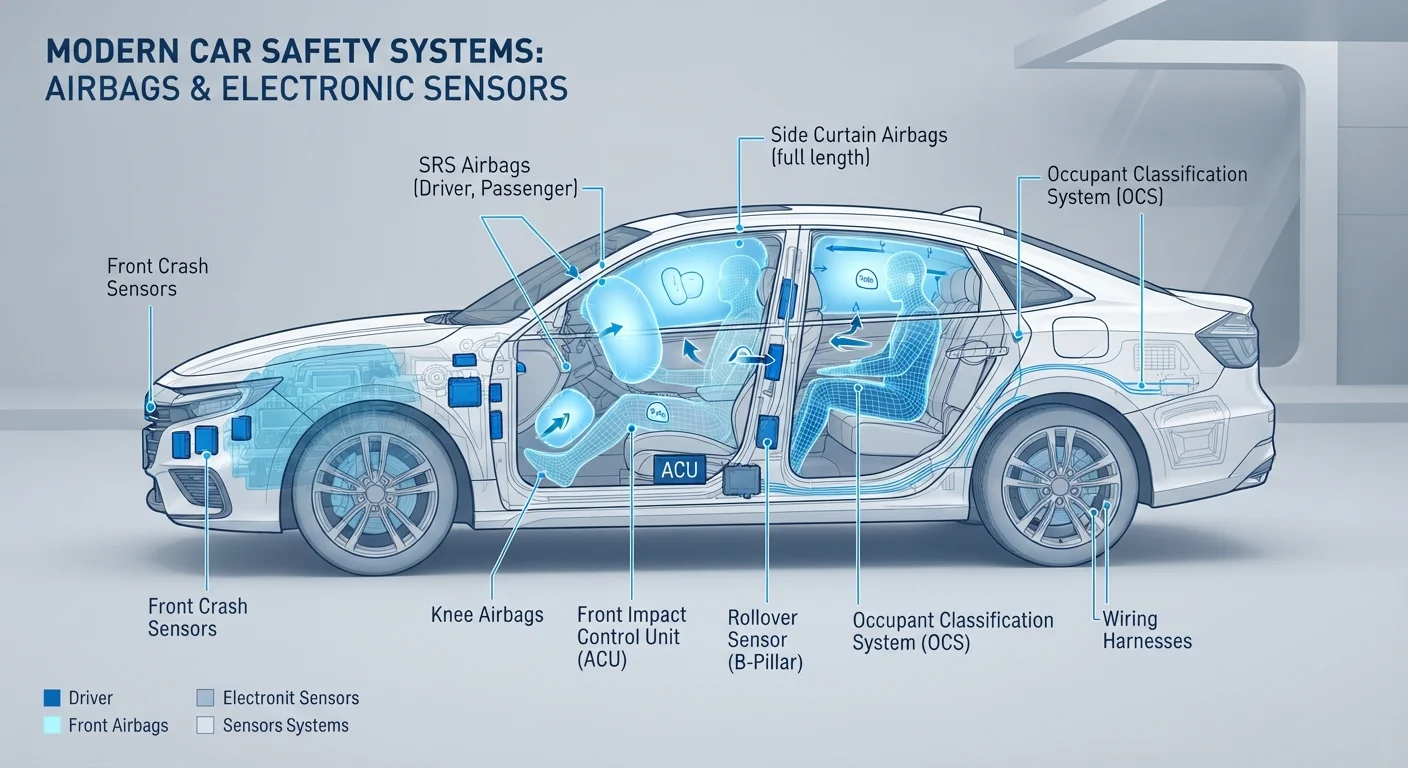
These systems rely on cameras, radar, and ultrasonic sensors working together. For a deeper look at how these technologies function, see Modern Car Safety Systems Explained.
| Criterion | Active Safety | Passive Safety |
|---|---|---|
| Primary purpose | Prevent crashes from occurring | Reduce harm during a crash |
| When it activates | Before or during a hazard event | During and after impact |
| Driver interaction | May warn or intervene automatically | Requires no driver action |
| Key examples | AEB, ESC, lane assist, blind spot monitoring | Airbags, seatbelts, crumple zones, safety cage |
| Technology basis | Cameras, radar, sensors, software | Structural engineering and materials |
| Evaluated by | IIHS active safety tests, NHTSA ratings | NHTSA crash tests, IIHS crashworthiness ratings |
What Are Passive Safety Features?
Passive safety features don't prevent a crash - they're designed to protect occupants when one occurs. They activate automatically during an impact or are simply built into the vehicle's structure, requiring no action from the driver.
Core passive safety components include:
- Airbags: Deploy in milliseconds during a collision to cushion occupants from striking hard interior surfaces. Modern vehicles may include front, side, curtain, and knee airbags.
- Seatbelts with Pretensioners: In a crash, pretensioners tighten the belt instantly to restrain occupants; load limiters then ease tension slightly to reduce chest injury.
- Crumple Zones: Sections of the vehicle body - typically the front and rear - engineered to deform in a controlled way, absorbing crash energy before it reaches occupants.
- Safety Cage / Passenger Cell: The rigid structural core of the vehicle designed to maintain a protective space around occupants even when the surrounding bodywork collapses.
- Head Restraints: Properly positioned head restraints reduce the risk of whiplash injury in rear-end collisions.
Passive safety performance is a central component of crash-test programs run by organizations such as the NHTSA and IIHS. Understanding how those ratings work can help you evaluate any vehicle - see Car Safety Ratings Decoded for a full breakdown.
~56%
Reduction in rear-end crashes with AEB
NHTSA research has estimated that automatic emergency braking can significantly reduce the frequency of rear-end collisions compared to vehicles without the system.
~45%
Reduction in frontal crash deaths attributed to airbags
According to NHTSA data, frontal airbags have substantially reduced fatalities in frontal crashes since becoming widely mandated in US vehicles.
99%
Of new US vehicles with standard ESC
Electronic Stability Control has been required on all new passenger vehicles sold in the United States since model year 2012 under NHTSA regulations.
How the Two Categories Work Together
Active and passive safety systems are not competing approaches - they're complementary layers of protection. Think of it as a hierarchy: active systems try to prevent the crash; passive systems minimize harm if prevention fails.
Consider a scenario where a distracted driver doesn't notice a vehicle braking sharply ahead. AEB may reduce vehicle speed significantly before impact, even if it can't stop the car entirely. At that reduced speed, airbags and crumple zones operate under far less extreme conditions - dramatically improving the outcome for everyone involved.
This is why evaluating a vehicle purely on one category is incomplete. A car with excellent passive crash-test scores but no AEB is missing a critical preventive layer. Conversely, active systems - however sophisticated - can't eliminate every crash, making structural passive protection indispensable.
Pairing good safety hardware with sound driving habits matters too. Defensive driving principles complement both active and passive systems by reducing the conditions in which they need to activate at all. And for drivers thinking about long-term ownership, reducing ownership costs without compromising safety is a practical consideration worth exploring.
A Note on ADAS and Active Safety Overlap
Advanced Driver Assistance Systems (ADAS) is a broad category that overlaps significantly with active safety. Not all ADAS features are strictly safety-focused - some, like adaptive cruise control, are as much about convenience as crash prevention. When evaluating a vehicle, it helps to distinguish between features specifically designed to reduce crash risk and those that primarily enhance comfort. For a closer look at how two closely related active systems differ in practice, see Lane Keeping Assist vs. Lane Centering.