

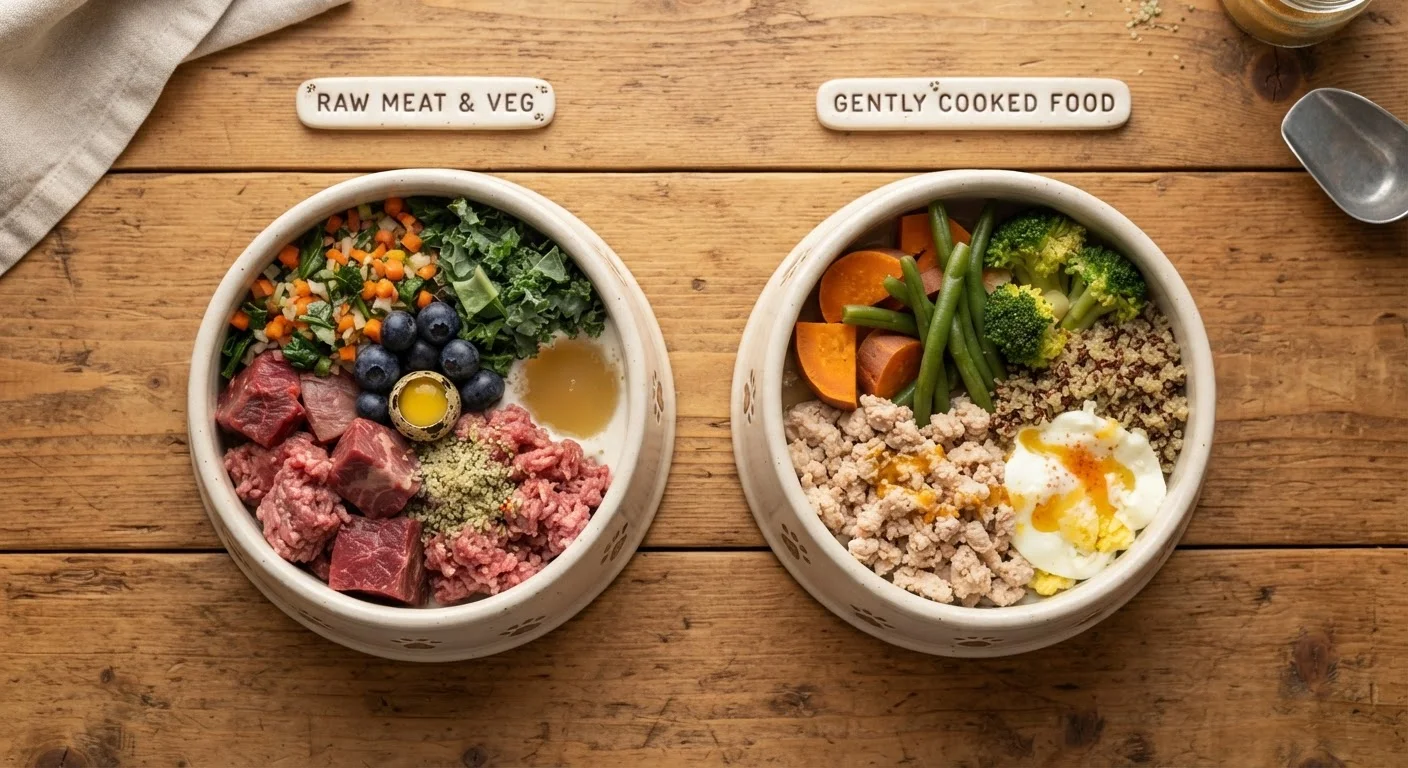
Key Takeaways
- Raw diets carry documented risks of bacterial and parasitic contamination for dogs and their human households.
- Cooked diets reduce pathogen risk but may affect the bioavailability of certain heat-sensitive nutrients.
- Neither approach is universally superior — nutritional completeness matters more than the cooking method.
- Dogs with compromised immunity, puppies, and seniors face greater risk from raw feeding.
- A veterinary nutritionist can help design a diet — raw or cooked — that is genuinely complete and balanced.
Option A
Raw Diet
The ancestral-feeding approach backed by passionate advocates.
Best for: Pet owners who prioritize minimally processed ingredients and are prepared to handle food safety requirements carefully.
Option B
Cooked Diet
The heat-processed option with stronger food safety credentials.
Best for: Owners who want reduced pathogen risk, easier nutritional verification, and the ability to use home-prepared or commercial options.
If your dog is a puppy, senior, pregnant, or immunocompromised
Cooked Diet
These groups face heightened vulnerability to the bacterial pathogens commonly found in raw meat. A cooked diet significantly reduces that exposure.
If you have young children, elderly relatives, or immunocompromised people at home
Cooked Diet
Pathogens shed in a raw-fed dog's stool or saliva pose real risks to vulnerable people in the household — a concern multiple veterinary organizations have flagged.
If you want maximum control over ingredient sourcing and minimal processing
Raw Diet
With rigorous food-safe handling and veterinary nutritionist guidance to ensure completeness, raw can be a viable choice for healthy adult dogs in low-risk households.
If nutritional completeness and convenience are your top priorities
Cooked Diet
Commercial cooked diets meeting AAFCO standards offer a well-studied path to meeting your dog's nutritional needs without the handling complexity of raw.
What Does the Research Actually Show?
The raw-versus-cooked debate generates strong opinions in dog-owner communities, but the scientific evidence is more nuanced — and more limited — than either camp often admits. Most peer-reviewed research on raw diets focuses on two areas: microbiological safety and digestibility. The picture that emerges is complicated.
On the safety side, multiple studies have detected pathogenic bacteria — including Salmonella, Listeria, and E. coli — in commercial raw pet food at rates that consistently exceed those found in processed cooked diets. Importantly, these pathogens don't just affect dogs; they can be shed in feces and saliva, creating real household exposure risk. The American Veterinary Medical Association and the U.S. Food and Drug Administration have both issued guidance cautioning against raw feeding, particularly for at-risk populations.
On digestibility, some studies suggest that minimally processed proteins may be more bioavailable for certain dogs, though findings vary by protein source and individual animal. The evidence here is genuinely mixed and not yet definitive.
| Criterion | Raw Diet | Cooked Diet |
|---|---|---|
| Pathogen risk | Higher — Salmonella, Listeria detected frequently | Lower — heat kills most pathogens |
| Nutrient bioavailability | Possibly higher for some proteins; evidence mixed | Some heat-sensitive nutrients reduced; formulated to compensate |
| Nutritional completeness (commercial) | Varies widely by product | AAFCO-compliant options well-established |
| Home-preparation risk | High — deficiencies common without expert guidance | High — deficiencies still common without expert guidance |
| Handling complexity | High — strict food-safe protocols required | Low to moderate |
| Suitability for vulnerable dogs | Not recommended for puppies, seniors, immunocompromised | Generally suitable across life stages |
| Household safety | Greater risk if vulnerable humans are present | Lower household contamination risk |
Nutritional Completeness: The Issue Both Sides Often Overlook
Regardless of whether food is raw or cooked, the most important nutritional question is whether a diet is complete and balanced — meaning it provides all essential nutrients at appropriate levels. This is where many home-prepared diets, raw or cooked, fall short.
Studies analyzing home-prepared dog diet recipes have found a high proportion to be deficient in one or more essential nutrients, including calcium, zinc, and key vitamins. Cooking does alter certain heat-sensitive nutrients — vitamin B1 (thiamine) is one example — but commercial cooked diets are typically formulated to account for those losses. Understanding what "complete and balanced" means on a label is an important first step before evaluating any diet approach.
If you choose to feed a home-prepared diet — raw or cooked — working with a board-certified veterinary nutritionist is strongly advisable. Generic recipes found online frequently miss the mark on micronutrient targets. You can also explore how to read a pet food label to evaluate commercial options more critically.
~55%
Home-prepared dog diet recipes with nutrient deficiencies
A study published in the Journal of Nutritional Science found that a majority of analyzed home-prepared dog diet recipes failed to meet all AAFCO minimum nutrient recommendations.
7x
Higher Salmonella detection rate in raw vs. dry kibble
FDA surveillance testing has found pathogen detection rates significantly higher in raw pet food compared to conventional dry and wet commercial products.
~20%
Commercial raw pet foods testing positive for Listeria
Research published in veterinary literature has reported Listeria monocytogenes in roughly one in five commercial raw pet food samples tested.
Practical Considerations for Real Households
Science aside, day-to-day practicalities shape which approach is genuinely sustainable for a given family. Raw feeding requires strict handling protocols: separate cutting boards, careful refrigeration and thawing, and thorough handwashing after any contact with the food or the dog's food surfaces. Cross-contamination risks are real and not always intuitive — for example, surfaces a dog licks after eating raw food can transfer bacteria.
Cooked diets, whether commercial or home-prepared, carry a lower handling burden, though home-cooked versions still require careful nutritional planning. For owners curious about how wet and dry cooked commercial options compare, the moisture content and palatability differences are worth understanding separately.
Cost is another real factor. High-quality commercial raw diets tend to be expensive, and home-prepared raw diets require time and sourcing effort. Home-cooked options can be cost-effective but must be nutritionally complete, which typically requires supplementation guided by a professional.
This article is for general informational and educational purposes only and is not a substitute for professional veterinary advice. Always consult a qualified veterinarian or veterinary nutritionist before making significant changes to your dog's diet, especially if your pet has any health conditions.