

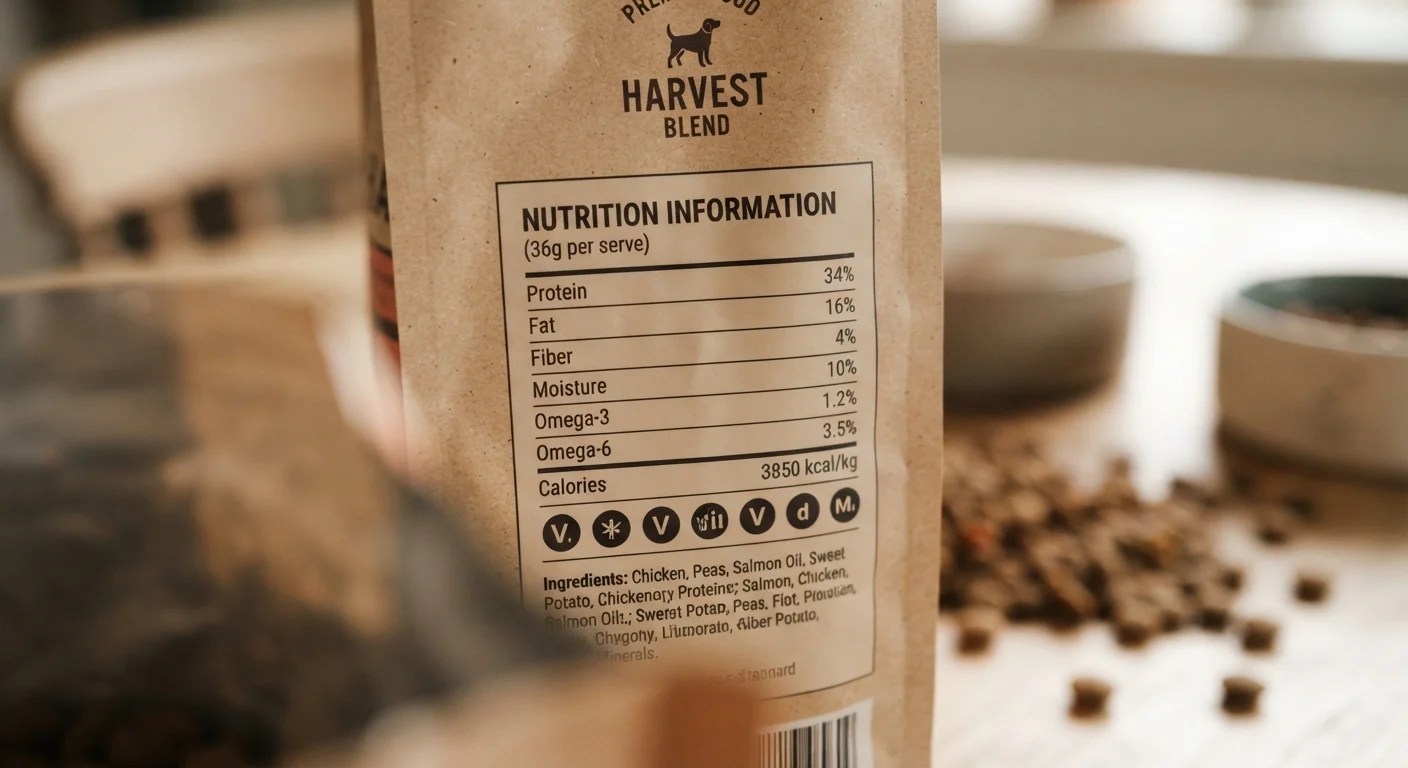
Key Takeaways
- "Complete and balanced" is a regulated claim, not a marketing phrase — it requires meeting defined nutrient standards.
- AAFCO sets the nutritional profiles that US pet food manufacturers must satisfy to use the claim.
- The claim is life-stage specific: a food may be complete for adult dogs but not for puppies or pregnant dogs.
- There are two ways to substantiate the claim: meeting a nutrient profile or passing a feeding trial.
- The phrase tells you a food clears a baseline threshold — it doesn't tell you everything about ingredient quality.
- Always consult your veterinarian if your pet has specific health conditions or unusual nutritional needs.
Complete and Balanced
"Complete and balanced" is a regulated phrase used on pet food packaging to indicate that a food meets minimum nutritional standards for a specific species and life stage. "Complete" means the food contains all nutrients an animal is known to require. "Balanced" means those nutrients are present in the right proportions relative to one another. A food must meet standards set by an authoritative body to legally use this claim.
In the United States, these standards are established by the Association of American Feed Control Officials (AAFCO), which publishes nutrient profiles for dogs and cats at different life stages.
Where the Phrase Comes From
Walk down any pet food aisle and you'll find "complete and balanced" printed on almost every bag or can. It looks like a routine marketing phrase, but it actually has a specific regulatory meaning in the United States.
The standard is set by AAFCO, which publishes detailed nutrient profiles for dogs and cats. Most US states incorporate AAFCO's model regulations into their own feed laws, which means a manufacturer cannot legally print the claim on packaging unless the food genuinely meets those requirements.
The profiles specify minimum — and in some cases maximum — amounts for dozens of nutrients: proteins, fats, vitamins, minerals, and essential fatty acids. These requirements differ by species, and critically, by life stage. A food formulated for adult maintenance may not contain sufficient calcium or phosphorus for a growing puppy or a nursing mother. This is why the label always specifies the life stage the claim applies to. For a deeper look at how to read all the other information on a pet food package, see our guide to pet food label basics.
Two Ways to Earn the Claim
Manufacturers can substantiate a complete and balanced claim in one of two ways, and both are considered valid under AAFCO guidelines.
- Nutrient profile formulation: The food is formulated so that laboratory analysis confirms every required nutrient is present at or above the minimum level. This is the more common path and is conducted before the food goes to market.
- AAFCO feeding trial: The food is fed to a group of animals under standardized protocols for a set period. Animals are monitored for health indicators including weight, blood values, and physical condition. A food that passes a feeding trial has demonstrated real-world nutritional adequacy, not just a calculated profile on paper.
Both methods result in the same claim on the label, but the packaging should state which method was used — look for language like "formulated to meet" (nutrient profile) versus "animal feeding tests substantiate" (feeding trial). Neither method is inherently superior in every situation, but many veterinary nutritionists consider feeding trials a more direct demonstration of how the food performs in living animals.
40+
Nutrients specified in AAFCO dog food nutrient profiles
AAFCO's published nutrient profiles for dogs list more than 40 individual nutrients with established minimums, covering proteins, fats, vitamins, and minerals.
2
Accepted pathways to the complete and balanced claim
AAFCO recognizes nutrient profile formulation and feeding trials as the two valid methods for substantiating a complete and balanced nutritional claim on US pet food packaging.
3
AAFCO life stage categories for dog food
AAFCO defines nutritional profiles for growth (puppies), adult maintenance, and reproduction — meaning the same claim can apply to different formulations serving different life stages.
What the Claim Doesn't Tell You
Clearing the complete and balanced threshold is meaningful, but it's a floor — not a ceiling. The claim confirms minimum nutritional adequacy; it says nothing about ingredient quality, sourcing, processing, or how digestible those nutrients actually are.
For example, a food could technically meet protein minimums using ingredients that are less bioavailable, while another food with higher-quality protein sources meets the same standard more efficiently. The label claim won't distinguish between the two.
This is why veterinary nutritionists often recommend looking beyond the claim itself. The nutritional adequacy statement, the ingredient list, and the guaranteed analysis all provide additional context — though even those require some interpretation. Our guide to the ingredients list explains what those details actually reveal.
Check the Life Stage, Every Time
Before buying any new pet food, locate the nutritional adequacy statement — usually a small paragraph near the guaranteed analysis panel. Confirm it matches your pet's current life stage: growth, adult maintenance, or all life stages. A food that is complete and balanced for adults is not automatically appropriate for puppies, kittens, or pregnant or nursing animals.
It's also worth noting that the claim applies only to that food as a standalone diet. If you regularly mix in toppers, treats, or home-prepared additions, the overall nutritional balance of what your pet eats can shift. Pets with chronic health conditions, unusual metabolic needs, or food sensitivities may benefit from a consultation with a board-certified veterinary nutritionist rather than relying solely on label claims.
Using the Label as a Starting Point
For most healthy adult pets, choosing a food that carries a complete and balanced claim for the appropriate life stage is a reasonable and well-supported starting point. It means an independent standard has been applied, not just a manufacturer's own quality assertion.
That said, even a nutritionally adequate food may not be the right fit for every individual animal. Body condition, activity level, and health history all factor into what a pet actually needs day to day. Our article on pet weight and body condition explores how vets assess whether a pet is thriving on their current diet beyond what the scale shows.
Think of the complete and balanced claim as a threshold you should require — a necessary condition, not a sufficient one. From there, your veterinarian is your best resource for tailoring food choices to your specific animal's needs.
This article is for general informational purposes only and is not veterinary advice. Always consult a qualified veterinarian for guidance specific to your pet's health and nutrition.