

Key Takeaways
- Gutters channel water away from your foundation, walls, and landscaping during rain events.
- Clogged gutters can lead to foundation damage, basement flooding, and roof rot.
- Most gutters should be cleaned at least twice a year — more often near heavy tree cover.
- Sagging or leaking gutters need prompt attention to remain effective.
- Downspout placement and grading around your home are as important as the gutters themselves.
Gutters
Gutters are channels fixed along the lower edge of a roof designed to collect rainwater and snowmelt and direct it away from the home through downspouts. Their primary job is to prevent water from pooling around the foundation, saturating soil, and running down exterior walls. Without functioning gutters, even moderate rainfall can cause serious and costly damage over time.
Gutters are typically fabricated from aluminum, vinyl, steel, or copper and come in K-style or half-round profiles. Downspouts should discharge water at least 6 feet from the foundation, according to common building guidance.
The Real Job a Gutter Does
It's easy to underestimate a gutter. From the street it looks like a thin strip of metal or vinyl — almost decorative. But gutters perform a demanding job every time it rains: they intercept thousands of gallons of water per year that would otherwise pour directly off your roof and collect at the base of your home.
A properly functioning gutter system routes that water into downspouts and directs it away from the structure. Without this, rainfall saturates the soil along the foundation, which can cause hydrostatic pressure (the pushing force of water-saturated soil) to build against foundation walls. That pressure is a leading contributor to basement leaks and, in severe cases, foundation cracking and settling.
Gutters also protect the fascia boards (the horizontal boards behind the gutter along the roofline), exterior siding, and landscaping beds directly below the roofline. Unchecked roof runoff erodes mulch, exposes roots, and splashes mud onto lower siding — all problems that compound quietly over time. As part of your broader home upkeep, gutters tie directly into the kind of routine maintenance described in first-time homeowner maintenance essentials.
What Goes Wrong When Gutters Are Neglected
Gutter problems rarely announce themselves loudly. They tend to unfold over months or years, which is why so many homeowners are caught off guard by the repair bills.
2×/year
Minimum recommended gutter cleaning frequency
Most home maintenance guidelines recommend cleaning gutters at least twice annually — spring and late fall — with more frequent cleaning near heavy tree cover.
4–6 ft
Recommended downspout clearance from foundation
Standard building guidance calls for downspout extensions that discharge water at least 4 to 6 feet from the foundation to prevent soil saturation and basement intrusion.
~$150–$300
Typical professional gutter cleaning cost
Professional cleaning costs vary by home size, height, and region; this range is a general estimate and not a guarantee of pricing in any specific market.
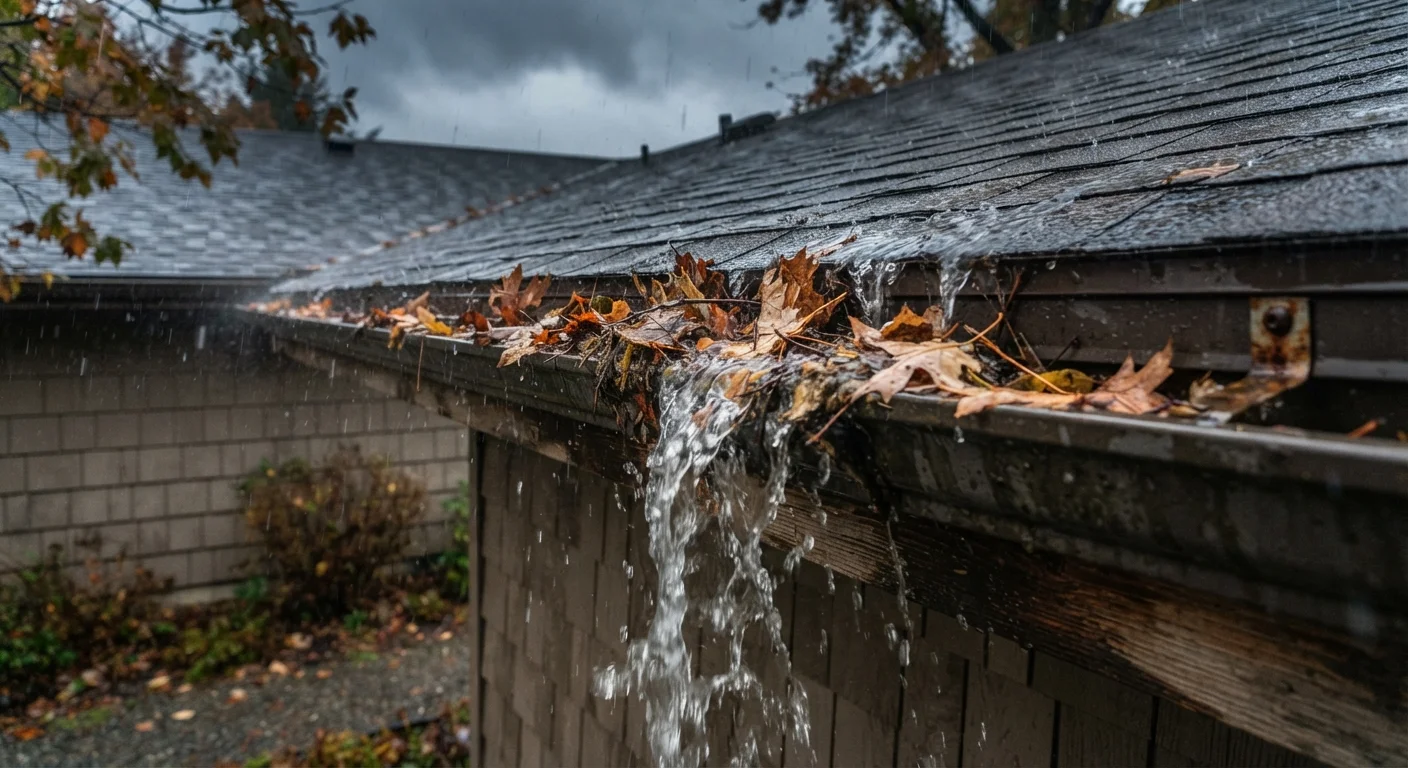
Clogs are the most common issue. Leaves, pine needles, seed pods, shingle grit, and even bird nests accumulate in the channel. Once a clog forms, water backs up and overflows at the weakest point — often directly against the foundation or down the exterior wall behind the gutter.
Sagging and separation happen when the weight of wet debris or standing water bends the gutter away from its hangers. A sagging gutter holds water instead of draining it, which accelerates rust in steel gutters and stresses the fascia board underneath.
Fascia rot is one of the most costly secondary consequences. When a gutter pulls away from or overflows against the fascia board repeatedly, the wood becomes saturated and begins to decay. Repairing rotted fascia often costs significantly more than routine gutter cleaning would have.
Water that migrates toward the foundation also creates basement moisture risks. Our guide on maintaining a healthy basement covers how to detect and address those problems before they escalate.
Time Your Cleaning Strategically
The most effective gutter cleanings happen in late spring (after seed pods and helicopter seeds fall) and late fall (after the last leaves drop). Cleaning too early in fall means you'll catch another round of debris before winter. Waiting until after the last substantial leaf drop gives you a full winter's worth of protection with a single cleaning.
Cleaning, Inspecting, and Knowing When to Call a Pro
For most single-story homes, gutter cleaning is a manageable DIY task. The core steps are straightforward: remove debris by hand or with a scoop, flush the channel with a hose to check flow, and confirm that downspouts are clear and directing water away from the home. Wear gloves — gutter debris can harbor mold and sharp debris.
While cleaning, inspect for these warning signs:
- Visible rust, holes, or cracks in the channel
- Loose or missing hangers causing the gutter to sag or pull away
- Joints or seams that are separated or leaking
- Peeling paint or staining on the fascia board behind the gutter
Leaking seams on sectional gutters can often be resealed with gutter-specific sealant — a job most homeowners can handle themselves. This is similar in principle to the resealing work covered in why caulking fails and how to fix it. However, if the fascia board underneath is soft, spongy, or visibly rotted, that repair typically warrants a contractor.
For multi-story homes or steeply pitched rooflines, hiring a professional is the safer choice. Falls from ladders are among the most serious DIY injuries, and no maintenance task is worth that risk.
Finally, remember that the gutter itself is only part of the system. Downspout extensions and the grading of soil around your home's perimeter are equally important. This connects closely to the broader water management topics in our article on plumbing basics every homeowner should understand — because keeping water away from your home starts at the roofline and ends at the foundation drain.