

Key Takeaways
- Rabbits, guinea pigs, and birds all respond well to positive reinforcement when sessions are kept short and consistent.
- Trust-building is the essential first step before introducing any formal training behaviors.
- Each species has distinct motivators — food rewards, social interaction, and timing all vary by animal.
- Patience and repetition matter more than duration; five minutes daily outperforms occasional long sessions.
- Recognizing stress signals helps you stop before training becomes a negative experience for your pet.
Small Pets Can Learn More Than You Think
Many pet owners assume that training is reserved for dogs — and that small animals like rabbits, guinea pigs, and birds simply aren't wired for it. The reality is quite different. These animals are cognitively capable, socially aware, and often highly motivated by food and positive interaction. What they need is an approach tailored to how they actually experience the world.
Before your first session begins, it's worth reviewing what preparation looks like. Our preparation checklist for new pet owners walks through environment setup, timing, and mindset — all of which apply whether you're working with a parrot or a Holland Lop. The techniques below are organized around what research and hands-on animal care experience suggest works best for each species group.
Time your sessions strategically
Small pets are often most alert and receptive at dawn and dusk, when their natural activity peaks. Scheduling training sessions during these windows can improve engagement and reduce the chance of working with a sleepy or overstimulated animal. Avoid sessions immediately after feeding, when motivation for food rewards is naturally lower.
Techniques That Work Across Species
Start with trust, not tricks
For rabbits and guinea pigs, the first training goal isn't a behavior — it's simply being comfortable near you. These are prey animals with strong flight instincts. Rushing into handling or cue-training before they feel safe will undermine everything that follows.
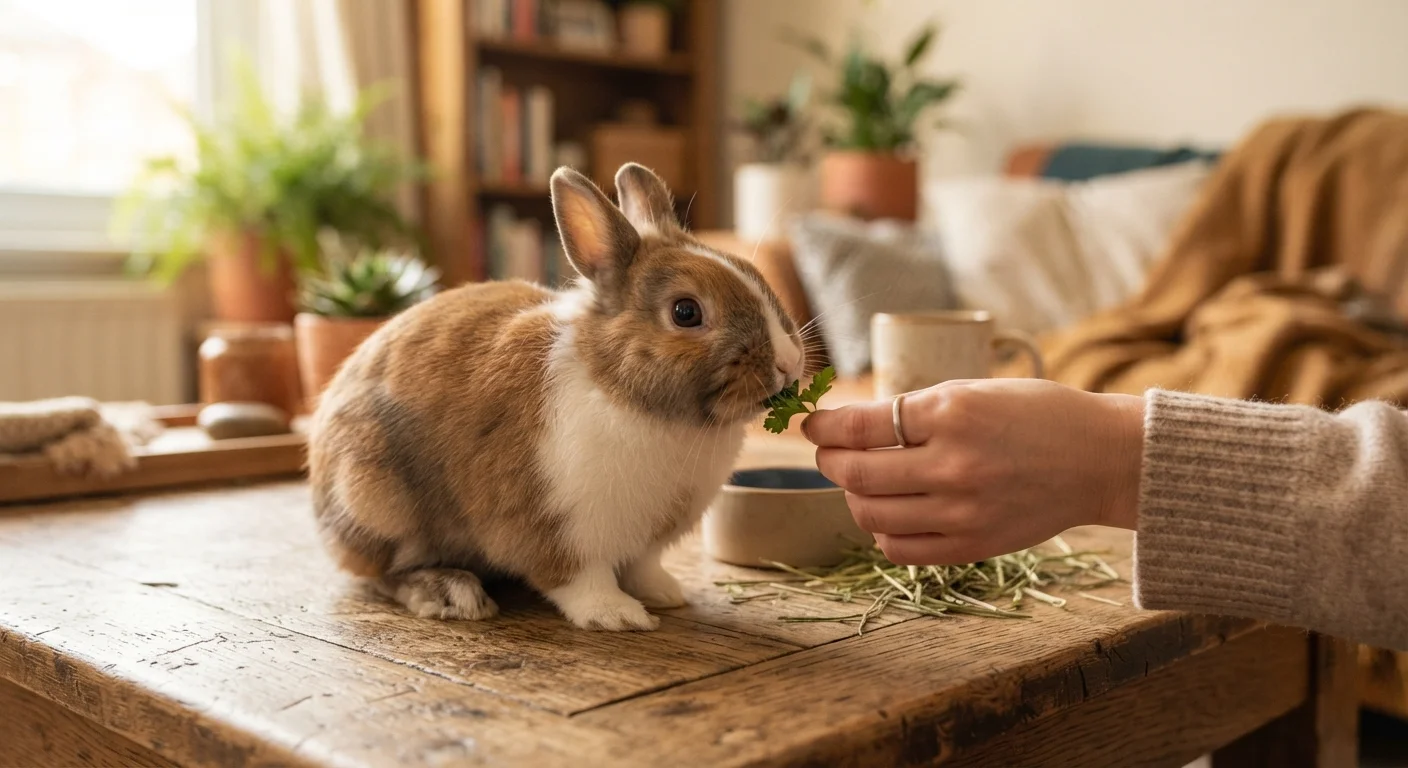
Begin by sitting quietly at their level and letting them approach on their own terms. Offer small pieces of preferred food (like a fragment of leafy green for a rabbit, or a tiny slice of bell pepper for a guinea pig) from an open palm. Repeat this daily until your pet actively seeks you out. Only once they consistently approach without hesitation should you introduce any structured training.
For prey animals, earning trust before teaching tricks is not optional — it's the foundation.
Use short, frequent sessions
Small pets have shorter attention spans and lower stress thresholds than dogs or cats. Sessions lasting two to five minutes are far more productive than extended attempts to push through disengagement. Ending on a successful moment — even a small one — reinforces a positive association with training time.
Guinea pigs in particular can become overwhelmed quickly, especially in new environments. Keep the training space calm, familiar, and free of other animals or loud distractions. Consistency across several short daily sessions builds far stronger habits than occasional long ones.
Two focused minutes every day will outperform a single exhausting twenty-minute session every week.
Match your rewards to what each species values
Positive reinforcement works across all three species, but the reward itself must be genuinely motivating to the individual animal. Rabbits often respond well to small pieces of herbs like cilantro or parsley. Guinea pigs tend to be highly food-motivated and may work enthusiastically for tiny pieces of vegetable. Birds — especially parrots and cockatiels — can be motivated by preferred seeds, a favorite food, or even praise and physical attention, depending on the individual bird.
Avoid using a treat that makes up a significant part of their daily diet in a single session. Treats should be small, species-appropriate, and offered immediately after the target behavior so the animal can connect the action to the reward.
The best reward is whatever your specific animal finds genuinely exciting — not what seems logical to you.
Teach one simple behavior at a time
Rabbits can learn to come when called, use a litter box reliably, or hop onto a designated surface on cue. Guinea pigs can learn to follow a target (such as a small stick touched to their nose), recognize their name, or return to their enclosure. Birds can learn to step up onto a hand, return to their cage on cue, or perform simple tricks like spinning in a circle.
The key is focusing on a single, clearly defined behavior until it's reliable before adding anything new. Introducing multiple cues simultaneously creates confusion and slows progress significantly. Use a consistent verbal cue or hand signal each time, and keep the behavior criterion clear — the animal should know exactly what earns the reward.
One behavior mastered fully is worth more than five behaviors learned halfway.
Read and respect stress signals
Knowing when to stop is just as important as knowing how to begin. Rabbits may thump, freeze, or attempt to flee when overwhelmed. Guinea pigs may chatter their teeth, refuse food, or try to hide. Birds may feather-fluff, beak-grind in agitation, or show dilated pupils when stressed during a session.
If any of these signals appear, end the session calmly and give your pet time to decompress. Pushing through stress doesn't build resilience — it damages trust and can make future training significantly harder. Training should always feel voluntary to the animal. The Pet Care Basics hub includes habitat and enrichment guidance that can help you build a lower-stress environment overall.
A pet that chooses to engage with you is learning; a pet that feels trapped is just surviving the session.
Adapt your approach for birds specifically
Birds present unique training considerations because many species are highly social and emotionally sensitive. Parrots, for example, can form strong preferences and may refuse to work with someone they associate with a negative experience. A calm, predictable presence matters enormously.
Clicker training — pairing a distinct click sound with a reward to mark the exact moment of correct behavior — is widely used with birds and can be very effective. The click bridges the gap between the behavior and the delivery of the reward, giving the bird precise information about what earned the treat. For birds that are not yet hand-tame, the same trust-building process described for rabbits and guinea pigs applies: patience, no forced handling, and letting the bird set the pace.
Birds learn fastest when they feel emotionally safe and have agency over their own participation.
Training is not one-size-fits-all
Individual personality varies enormously even within the same species. One rabbit may be bold and food-motivated from the start; another may need weeks of quiet trust-building before showing any interest in structured interaction. Observe your specific animal closely and let their responses guide your pace. If progress stalls despite consistent effort, a certified animal behaviorist familiar with small mammals or avian species can offer tailored guidance.
Building a Lasting Bond Through Training
Training isn't just about behaviors — it's one of the most reliable ways to deepen trust between you and a small pet. Each successful interaction teaches your animal that engaging with you leads to something good. Over time, this shifts the relationship from one of cautious coexistence to active, willing participation.
If your household includes multiple animals, the dynamics get a little more complex. Our guide on introducing a new pet to a household that already has animals offers strategies for managing that process without undermining the trust you've worked to build. And if you're curious how small-pet training compares to working with other species, cat training has its own learning curve worth exploring separately.
This article is for general informational purposes only. For guidance specific to your pet's health or behavioral concerns, consult a qualified veterinarian or certified animal behaviorist.