

Key Takeaways
- Crate training can support house training and reduce destructive behavior when used humanely.
- Misuse — such as excessive confinement — can cause anxiety, stress, and behavioral problems.
- Dogs should never be crated as punishment; association with the crate must always remain positive.
- Puppies, adult dogs, and seniors all have different crate needs and tolerance levels.
- A crate is a tool, not a substitute for adequate exercise, socialization, or companionship.
Accelerates house training for puppies
Dogs instinctively avoid soiling their sleeping area, making a correctly sized crate an effective tool for teaching bladder control. Consistent crate use during overnight or unsupervised periods reduces accidents and speeds up the overall house training timeline.
Provides a predictable safe space
For many dogs, a familiar crate offers a reliable retreat from household noise, visitors, or overstimulation. This predictability can lower stress, particularly for dogs that are naturally more anxious or easily overwhelmed.
Reduces destructive behavior when unsupervised
Puppies and adolescent dogs left unsupervised are prone to chewing, counter-surfing, and other hazardous behaviors. A crate limits access to dangerous items and prevents habits from forming that are harder to correct later.
Supports safer travel and veterinary visits
A dog comfortable in a crate is significantly easier to transport safely by car or plane, and less distressed during vet stays. Familiarity with confinement reduces fear in medical situations where restriction is unavoidable.
Aids post-surgical or injury recovery
When a dog needs restricted movement during recovery, a crate they already trust dramatically reduces the stress of enforced rest. Veterinarians frequently recommend crate rest, making prior familiarity a practical health benefit.
Excessive confinement causes stress and behavioral harm
Leaving a dog crated for too many hours — particularly on a daily, long-term basis — can lead to anxiety, depression, and learned helplessness. Dogs are social animals with significant needs for movement, interaction, and mental stimulation.
Can worsen separation anxiety if misapplied
For dogs already struggling with separation anxiety, the crate can become an additional source of distress rather than comfort. Confinement amplifies panic in anxious dogs and may require behavioral intervention before any crate use is appropriate.
Misused as a punishment, damaging trust
When owners use the crate as a consequence for unwanted behavior, dogs quickly form negative associations with it. This erases the positive conditioning the crate depends on and can make a dog resistant or fearful of entering.
Not suitable for all dogs or temperaments
Some dogs — especially those with a history of trauma, prior negative confinement experiences, or specific anxiety disorders — may never acclimate comfortably to a crate. Forcing the process can cause lasting behavioral setbacks.
Can substitute for necessary care and engagement
A crate used out of convenience rather than genuine training need can mask the underlying problem: a dog that isn't getting enough exercise, enrichment, or training. Over-reliance on the crate does not address the root causes of problematic behavior.
Our Verdict
Crate training, when introduced patiently and used appropriately, offers real benefits for house training, safety, and a dog's sense of security. However, it carries genuine risks if relied on as a long-term housing solution or used as punishment. Outcomes depend entirely on how — and how much — the crate is used.
Crate training is best suited to new puppy owners working on house training, owners managing a dog's recovery from illness or injury, and households where short-term safe confinement is genuinely necessary.
What Crate Training Actually Involves
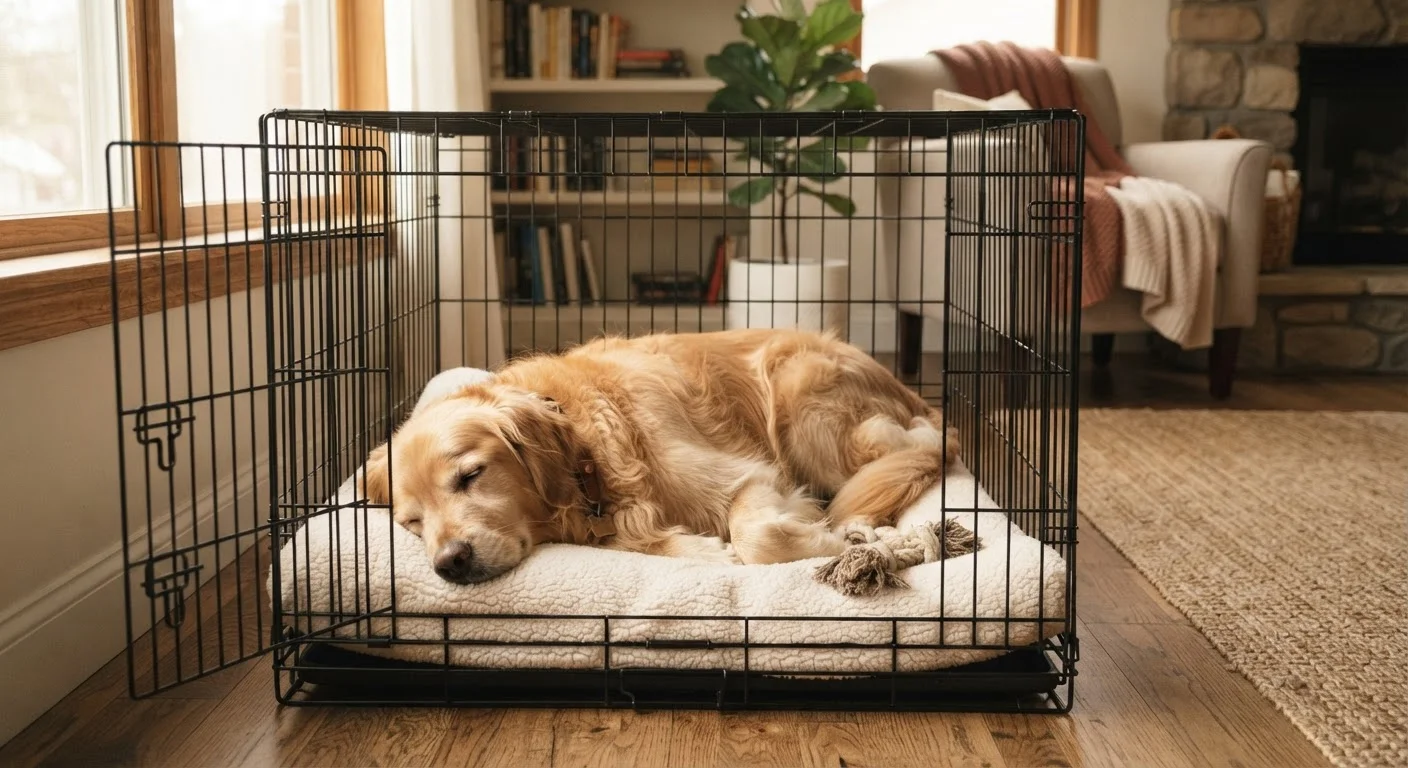
Crate training is the process of gradually teaching a dog to view an enclosed space — typically a wire, plastic, or fabric kennel — as a comfortable, safe resting area. The goal is voluntary acceptance, not forced confinement. Done well, the crate becomes a den-like retreat the dog chooses to use on its own.
The process relies heavily on patience and consistency. Trainers typically introduce the crate with the door open, encourage exploration using treats and familiar bedding, build up time inside incrementally, and always pair the experience with something positive. This approach aligns with the principles of reward-based training, which behavioral science consistently supports as the most effective and humane method for shaping behavior.
Crate training is not a one-size-fits-all solution, and what works for a twelve-week-old puppy may need significant adjustment for an adult rescue dog. Older dogs may need a very different introduction to the crate, especially if they have no prior positive associations with enclosed spaces.
The Benefits: When a Crate Genuinely Helps
For many owners and dogs, crate training delivers meaningful practical advantages — particularly in the early weeks of a dog joining a household.
Accelerates house training for puppies
Dogs instinctively avoid soiling their sleeping area, making a correctly sized crate an effective tool for teaching bladder control. Consistent crate use during overnight or unsupervised periods reduces accidents and speeds up the overall house training timeline.
Provides a predictable safe space
For many dogs, a familiar crate offers a reliable retreat from household noise, visitors, or overstimulation. This predictability can lower stress, particularly for dogs that are naturally more anxious or easily overwhelmed.
Reduces destructive behavior when unsupervised
Puppies and adolescent dogs left unsupervised are prone to chewing, counter-surfing, and other hazardous behaviors. A crate limits access to dangerous items and prevents habits from forming that are harder to correct later.
Supports safer travel and veterinary visits
A dog comfortable in a crate is significantly easier to transport safely by car or plane, and less distressed during vet stays. Familiarity with confinement reduces fear in medical situations where restriction is unavoidable.
Aids post-surgical or injury recovery
When a dog needs restricted movement during recovery, a crate they already trust dramatically reduces the stress of enforced rest. Veterinarians frequently recommend crate rest, making prior familiarity a practical health benefit.
~4 hrs
Maximum crate time for adult dogs per session
Most certified professional dog trainers and veterinary behaviorists recommend adult dogs should not be crated for more than four hours at a stretch during the day.
1–2 hrs
Recommended crate limit for young puppies
Puppies under 12 weeks have very limited bladder control; general guidance suggests crating for no longer than their age in months plus one hour, up to a practical maximum.
Beyond house training, crates serve a valuable role during veterinary recovery. When a dog needs restricted movement after surgery or injury, a familiar crate reduces stress considerably compared to an unfamiliar confinement environment. Crates also simplify travel, making car journeys and vet visits safer and calmer for dogs already comfortable in the space.
The Drawbacks: Where Crate Use Goes Wrong
The most significant risks associated with crate training are not inherent to the tool itself — they arise from misuse. Understanding these pitfalls is essential for any owner considering this approach.
Excessive confinement causes stress and behavioral harm
Leaving a dog crated for too many hours — particularly on a daily, long-term basis — can lead to anxiety, depression, and learned helplessness. Dogs are social animals with significant needs for movement, interaction, and mental stimulation.
Can worsen separation anxiety if misapplied
For dogs already struggling with separation anxiety, the crate can become an additional source of distress rather than comfort. Confinement amplifies panic in anxious dogs and may require behavioral intervention before any crate use is appropriate.
Misused as a punishment, damaging trust
When owners use the crate as a consequence for unwanted behavior, dogs quickly form negative associations with it. This erases the positive conditioning the crate depends on and can make a dog resistant or fearful of entering.
Not suitable for all dogs or temperaments
Some dogs — especially those with a history of trauma, prior negative confinement experiences, or specific anxiety disorders — may never acclimate comfortably to a crate. Forcing the process can cause lasting behavioral setbacks.
Can substitute for necessary care and engagement
A crate used out of convenience rather than genuine training need can mask the underlying problem: a dog that isn't getting enough exercise, enrichment, or training. Over-reliance on the crate does not address the root causes of problematic behavior.
It is also worth noting that some dogs — particularly those with a history of trauma, confinement-related anxiety, or claustrophobia — may never become comfortable in a crate despite careful introduction. Forcing the process can worsen anxiety and damage the trust between dog and owner. If a dog shows persistent distress, consulting a certified professional trainer or veterinary behaviorist is strongly advisable rather than persisting alone.
Humane Crate Use: What the Evidence Suggests
The debate around crate training often polarizes into two camps: those who view it as an indispensable training tool and those who consider any confinement inherently cruel. The evidence suggests the reality is more nuanced.
Crate Size Matters More Than You Think
A crate should be large enough for your dog to stand, turn around, and lie down comfortably — but not so large that a puppy can use one corner as a bathroom. Dividers are available for wire crates and allow you to adjust the interior space as your dog grows. An appropriately sized crate supports the natural instinct to keep a sleeping area clean, which underpins the house training benefit.
Most animal behavior professionals agree on a few core principles: the crate door should be left open whenever supervision is possible, crating should never exceed a few hours for adult dogs and even less for puppies, and the space should always be associated with comfort rather than isolation or punishment. Puppies under six months generally should not be crated for more than three to four hours at a stretch, as they cannot yet control their bladder for longer periods.
For owners just starting out, crate training fits naturally into a broader training foundation. New dog owners benefit most from building crate habits early, before problematic patterns take hold. And for owners curious about the wider training landscape, exploring force-free versus dominance-based approaches provides helpful context for why humane methods consistently produce better long-term outcomes.
This article is for general informational purposes only and does not constitute professional veterinary or behavioral advice. If your dog is showing signs of significant anxiety or distress, please consult a qualified veterinarian or certified animal behaviorist.