

Key Takeaways
- Training begins on day one — every interaction teaches your dog something.
- Positive reinforcement is the most well-supported approach for building lasting behavior.
- Consistency from all household members is more important than any single technique.
- Short, frequent training sessions outperform long, infrequent ones for dogs of any age.
- Early socialization shapes how your dog responds to the world for life.
- Professional guidance is a strength, not a last resort — seek it early if needed.
Start here
Why Training Starts the Moment Your Dog Comes Home
Understand the 'why'
The Core Principles Behind Effective Dog Training
Build your toolkit
Essential Skills to Teach First
Put it into practice
Building a Consistent Daily Routine
Avoid the pitfalls
Common Mistakes New Owners Make
Know your limits
When to Seek Professional Help
Why Training Starts the Moment Your Dog Comes Home
Many new owners believe training is something that begins once a dog has "settled in." In reality, every moment from arrival is a learning opportunity — and your dog is already drawing conclusions about what earns attention, what's allowed, and what home feels like.
The environment you create in those first days sets behavioral expectations that can be remarkably durable. A dog who learns that jumping earns greeting cuddles will keep jumping. A dog who discovers that sitting quietly brings reward will offer that behavior more and more. This isn't a matter of discipline — it's simply how dogs learn.
Early experiences also shape socialization, which is the process by which dogs learn that new people, animals, sounds, and environments are safe and normal. Veterinary behaviorists generally consider the window between roughly 3 and 14 weeks of age to be a critical period for socialization, though positive exposure continues to matter well beyond that. For everything related to your dog's overall care during this period, the Pet Care Basics hub is a helpful companion resource.
The Core Principles Behind Effective Dog Training
Understanding a few foundational ideas will make every technique you use more effective.
Positive reinforcement
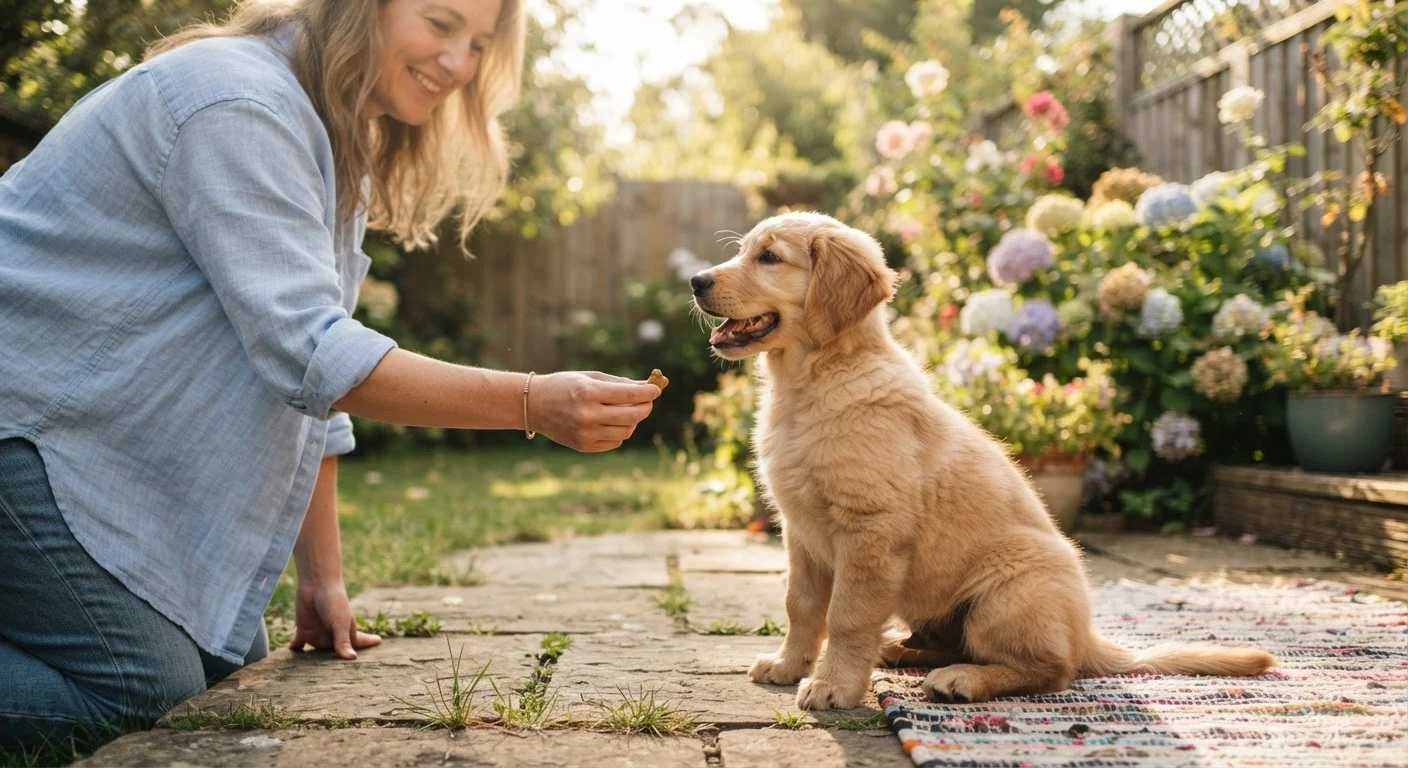
Adding something the dog finds rewarding — such as a treat, praise, or play — immediately after a desired behavior to make that behavior more likely to happen again.
Classical conditioning
A form of learning where a neutral signal (like a clicker sound) becomes associated with something meaningful (like a treat), helping dogs understand what's coming next.
Socialization
The gradual process of introducing a dog to a wide variety of people, animals, sounds, and environments in a calm, positive way so they learn the world is safe.
Luring
Using a treat or toy held in your hand to guide a dog's body into a desired position, which is then rewarded to help the dog understand what behavior is being asked for.
Reinforcement schedule
The pattern with which rewards are delivered during training — for example, rewarding every repetition when teaching something new, then gradually rewarding less predictably to maintain the behavior.
Timing matters enormously. Reinforcement works best when it arrives within one to two seconds of the desired behavior. Even a brief delay can cause your dog to associate the reward with whatever they were doing at that moment — not what you intended to reward.
Reward what you want, redirect what you don't. Instead of punishing unwanted behavior, interrupt it calmly and guide your dog toward an acceptable alternative, then reward that. This approach avoids confusion and fear, which are the two most common reasons training stalls.
Every family member must be consistent. Dogs learn patterns. If one person allows the dog on the couch and another doesn't, the dog isn't confused — the humans are sending mixed messages. Agreeing on rules before your dog arrives prevents a great deal of frustration.
Essential Skills to Teach First
Rather than teaching a long list of tricks, prioritize the skills that make daily life safer and more manageable for both of you.
- Name recognition: Your dog's name should predict good things are coming. Say it once, reward eye contact, and repeat frequently in low-distraction settings.
- Sit: One of the easiest cues to teach and one of the most useful. A dog who sits on cue has a built-in alternative to jumping, barking, or rushing through doors.
- Come (recall): A reliable recall is a safety skill. Practice it with enthusiasm — coming to you should always feel rewarding, never like a trap.
- Loose-leash walking: Pulling on leash is the most common complaint among new owners. Teaching your dog to walk without tension takes patience but makes every walk more enjoyable for both parties.
- Leave it and drop it: These cues can prevent your dog from ingesting something dangerous. Practice them early and often.
Use High-Value Rewards for New Skills
When introducing a brand-new behavior, use your dog's highest-value treats — small pieces of cooked chicken, cheese, or whatever your dog finds irresistible. Once the behavior is reliable, you can gradually shift to more routine rewards. Matching reward value to task difficulty keeps motivation high.
For a broader look at how these foundations evolve through puppyhood and into adulthood, see the complete dog training owner's reference.
Building a Consistent Daily Routine
Dogs thrive on predictability. A structured daily schedule reduces anxiety, minimizes problem behaviors born of boredom, and gives you natural windows to practice training without carving out extra time.
Weave brief training moments into existing routines: ask for a sit before placing the food bowl down, practice a recall before opening the back door, reward calm behavior during grooming. These micro-sessions accumulate quickly without feeling like formal work.
Adequate physical exercise and mental stimulation are also non-negotiable parts of a training-friendly routine. A dog who is understimulated is far more likely to invent their own entertainment — often in ways owners find destructive. Puzzle feeders, sniff walks, and age-appropriate play all reduce that pressure.
Common Mistakes New Owners Make
Even well-intentioned owners can unintentionally undermine their own training. These are the patterns worth watching for:
Avoid Punishment-Based Methods
Techniques such as leash corrections, alpha rolls, or yelling may suppress behavior in the short term but frequently increase anxiety, fear, and aggression over time. Veterinary and behavioral organizations consistently advise against aversive training tools. If a method feels unkind, it's worth reconsidering.
- Repeating cues: Saying "sit, sit, sit" teaches your dog that the first "sit" means nothing. Say the cue once, wait, and if needed, use a lure or prompt — then try again.
- Training only when things go wrong: Reactive training, where you only engage with your dog's behavior when it's bad, misses the far more powerful opportunity to reward good behavior as it naturally occurs.
- Expecting too much too soon: Learning takes time and repetition. Frustration is understandable, but it's not useful. Lower the difficulty, increase your reward rate, and rebuild confidence.
- Skipping socialization: Owners sometimes shelter young dogs from the world to "protect" them. Carefully managed positive exposure during the socialization window is far more protective than isolation.
When to Seek Professional Help
Reaching out to a professional trainer or veterinary behaviorist is a sign of good ownership, not failure. If your dog shows signs of fear, anxiety, or aggression — growling, snapping, hiding, or extreme reactivity — professional guidance is important and should not be delayed.
When choosing a trainer, look for credentials that reflect education in animal behavior and commitment to humane methods. Organizations such as the Certification Council for Professional Dog Trainers (CCPDT) and the International Association of Animal Behavior Consultants (IAABC) maintain directories of credentialed professionals.
Your veterinarian is also a valuable first point of contact. Sometimes behaviors that look like training problems have an underlying health component — pain, thyroid imbalance, and other medical issues can all affect behavior. A veterinary check-up before or alongside any training program is always worthwhile.
This article is for general informational purposes only and is not a substitute for professional veterinary or behavioral advice. Always consult a qualified professional for concerns about your individual dog's health or behavior.