

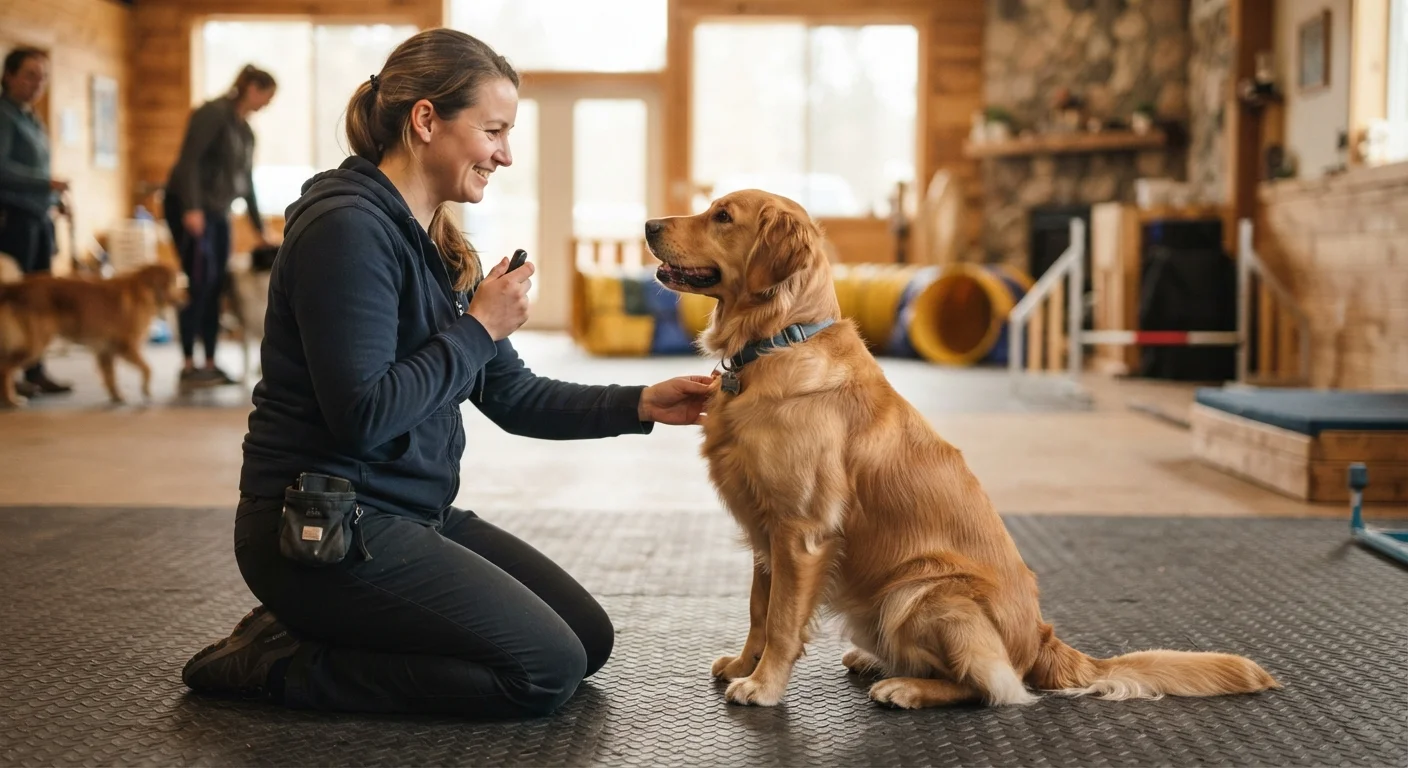
Key Takeaways
- Clicker training uses a distinct sound to mark the exact moment a correct behavior occurs, improving timing precision.
- Verbal cues are always with you — no equipment needed — making them practical for real-world, everyday situations.
- Both methods rely on positive reinforcement; the science behind them is the same.
- Many professional trainers combine both tools, using the clicker to teach and verbal cues to maintain behaviors.
- Your consistency and timing matter more than which method you choose.
- Dogs with hearing challenges may need visual markers instead of either auditory approach.
Option A
Clicker Training
The precise, science-backed marker method.
Best for: Owners learning new skills or dogs who need fast, unambiguous feedback during complex behavior shaping.
Option B
Verbal Cues
The flexible, hands-free everyday approach.
Best for: Owners who want a seamless, always-available communication system without carrying extra equipment.
If you're shaping complex or precise new behaviors
Clicker Training
The clicker's consistent, neutral sound marks exact moments with clarity that's hard to replicate with voice alone, speeding up the learning process.
If you want a hands-free, always-available method
Verbal Cues
Your voice is always with you — ideal for on-leash walks, public settings, or moments when carrying a clicker isn't practical.
If your dog is easily distracted or slow to generalize behaviors
Clicker Training
The consistent marker sound cuts through noise and emotional variability, helping distracted dogs zero in on what earned their reward.
If you're training an older dog or reinforcing established commands
Verbal Cues
Dogs with existing word associations often respond well to voice cues, and verbal maintenance is low-effort for well-learned behaviors.
If you want the most flexible long-term training system
Clicker Training
Start with the clicker to build a behavior clearly, then layer in a verbal cue — giving you the precision of both tools working together.
How Each Method Works
Both clicker training and verbal cues are rooted in the same behavioral science — positive reinforcement — where desired behaviors are strengthened by pairing them with something the dog values. The difference lies in how you communicate the moment the right behavior happens.
Clicker training uses a small handheld device that produces a short, consistent click sound. That sound is first "charged" — paired repeatedly with treats until the dog learns the click itself predicts a reward. Once charged, the click acts as a marker: it tells your dog precisely which action earned the treat, even if the treat arrives a few seconds later. This precision is the clicker's biggest strength. The sound never changes tone based on your mood, fatigue, or frustration.
Verbal cues use spoken words — "sit," "stay," "yes" — either as direct commands or as verbal markers. A word like "yes!" can serve the same marking function as a click, while command words tell the dog what behavior to perform. Most owners use verbal cues naturally without realizing it, making this method feel intuitive from the start.
| Criterion | Clicker Training | Verbal Cues |
|---|---|---|
| Timing precision | Very high — consistent mechanical click | Moderate — varies with delivery |
| Equipment needed | Yes — clicker required | None — voice always available |
| Emotional consistency | High — unaffected by mood | Variable — tone reflects emotion |
| Best phase | Teaching new behaviors | Maintaining learned behaviors |
| Ease for beginners | Slight learning curve | Feels natural from day one |
| Works with hearing loss | No — auditory signal | No — auditory signal |
| Social bonding potential | Moderate | High — voice carries warmth |
Where Each Approach Shines
Clicker training excels during the acquisition phase — when you're actively teaching a new behavior. The mechanical consistency removes variables that verbal communication can't always avoid. Your voice reflects emotion; a click does not. For dogs working through foundational obedience commands or intricate skills like service-dog tasks, that reliability accelerates learning noticeably.
Verbal cues, on the other hand, thrive in the maintenance phase — once a dog knows what a word means and can perform the behavior reliably. They're also indispensable in real life. You can ask your dog to "wait" at a curb, call a "come" across a yard, or quietly say "down" in a café without reaching for any equipment. If your dog struggles with recall, the reasons they ignore the "come" command often have more to do with reinforcement history than the delivery method itself.
~0.3 sec
Ideal marker timing window after behavior
Behavioral science research suggests the reward marker must fall within roughly half a second of the behavior to associate clearly in the dog's mind.
100%
Clicker consistency vs. human voice variability
Unlike a human voice, a mechanical clicker produces the same sound every single time, eliminating tonal variation that can confuse dogs during early training.
Verbal cues can also carry emotional warmth that strengthens your bond — tone of voice communicates safety and enthusiasm in ways a mechanical click cannot replicate socially.
Practical Considerations for Your Routine
Neither method works in isolation from real life. A few honest questions can help guide your choice:
- Do you have free hands during training? A clicker requires one hand, which can be limiting if you're also managing a leash, treats, or a young child.
- How consistent is your voice? If stress or illness regularly changes your vocal tone, a clicker's neutral sound may serve your dog better during early learning.
- Where do you train most often? Indoors, with minimal distraction, either method works well. In busy outdoor environments, the clicker can cut through noise more reliably.
- What's your dog's hearing status? Dogs with partial or full hearing loss need visual markers — a hand signal or thumbs-up — rather than either auditory approach.
For adult and senior dogs, the method matters less than patience and session length. Keep sessions short — five to ten minutes — and always end on a success.
Can You Use Both at the Same Time?
Yes — and many trainers recommend it. Once your dog has learned that the click means a reward is coming, you can begin saying the behavior's name just before clicking, gradually transferring the association to the verbal cue. Over time, the clicker can be faded out entirely, leaving a clean verbal command your dog responds to reliably. This layered approach gets the best of both worlds.
Many experienced trainers use clickers to shape new behaviors and then deliberately pair a verbal cue with each behavior before phasing the clicker out. This hybrid approach lets you enjoy the precision of a marker during learning and the convenience of voice for life.