

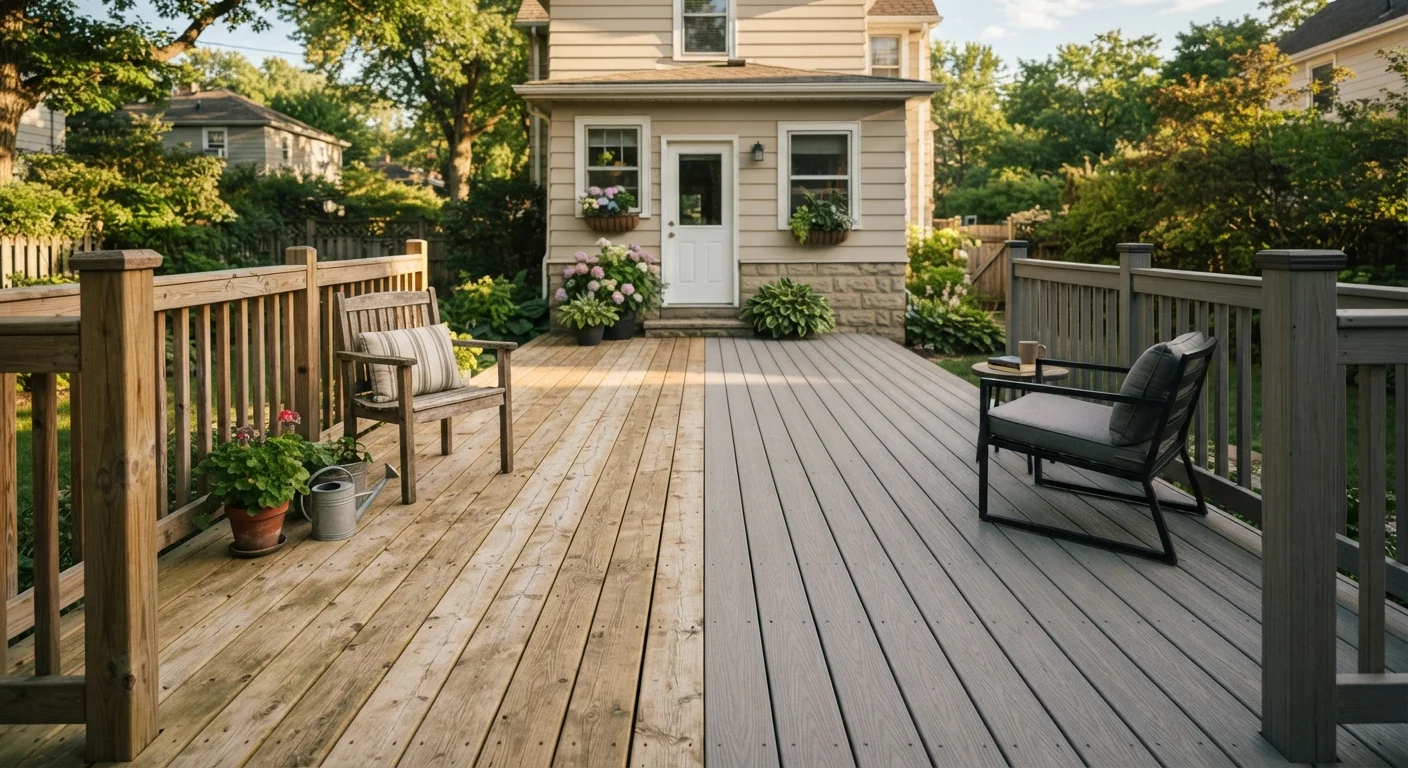
Key Takeaways
- Pressure-treated lumber costs less upfront but requires sealing or staining every one to three years to maintain its integrity.
- Composite decking typically carries a higher purchase price but needs little more than periodic cleaning to stay in good shape.
- Both materials can last 25 years or more when properly installed and maintained; neglect shortens that lifespan significantly.
- Climate, sun exposure, and foot traffic level should all factor into which material fits your specific situation.
- Total cost of ownership — not just sticker price — is the most useful metric when comparing the two options.
Option A
Pressure-Treated Decking
The time-tested, budget-accessible choice.
Best for: Homeowners who want a lower upfront cost and are comfortable with regular sealing, staining, and occasional board replacement.
Option B
Composite Decking
The low-maintenance, long-horizon alternative.
Best for: Homeowners who prefer to minimize recurring upkeep and are willing to pay more initially for a material that resists rot, fading, and splintering.
If you're working within a tight initial budget
Pressure-Treated Decking
Pressure-treated lumber typically costs considerably less per square foot to purchase and install, making it the more accessible starting point for many homeowners.
If you want to minimize annual maintenance time and expense
Composite Decking
Composite boards don't need sealing, staining, or sanding, so your ongoing time and material investment stays very low once the deck is built.
If your deck faces heavy moisture, shade, or humid conditions
Composite Decking
Quality composite materials resist rot and mold far more reliably than wood, which is prone to moisture damage when not consistently sealed.
If you're planning a DIY build and want familiar materials
Pressure-Treated Decking
Pressure-treated lumber is widely available, easy to cut with standard tools, and well-documented in building codes across the US.
If long-term appearance stability is a priority
Composite Decking
Composite boards are engineered to resist fading, warping, and splintering, maintaining a consistent look with far less intervention over the years.
What Each Material Actually Is
Understanding what you're comparing matters before weighing trade-offs. Pressure-treated lumber is dimensional wood — typically southern yellow pine in the US — that has been infused with chemical preservatives under pressure. These preservatives protect against rot, fungal decay, and insect damage, making it suitable for ground-contact and above-ground outdoor use.
Composite decking is an engineered product made from a blend of wood fiber, recycled plastics, and binding agents. It mimics the appearance of wood while adding resistance to moisture, UV fading, and biological decay. Most composite boards sold today have a protective polymer cap layer on the exposed surfaces, which significantly improves durability compared to earlier uncapped versions.
This distinction is worth keeping in mind: composite is not one uniform product. Capped composite performs meaningfully better than uncapped boards, so it's worth understanding what you're purchasing before comparing costs.
| Criterion | Pressure-Treated | Composite |
|---|---|---|
| Upfront material cost | Lower | Higher |
| Annual maintenance required | Sealing/staining every 1–3 years | Periodic cleaning only |
| Typical lifespan (maintained) | 20–30+ years | 25–30+ years |
| Splinter risk | Yes, especially aged boards | Minimal |
| Moisture/rot resistance | Moderate (depends on sealing) | High (capped composite) |
| Color/stain flexibility | High — paintable and stainable | Limited to manufacturer options |
| Heat retention in sun | Moderate | Higher — can be hot underfoot |
| DIY workability | Standard tools, widely familiar | Straightforward but heavier boards |
Maintenance: Where the Real Difference Lives
This is the category that most clearly separates the two materials in practice.
Pressure-treated wood requires active, recurring maintenance. After installation, new boards should be allowed to dry — typically for several months — before a water-repellent sealer or stain is applied. After that, reapplication every one to three years is generally recommended to prevent water infiltration, cracking, and graying. Without this routine, the wood can warp, splinter, and become structurally compromised over time. Cleaning, sanding rough spots, and replacing individual boards are all realistic tasks for a PT deck owner. For more context on how surface exposure affects material longevity, see our guide on what shortens and extends exterior finish life.
Composite decking's maintenance demand is dramatically lower. Most manufacturers recommend washing the surface one to two times per year with soap and water or a composite-safe cleaner to prevent mold and mildew buildup in the grooves. Beyond that, there's no sealing, staining, or sanding required. The tradeoff is that when composite boards do sustain damage, individual board replacement can be more complicated depending on how the deck was built and whether the product line is still available.
1–3 years
Resealing interval for pressure-treated decks
Most deck care professionals recommend applying a water-repellent sealer or stain on PT lumber every one to three years depending on exposure and climate.
25–30 years
Expected lifespan of quality composite decking
Many capped composite manufacturers offer warranties in the 25–30 year range, though actual performance depends on installation quality and maintenance.
~50%
Potential material cost premium for composite over PT
While pricing varies widely by region and product tier, composite decking materials commonly cost 50% or more above pressure-treated lumber at point of purchase.
Cost Over Time: Upfront vs. Lifetime
Pressure-treated lumber is consistently less expensive at point of purchase. Material costs for PT decking can run roughly half to two-thirds the price of mid-range composite, though regional pricing and lumber market fluctuations affect this meaningfully.
However, the lifetime cost picture is more nuanced. Factor in the recurring cost of sealers, stains, and cleaning products every year or two, plus any labor if you hire out that work, and the gap narrows considerably over a decade. A composite deck that requires only periodic cleaning can end up costing less per year of useful life when that math is fully accounted for.
Neither material is immune to structural concerns. The framing — joists, posts, and beams — is almost always pressure-treated regardless of which decking surface you choose, and that framing's condition matters just as much for longevity. Keeping an eye on the structural elements of your outdoor spaces ties into the same thinking covered in our framework for prioritizing home improvement projects.
Appearance, Feel, and Environmental Considerations
Pressure-treated lumber has a natural, tactile quality that many homeowners prefer. It can be painted or stained in virtually any color, which gives you flexibility if your design preferences change. That said, it will gray and weather without treatment, and surface splintering is a legitimate concern in high-traffic areas or homes with children and barefoot users.
Composite decking generally offers a more uniform, finished appearance out of the box. It comes in a range of colors and wood-grain textures, though some homeowners find the look slightly synthetic compared to natural wood. Composite also tends to get hotter underfoot in direct sun — a real comfort consideration in warm climates.
On the environmental side, both materials have trade-offs. Pressure-treated lumber uses chemical preservatives, though modern formulations have moved away from earlier arsenic-based compounds. Composite products incorporate recycled materials, which is a genuine benefit, though the mixed-material composition makes them difficult to recycle at end of life.
Whichever surface you choose, pairing it with thoughtful landscaping around the base of your deck can reduce moisture buildup and pest pressure. The same trade-off thinking that applies to decking applies to other outdoor material choices — see our organic vs. inorganic mulch comparison for a parallel example of weighing upfront simplicity against long-term performance.