

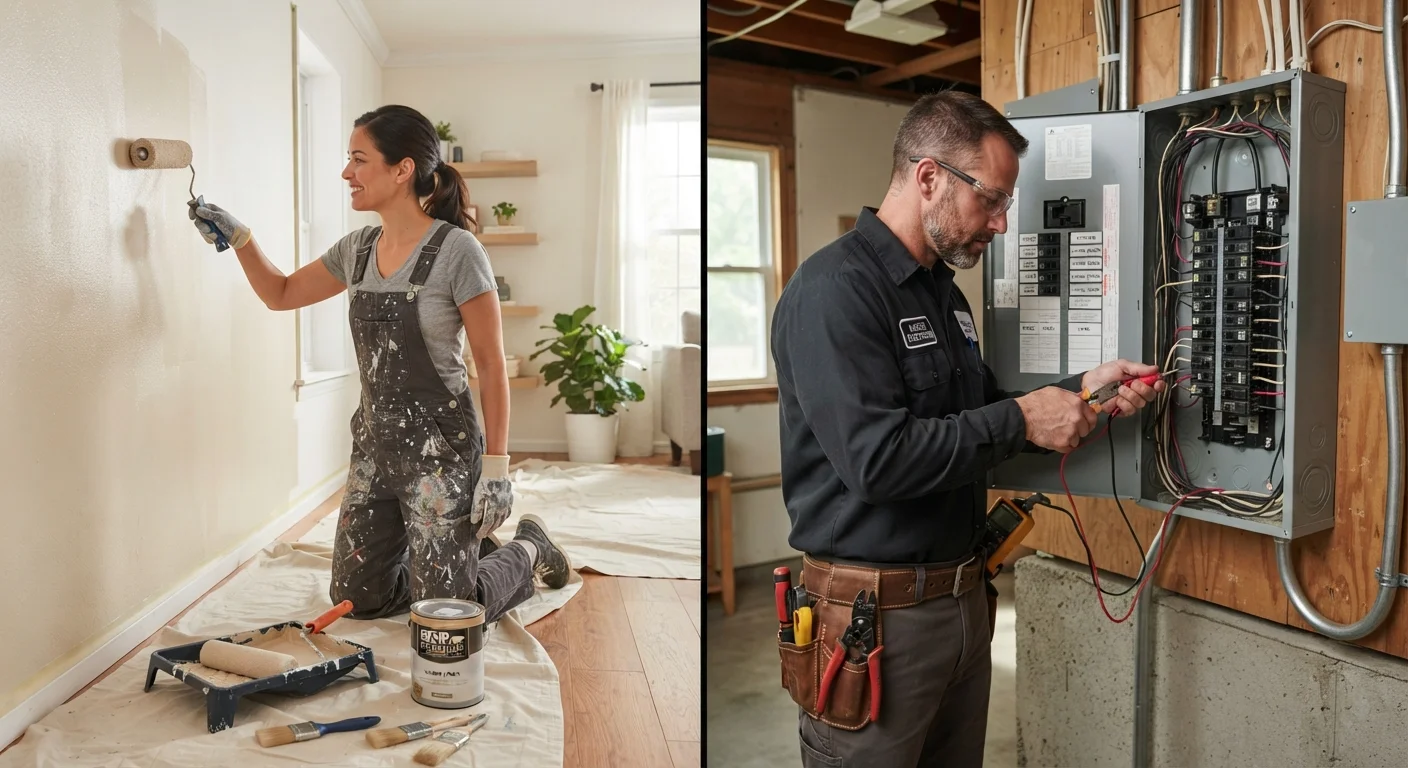
Key Takeaways
- Cosmetic tasks like painting, caulking, and basic landscaping are generally safe for confident DIYers.
- Electrical, structural, gas, and main plumbing work typically require licensed professionals and permits.
- Skipping required permits can create costly problems when you sell or insure your home.
- Your skill level, available tools, and local code requirements should all factor into the decision.
- Hiring out doesn't always cost more when you factor in mistakes, materials, and your own time.
Our Verdict
The DIY vs. hiring decision isn't one-size-fits-all — it depends on the task's complexity, the safety and permit implications, and your honest skill assessment. Cosmetic and light maintenance work is well-suited to capable homeowners, while anything touching structural integrity, electrical systems, gas lines, or regulated plumbing is best left to licensed professionals.
| Best for | Recommended |
|---|---|
| Homeowners with basic tool skills and time to spare | DIY |
| Projects involving electrical panels, gas lines, or load-bearing structures | Hire a Licensed Professional |
| Work that requires permits or inspections in your municipality | Hire a Licensed Professional |
| Finishing work, painting, simple fixture swaps, and landscaping | DIY |
Why the DIY Line Isn't Always Obvious
Walk into any home improvement store on a Saturday morning and you'll find dozens of homeowners convinced they can handle almost anything. Some of them are right. Others are a Google search away from a mistake that voids their homeowner's insurance or triggers a failed home inspection years later.
The reality is that the line between appropriate DIY and work that genuinely requires a licensed professional isn't drawn by confidence — it's drawn by safety codes, local permit requirements, and the real consequences of getting it wrong. Understanding that line is one of the most useful things a homeowner can do before picking up a tool or picking up the phone. See our guide to prioritizing home improvement projects for a framework on ranking renovation tasks by urgency and risk.
Tasks That Are Genuinely DIY-Friendly
A broad category of home improvement work carries low risk, requires no permits, and responds well to a patient, capable homeowner. These typically include:
- Interior painting and wallpaper removal — low risk, reversible, and well-documented with tutorials
- Basic landscaping and garden bed preparation — planting, mulching, and simple grading that doesn't redirect drainage
- Caulking and weatherstripping — sealing windows and doors improves efficiency and is straightforward to redo if done poorly
- Installing pre-hung interior doors — non-structural and generally permit-free in most jurisdictions
- Replacing light fixtures and outlets — switching like-for-like fixtures on existing circuits is manageable for careful homeowners, though always shut off the breaker and verify with a non-contact voltage tester before touching any wiring
- Tile work in non-structural areas — backsplashes and bathroom floors are forgiving projects for first-timers willing to practice
The common thread: these tasks are reversible, don't affect the home's systems or structure, and don't require permits in most areas. Mistakes are costly in time and money, but not in safety.
Evaluate Your Skill Level Honestly
Before starting any project, look up two things: whether a permit is required in your municipality, and whether the task involves any of the high-risk categories (electrical, gas, structural, or mains plumbing). Your local building department's website or a quick call can answer the permit question in minutes. When in doubt, a paid consultation with a licensed professional — even if you ultimately DIY — is money well spent.
Where You Should Step Back and Hire Out
Certain categories of work carry risks — to your safety, your home's structural integrity, or your legal standing — that make professional licensing a genuine requirement rather than a suggestion.
| Task Type | DIY | Hire a Professional | |
|---|---|---|---|
| Interior painting | Suitable — low risk, no permit needed | Optional — rarely necessary | |
| Electrical panel / new circuits | Not recommended — safety and code risk | Required — licensed electrician and permit | |
| Gas line modifications | Not safe — leak risk is life-threatening | Required — licensed gas fitter | |
| Faucet / fixture replacement | Generally suitable — no permit in most areas | Optional — useful if access is difficult | |
| Load-bearing wall removal | Not appropriate — structural and permit risk | Required — contractor and structural engineer | |
| Tile backsplash / flooring | Suitable for patient, careful homeowners | Optional — worth it for large or complex areas | |
| Roofing replacement | Risky — may void warranty or insurance | Recommended — licensed roofer advised |
Electrical panel work and new circuit installation — Adding circuits, upgrading a panel, or running new wiring from the panel typically requires a licensed electrician and an electrical permit. Faulty wiring is a leading cause of house fires.
Gas line work — Any modification to gas lines — extending them, capping them, adding appliances — should only be performed by a licensed plumber or gas fitter. Leaks can be fatal.
Load-bearing structural changes — Removing walls, adding beams, or altering the home's framing requires engineering oversight and a structural permit in nearly every jurisdiction.
Main plumbing connections — Connecting to or altering the main supply or drain lines typically requires a licensed plumber and an inspection. Fixture swaps (like replacing a faucet) are generally DIY-acceptable.
Roofing with insurance or warranty implications — Many homeowner insurance policies and manufacturer warranties require licensed installation. Confirm your policy terms before climbing up.
For more on permit and inspection requirements, see our companion piece on permits, inspections, and code.
The Real Cost Equation
Homeowners often frame DIY as "saving money" and hiring out as "spending more." That framing misses several factors:
- Tool costs — Specialty tools needed for a one-time job can erase the labor savings. Renting is often smarter than buying.
- Mistake costs — A DIY tiling job done incorrectly may need a professional to undo and redo — doubling the expense.
- Time costs — A weekend project that stretches into three weekends has a real cost in household disruption and your own time.
- Resale implications — Unpermitted work can complicate or derail a home sale. Buyers and their inspectors look for this.
The honest calculus: DIY pays off most when the task is repeatable (so skills transfer), when you already own the tools, and when the risk of a costly mistake is genuinely low. When you're ready to bring in a pro, our guide on questions to ask contractors before hiring can help you vet candidates and protect your investment.
For related decision-making in another domain, the same logic applies to vehicle care — see how homeowners think through DIY car maintenance vs. taking it to a shop.