
Bodyweight Training: A Complete Reference for Exercises, Progressions, and Terms

| Equipment needed | None required; a pull-up bar expands pull pattern options |
| Minimum effective frequency | 2 full-body sessions per week for general fitness maintenance (U.S. Department of Health & Human Services Physical Activity Guidelines) |
| Primary movement patterns | Push, pull, squat, hinge, core |
| Most commonly skipped pattern | Pull (horizontal and vertical rowing movements) |
| Beginner progression approach | Increase reps and form quality before moving to harder variations |
| Recovery between sessions | Typically 48 hours before training the same muscle groups again |
What Bodyweight Training Is - and Why It Matters
Bodyweight training uses your own mass as resistance to build strength, endurance, flexibility, and coordination - no gym membership or equipment required. For busy Americans juggling work, family, and commuting, it offers one of the most practical on-ramps to consistent physical activity.
Unlike machine-based exercise, bodyweight movements engage stabilizing muscles and require control across multiple joints simultaneously. That functional demand transfers well to everyday tasks like lifting, climbing stairs, and maintaining posture. See how home training compares to gym workouts for a fuller picture of what each environment offers beyond cost.
This reference covers foundational movements, progression strategies, and the terminology you'll encounter as you explore or deepen a bodyweight practice. It is general educational information, not a personalized fitness prescription. Consult a qualified health or fitness professional before beginning any new exercise program, especially if you have existing injuries or health conditions.
Progressive Overload
The gradual increase of stress placed on the body during exercise - through more reps, harder variations, or reduced rest - so that muscles continue to adapt and grow stronger over time.
Movement Pattern
A category of motion that groups exercises by how the body moves, such as push, pull, squat, or hinge. Training across all major patterns helps create balanced, functional strength.
Regression
An easier version of an exercise that reduces load or complexity, allowing a beginner or someone managing an injury to practice the movement pattern safely.
Progression
A harder variation of an exercise that increases the training demand, used once the current version can be performed with good form across all target sets and reps.
Rep (Repetition)
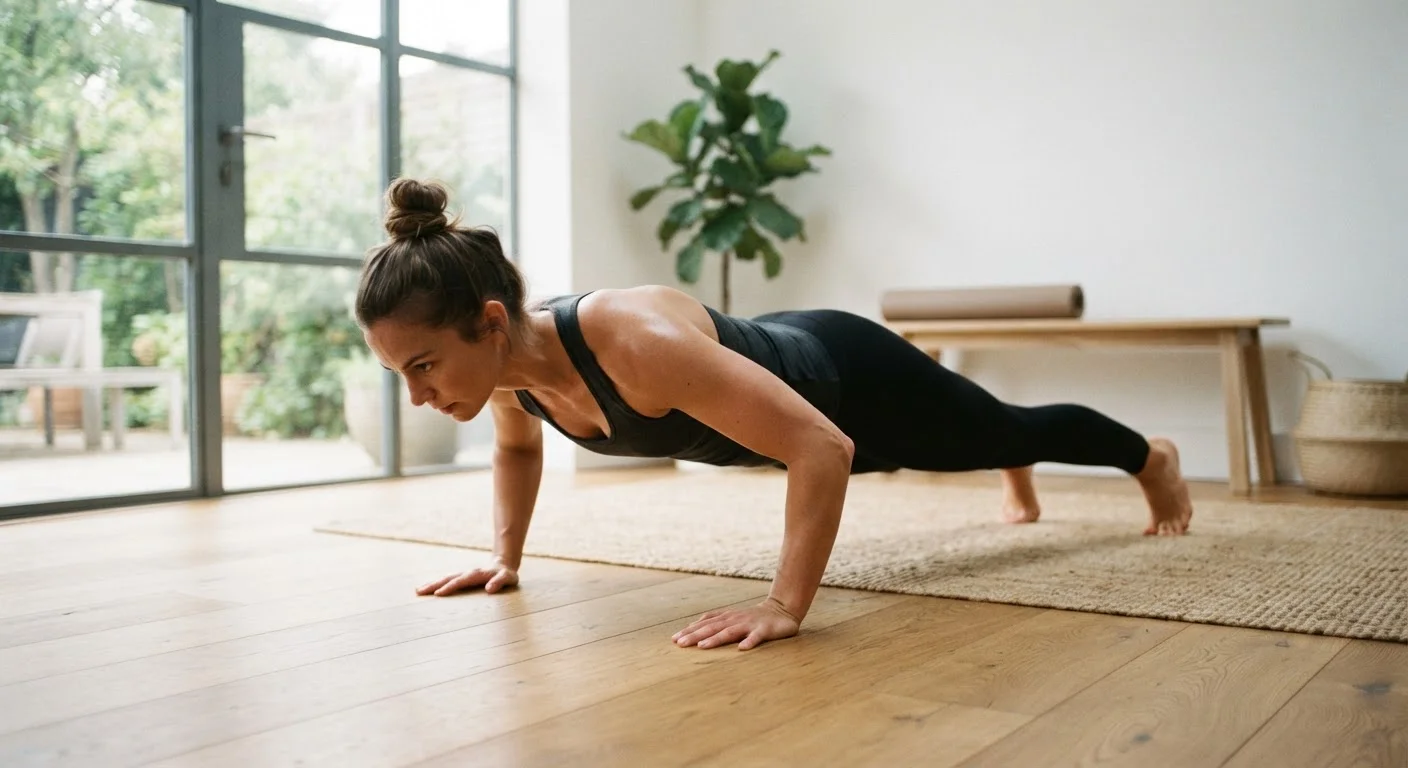
One complete execution of an exercise - for example, lowering and returning to the starting position in a push-up counts as one rep.
Tempo
The speed at which each phase of a movement is performed. Slowing the lowering phase (eccentric) of an exercise is a common way to increase difficulty without changing the exercise itself.
Isometric Hold
A static contraction where the muscle is engaged without visible joint movement - as in a plank or hollow body hold. Useful for building strength and body awareness at a specific point in a movement.
Unilateral Training
Exercises performed one limb at a time, such as a single-leg squat or single-arm row. Unilateral work can expose and address strength imbalances between sides of the body.
Core Movements and How to Progress Them
Bodyweight training is organized around a small set of movement patterns. Mastering these patterns - and knowing how to make them harder or easier - is the key to long-term progress.
| Equipment needed | None required; a pull-up bar expands pull pattern options |
| Minimum effective frequency | 2 full-body sessions per week for general fitness maintenance (U.S. Department of Health & Human Services Physical Activity Guidelines) |
| Primary movement patterns | Push, pull, squat, hinge, core |
| Most commonly skipped pattern | Pull (horizontal and vertical rowing movements) |
| Beginner progression approach | Increase reps and form quality before moving to harder variations |
| Recovery between sessions | Typically 48 hours before training the same muscle groups again |
Push Pattern
Foundational move: Push-up. Begin with wall or incline push-ups if floor push-ups are not yet accessible. Progress toward decline push-ups, archer push-ups, or eventually the planche progression.
Pull Pattern
Foundational move: Bodyweight row (using a low bar or sturdy table edge). Progress to assisted pull-ups, full pull-ups, and eventually weighted or single-arm variations. Pull training is the pattern most people underemphasize relative to pushing.
Squat Pattern
Foundational move: Bodyweight squat. Regress to box squats or assisted squats; progress to Bulgarian split squats, jump squats, or pistol (single-leg) squat progressions.
Hinge Pattern
Foundational move: Hip hinge drill (standing, folding at the hips with a neutral spine). Progress to single-leg Romanian deadlift variations using no additional load.
Core and Carry
Foundational moves: Dead bug, hollow body hold, plank. Progress by adding movement - bear crawls, ab wheel rollouts - rather than simply extending hold time indefinitely.
The principle behind all of these progressions is progressive overload: systematically increasing difficulty so the body continues to adapt. Learn how that principle applies across all strength training in our guide on progressive overload in effective strength programs.
Structuring a Realistic Routine
Frequency, volume, and recovery are the three levers of any bodyweight program. Most general fitness guidelines suggest adults aim for at least two days of muscle-strengthening activity per week, in addition to aerobic movement - a target achievable with bodyweight work alone.
A simple full-body structure: choose one exercise per major pattern (push, pull, squat, hinge, core), perform 2-4 sets, and allow 48 hours of recovery before repeating. Split routines - upper body one day, lower body the next - work well as training frequency increases.
Before jumping in, it helps to assess your starting point honestly. Our personal readiness checklist walks through physical, scheduling, and safety considerations worth reviewing first.
Consistency over intensity is the recurring theme among experienced practitioners. Pairing a manageable routine with good everyday nutrition habits supports recovery and sustained energy.
This article is for general informational and educational purposes only and does not constitute medical or fitness advice. Speak with a qualified healthcare or fitness professional before starting a new exercise routine, particularly if you have an existing health condition, injury, or are pregnant.