

Key Takeaways
- Starting with just three to four planned dinners per week is more sustainable than planning every meal.
- A balanced plate-protein, vegetables, and a whole grain-covers most nutritional bases without requiring calorie counting.
- Batch-cooking two or three versatile ingredients on one day dramatically reduces weeknight effort.
- Built-in flex nights prevent the routine from collapsing when real life intervenes.
- Shopping from a list tied to your plan reduces both food waste and impulse spending.
Start here
Why Meal Planning Works - and Why Most People Quit
Next
Setting Up Your First Weekly Plan
Then
Balancing Nutrition Without Overcomplicating It
When you're ready
Managing Prep Time Realistically
Finally
Building in Flexibility So the Routine Survives
Why Meal Planning Works - and Why Most People Quit
Meal planning has genuine evidence behind it: research consistently links home cooking and structured eating patterns with better diet quality and lower rates of obesity-related conditions. The problem isn't the concept - it's that most beginner approaches are too ambitious from day one.
People tend to quit because they try to plan every meal, every day, for a household with different preferences, on a schedule that leaves little time to cook. One disruption - a late meeting, a sick kid, unexpected leftovers - and the whole plan feels broken. The fix isn't more willpower; it's designing a system with failure points already accounted for.
Think of meal planning less as a rigid schedule and more as a decision-reduction tool. Its real value is eliminating the nightly scramble of figuring out what to eat, which often ends in expensive takeout or nutritionally thin convenience food. Even a partial plan delivers most of that benefit. For a deeper look at why consistency matters more than perfection, the principles behind sustainable eating habits are worth understanding before you build your routine.
Setting Up Your First Weekly Plan
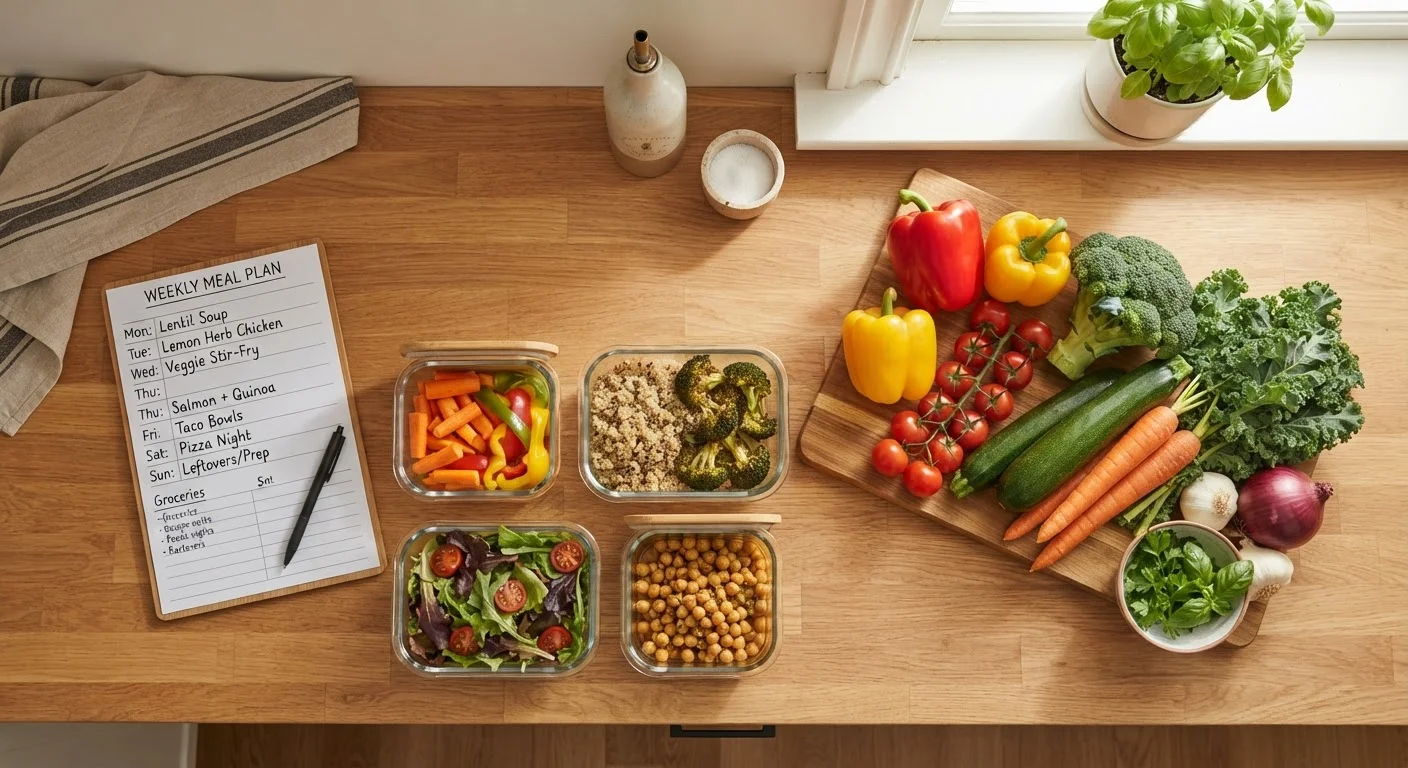
A workable first plan covers three to four dinners. That's it. Lunch and breakfast can follow once the habit is established. Here's a simple framework:
- Choose a planning day. Sunday is common, but any consistent day works. Spend ten to fifteen minutes reviewing the coming week.
- Audit what you already have. Check your pantry, freezer, and fridge before writing anything down. Building meals around existing ingredients reduces waste and cost.
- Pick meals by effort level. Assign one or two quick meals (under 20 minutes), one batch-friendly meal, and one slightly more involved recipe. Matching complexity to the realistic energy you'll have on a given night prevents the plan from failing on a busy Tuesday.
- Write a shopping list from the plan. A list tied directly to what you'll cook is the most effective way to shop intentionally. The weekly grocery walkthrough offers a useful department-by-department approach to stocking your kitchen with nutritious staples.
Batch cooking
Preparing larger quantities of one or more ingredients in a single cooking session so they can be used across multiple meals during the week.
Whole grain
A grain that contains all three parts of the kernel - bran, germ, and endosperm - providing more fiber and nutrients than refined grains. Examples include brown rice, oats, and whole wheat.
Macronutrients
The three main nutrient categories the body needs in relatively large amounts: carbohydrates, proteins, and fats. Each plays a distinct role in energy and body function.
Flex night
A planned evening within a meal routine that is intentionally left unstructured, allowing for takeout, leftovers, or simple improvised meals without disrupting the overall plan.
Food waste
Edible food that is discarded, often because it was purchased without a specific use in mind and spoiled before being cooked.
Registered dietitian (RD)
A nutrition professional with formal credentials and clinical training who can provide personalized dietary guidance, particularly for managing health conditions.
Balancing Nutrition Without Overcomplicating It
You don't need to be a nutritionist to build balanced meals. A practical guiding principle used by many dietitians: fill half your plate with vegetables, one quarter with a lean protein source, and one quarter with a whole grain or starchy vegetable. This loose framework covers fiber, micronutrients, and satiety without requiring tracking apps or calorie math.
A few principles worth keeping in mind:
- Variety over perfection. Eating a range of vegetables, proteins, and grains across the week naturally covers more nutritional ground than eating the same 'healthy' meal repeatedly.
- Don't eliminate entire food groups without guidance. Restrictive approaches that cut out whole categories of food often backfire and can create nutritional gaps - particularly for certain populations. Anyone considering significant dietary changes should consult a registered dietitian.
- Vegetables are the highest-leverage change most Americans can make. If your current meals skew toward refined grains and processed proteins, simply adding more vegetables - without removing anything - tends to improve diet quality measurably. The strategies for eating more vegetables without overhauling your diet offer low-friction ways to make this shift.
The 'Protein + Vegetable + Grain' Default
When in doubt about whether a meal is nutritionally balanced, use this simple three-part check: does it include a protein source, at least one vegetable, and a whole grain or starchy vegetable? You don't need precise portions - just the presence of all three. This mental shortcut works across almost any cuisine and takes seconds to apply.
Managing Prep Time Realistically
The biggest obstacle to sustained meal planning isn't motivation - it's time. Batch cooking is the most effective structural fix, but it doesn't require a full Sunday afternoon in the kitchen.
A minimal batch approach: pick one grain (brown rice, quinoa, farro) and one protein (roasted chicken thighs, a pot of legumes, hard-boiled eggs) and cook larger quantities once. These components mix into different meals across three or four days - a grain bowl one night, a quick stir-fry the next, a protein added to a salad for lunch.
A few time-saving habits that hold up in practice:
- Pre-wash and chop vegetables on prep day so weeknight assembly is fast.
- Keep a small rotation of five to eight reliable recipes your household already enjoys - novelty is the enemy of efficiency when you're tired.
- Use simple sheet-pan or one-pot meals as your weeknight defaults to minimize cleanup.
If stress around daily decisions is affecting more than just dinner, building a broader daily stress-management routine can complement the structure you're creating around food.
Building in Flexibility So the Routine Survives
A meal plan that can't absorb disruption will fail. The solution is to treat flexibility as a design feature, not a fallback.
Practically, this means:
- Designating one or two flex nights per week - evenings where takeout, simple eggs and toast, or leftovers are the intended plan, not a deviation from it.
- Keeping a small stock of no-plan meals: pantry staples (canned beans, pasta, canned tomatoes) that can become dinner in fifteen minutes with no planning required.
- Adjusting the plan mid-week without declaring failure. If Wednesday's planned meal shifts to Friday, that's the system working, not breaking.
Over time, the goal is to build enough of a rhythm that planning feels automatic - a ten-minute habit rather than a project. That's the point where meal planning genuinely supports long-term health rather than just adding another item to a to-do list. The science of sustainable eating habits explores why flexible, non-rigid approaches to nutrition consistently outperform stricter systems over months and years.
Meal planning also pairs well with broader household routines. If you're working on financial habits alongside your health goals, budgeting basics can help you align your grocery spending with a realistic household budget.
This article is for general informational and educational purposes only and does not constitute medical or dietary advice. Individual nutritional needs vary. Consult a registered dietitian or qualified healthcare professional before making significant changes to your diet, particularly if you have a medical condition or specific health concerns.