

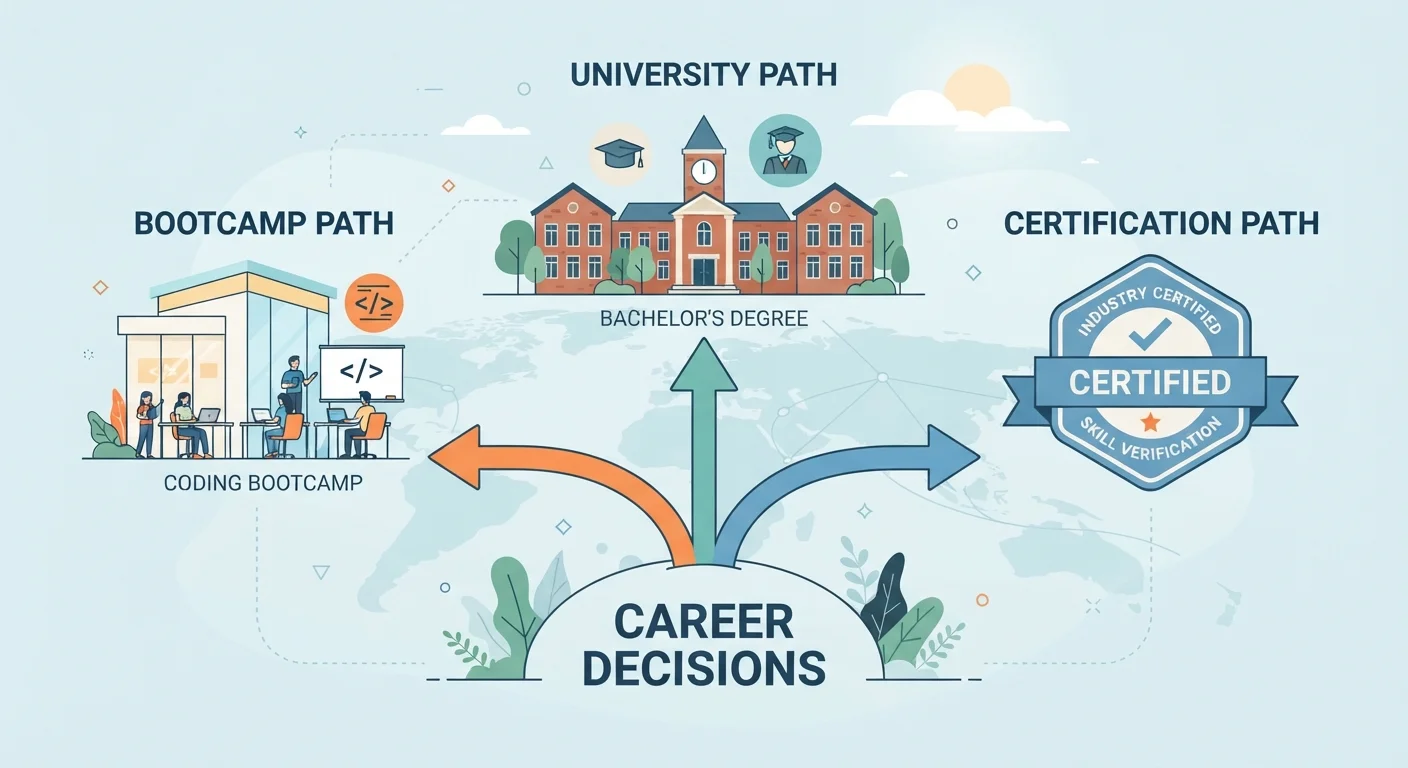
Key Takeaways
- Degrees offer the broadest credential recognition but carry the highest cost and longest time commitment.
- Bootcamps deliver focused, job-ready skills quickly, but quality and employer recognition vary widely.
- Certifications are most valuable in fields where industry bodies set clear, recognized standards.
- Your field, career stage, and financial situation all shape which route offers the strongest return.
- No single pathway suits every learner - honest self-assessment matters more than credential prestige.
Our Verdict
Each credential pathway serves a different learner profile and career context. Degrees remain the most widely recognized signal in credential-sensitive fields, while bootcamps offer speed to employment in skill-intensive roles. Certifications punch above their weight in industries with established standards bodies. The right choice depends on your timeline, target field, and financial capacity - not on which option sounds most impressive.
| Best for | Recommended |
|---|---|
| Those entering regulated or credential-dependent professions | Degree |
| Career changers seeking rapid, job-focused skill development | Bootcamp |
| Working professionals validating or updating technical expertise | Certification |
| Those building credentials incrementally over time | Stackable Certifications |
What Each Pathway Actually Delivers
Before comparing these routes head-to-head, it helps to understand what each one is designed to do - because they were built with very different goals in mind.
Degrees (associate, bachelor's, or graduate) are awarded by accredited colleges and universities. They signal broad academic preparation, critical thinking, and discipline-specific knowledge developed over one to four or more years. Accreditation - the process by which regional or national bodies verify an institution's quality standards - is what gives a degree its transferable credibility across most employers and industries.
Bootcamps are intensive, short-form training programs, typically running eight to twenty-four weeks. They originated in software development and have since expanded into data analytics, cybersecurity, UX design, and digital marketing. Their central promise is focused, applied skill-building aimed directly at entry-level employment. Unlike degrees, most bootcamps are not regionally accredited, though a small number have pursued state licensing or national accreditation.
Certifications are credentials awarded by professional or industry bodies after a candidate passes a standardized assessment. Well-known examples exist in IT, project management, accounting, and healthcare. Unlike degrees or bootcamps, certifications typically require renewal and continuing education, keeping holders current with evolving standards.
For a broader picture of how these fit within the online education landscape, see The Complete Map of Online Learning.
Key Differences: Cost, Time, and Recognition
These three dimensions - cost, time investment, and how broadly the credential is recognized - are where the pathways diverge most sharply.
| Degree | Bootcamp | Certification | |
|---|---|---|---|
| Typical duration | 2-4+ years | 8-24 weeks | Weeks to months (self-paced) |
| Estimated cost range | $10,000-$100,000+ | $5,000-$20,000 | $200-$5,000 |
| Accreditation status | Regionally accredited | Usually not accredited | Industry body recognized |
| Breadth of knowledge | Broad, theoretical & applied | Narrow, applied | Specific competency |
| Employer recognition | Widely recognized | Varies by employer/field | Strong in specific industries |
| Renewal required | No (degree is permanent) | No | Often yes, on a cycle |
| Financial aid eligibility | Federal aid available | Limited; varies by program | Employer-sponsored common |
Cost ranges are general estimates and vary significantly by institution, program type, location, and funding source. Federal financial aid applies to accredited degree programs; bootcamps and certifications generally rely on personal funds, employer tuition benefits, or income-share agreements (where the learner repays a portion of future earnings). Always verify specific program costs and funding options directly with the provider.
Recognition matters differently depending on your target industry. Some employers in technology, for example, weigh demonstrated skills heavily regardless of credential type. Others - particularly in law, medicine, engineering, and education - have statutory or regulatory requirements that only an accredited degree satisfies. See Fields Where Structured Learning Paths Have the Clearest ROI for a field-by-field breakdown.
How to Match the Pathway to Your Situation
The most important variable isn't the credential itself - it's the fit between the credential and your specific circumstances.
Consider a degree if:
- Your target profession has a licensing requirement tied to an accredited degree (teaching, nursing, engineering, law).
- You are early in your career and want the broadest range of future options, including graduate school.
- You have access to financial aid, scholarships, or employer tuition assistance that substantially reduces out-of-pocket cost.
Consider a bootcamp if:
- You need to change careers or build new technical skills within a defined, short timeline.
- You have researched the program's job placement rates and verified those claims independently - not just from the provider's marketing materials.
- The skills being taught are directly applicable to roles you are actively pursuing.
Consider a certification if:
- You are already working in a field and need to validate or upgrade a specific competency for a promotion or contract requirement.
- The certification is issued by a recognized industry body with established employer credibility in your sector.
- You want a credential you can build on incrementally. For more on that approach, see Credentials That Actually Travel.
Stack Your Credentials Strategically
You don't have to choose just one pathway for your entire career. Many working professionals begin with a degree, then add industry certifications as their specialization deepens. Others complete a bootcamp to enter a field and later pursue a part-time degree to widen their options. Thinking of credentials as a portfolio - built over time - is often more realistic and financially manageable than treating each choice as permanent.
If you're weighing a self-directed approach against any of these structured options, Self-Directed vs. Institution-Led Learning Paths offers research-grounded perspective on that trade-off.
Before You Commit: Questions Worth Asking
Whatever route you are leaning toward, the evaluation process before enrolling is as important as the choice of pathway itself. Key questions include:
- Is the program accredited or recognized by a relevant body? For degrees, look for regional accreditation. For certifications, verify the issuing body's standing in your target industry. For bootcamps, check state licensing and any third-party audits of outcomes data.
- What do graduates actually do? Outcome data - employment rates, salary ranges, time to employment - should be specific, independently verifiable, and recent. Generic testimonials are not a substitute for audited statistics.
- What are the full costs? Include tuition, materials, fees, and opportunity cost (income foregone while studying). A shorter program with higher tuition is not automatically cheaper than a longer one with aid.
- Does your employer or target employer recognize this credential? When possible, talk to hiring managers or HR professionals in your target field before enrolling.
Our Pre-Course Checklist for Evaluating Any Learning Program walks through this process in detail. You may also want to review Online vs. In-Person Learning Trade-Offs if the delivery format is part of your decision.