

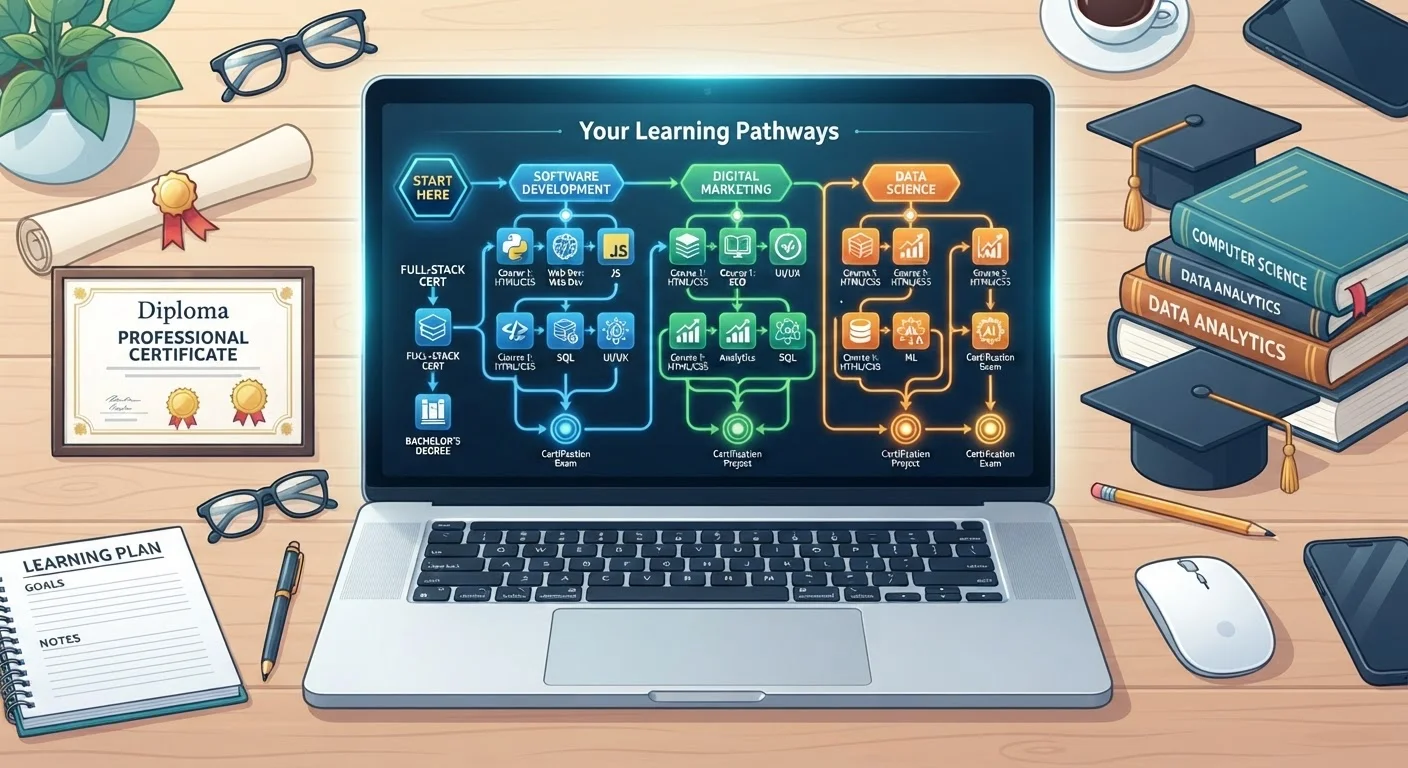
Key Takeaways
- Online learning spans a wide spectrum-from free single courses to fully accredited degrees that transfer to employers.
- Certificates and professional credentials typically take weeks to months and signal job-ready skills in specific fields.
- Accreditation is the most important quality marker when choosing an online degree program.
- Your learning goal-skill-building, career change, or credential attainment-should drive format selection, not price alone.
- Many online programs allow stackable credentials, letting you build toward a full degree incrementally.
The Online Learning Landscape at a Glance
Online education is no longer a single-lane road. It now spans a rich spectrum of formats, timelines, costs, and outcomes-from a free weekend course on a MOOC platform to a fully accredited master's degree delivered entirely over video and discussion boards. Understanding that spectrum is the essential first step to making a purposeful choice.
At the broadest level, online learning falls into three tiers: informal learning (single courses, tutorials, self-paced modules), credentialed learning (certificates, professional credentials, and bootcamps), and degree-bearing learning (accredited associate, bachelor's, and graduate programs). Each tier differs in time commitment, cost, academic rigor, and how employers and institutions recognize the credential. See our online learning glossary for clear definitions of terms like MOOC, LMS, and cohort model if any of this vocabulary is new to you.
7.3M+
US students enrolled in online courses
National Center for Education Statistics data shows millions of postsecondary students take at least one online course each academic year.
~$0-$50K
Cost range across online learning formats
Individual MOOC audits can be free, while fully online accredited degrees at some private universities approach traditional tuition levels.
4-52 weeks
Typical certificate program duration
Provider and professional certificates range from a few weeks to a full year, depending on subject depth and examination requirements.
Single Courses and MOOCs
A Massive Open Online Course (MOOC) is a single-subject course delivered through a digital platform, often taught by university faculty or industry practitioners. Platforms in this space typically offer courses in text, video, and quiz formats with optional peer interaction. Many are free to audit; a verified certificate of completion usually carries a modest fee.
Single courses are ideal when your goal is skill exploration, continuing education in a familiar field, or rapid upskilling on a specific tool or concept. They are not, on their own, academic credentials. However, many employers do recognize them as evidence of initiative and current knowledge, particularly in technology and data-related fields.
If you are entirely new to this environment, our first-timer's orientation to online education covers what to expect from a digital classroom before you enroll.
Audit a course before paying for the certificate. Most MOOC platforms allow free access to video content-use that window to assess the instructor's teaching style and your genuine interest in the material before committing funds.
Completion rates for online courses are notoriously low. Validating fit before spending reduces dropout risk and wasted expense.
When evaluating a certificate, search the issuing credential on LinkedIn to see how many professionals in your target field actually hold it. Real-world adoption is a stronger signal than marketing claims.
Credential value is partly social-how widely recognized it is among hiring managers in your specific industry matters more than the platform's stated prestige.
Certificates and Professional Credentials
One tier above the individual course sits the certificate-a structured sequence of courses or modules that culminates in a recognized credential. These range from provider-issued certificates (completed through a single platform) to industry-recognized certifications governed by professional bodies (such as those in project management, IT, or accounting).
Timelines vary: a provider certificate might take four to twelve weeks at a few hours per week, while a professional certification requiring an external exam can take several months of preparation. Costs range widely, from roughly $50 for a platform certificate to several hundred dollars for a proctored industry exam.
Key distinctions to understand:
- Provider certificates carry the brand weight of the issuing institution or platform. Their value is largely market-driven.
- Industry certifications (e.g., CompTIA, PMI, CPA-track certificates) are governed by professional bodies and often required for certain roles by employers.
- Academic certificates issued by accredited colleges signal credit-bearing coursework that may transfer toward a degree.
For learners mapping out a structured progression, explore learning paths in education and professional development to see how certificates can stack into broader credentials.
Online Degrees: Associate Through Graduate
Fully online degree programs now exist at every academic level and are offered by regionally accredited colleges and universities across the United States. The format-whether synchronous (live sessions at set times) or asynchronous (self-paced within weekly deadlines)-varies by institution and program.
- Associate degrees (two years, ~60 credits) provide foundational credentials and often transfer to four-year institutions.
- Bachelor's degrees (four years, ~120 credits) remain the most common baseline credential for professional employment in many fields.
- Master's and doctoral programs are increasingly delivered online, including MBAs, MEd programs, and select professional doctorates.
Tuition for online degrees varies considerably by institution type (public vs. private, in-state vs. out-of-state) and program. Many public universities offer online tuition at a flat rate regardless of residency, which can lower costs significantly for out-of-state learners.
For broader context on navigating higher education choices, our school and college tips hub offers practical guidance on enrollment, financial aid, and campus decisions.
Choosing the Right Pathway for Your Goals
The most common mistake online learners make is selecting a format based on price or availability rather than intended outcome. A clearer framework: start with your end goal, then work backward to the minimum credential that achieves it.
Ask yourself three questions before enrolling:
- What does my target employer or institution actually require? Some roles require accredited degrees; others accept certificates or demonstrated portfolios.
- How much time can I realistically commit? Online learning demands self-discipline. An intensive certificate may require 10-15 hours per week; a degree program closer to 20-25.
- Does this credential stack? Stackable credentials-where a certificate can count toward a degree later-maximize the return on your time and tuition investment.
Think in Stackable Steps
If you are unsure whether a full degree is the right move, look for programs that offer stackable credentials. Starting with a certificate from an accredited institution means your coursework may count toward a degree later-so you gain a credential quickly while keeping your longer-term options open. Ask any institution explicitly whether certificate credits apply to their degree programs before enrolling.
Accreditation, Quality, and What to Verify
Accreditation is the process by which an independent agency evaluates whether an institution meets established educational standards. In the US, regional accreditation (awarded by bodies such as HLC, SACSCOC, or NECHE) is the most widely respected form and is required for federal financial aid eligibility and for credits to transfer between institutions.
National accreditation exists but is less universally accepted; credits from nationally accredited schools often do not transfer to regionally accredited institutions. Before enrolling in any degree program, verify its accreditation status through the US Department of Education's Database of Accredited Postsecondary Institutions and Programs (DAPIP).
For certificates and professional credentials, verify the issuing body's standing within the relevant industry. A certification from a recognized professional association carries more weight than one from an unaffiliated commercial provider, regardless of how the marketing presents it.
Verify Accreditation Before You Enroll
Enrolling in an unaccredited or improperly accredited program can mean your degree is not recognized by employers, graduate schools, or professional licensing boards. Credits may also be non-transferable. Always confirm accreditation through the official US Department of Education database (DAPIP) or the Council for Higher Education Accreditation (CHEA) directory-not solely through the institution's own website.
This article provides general educational information only and does not constitute personalized academic or career counseling advice. Readers should verify program details, accreditation status, and financial aid eligibility directly with institutions before enrolling.