

Key Takeaways
- Stackable certifications are structured so each credential builds directly on the previous one.
- Learners can pause, apply skills in the workforce, and return to continue their credential pathway.
- Credit portability varies significantly between institutions and programs - verify articulation agreements before enrolling.
- Employer recognition depends heavily on the field and the issuing body's reputation.
- Stackable pathways are most clearly defined in technical, healthcare, and information technology fields.
Stackable Certifications
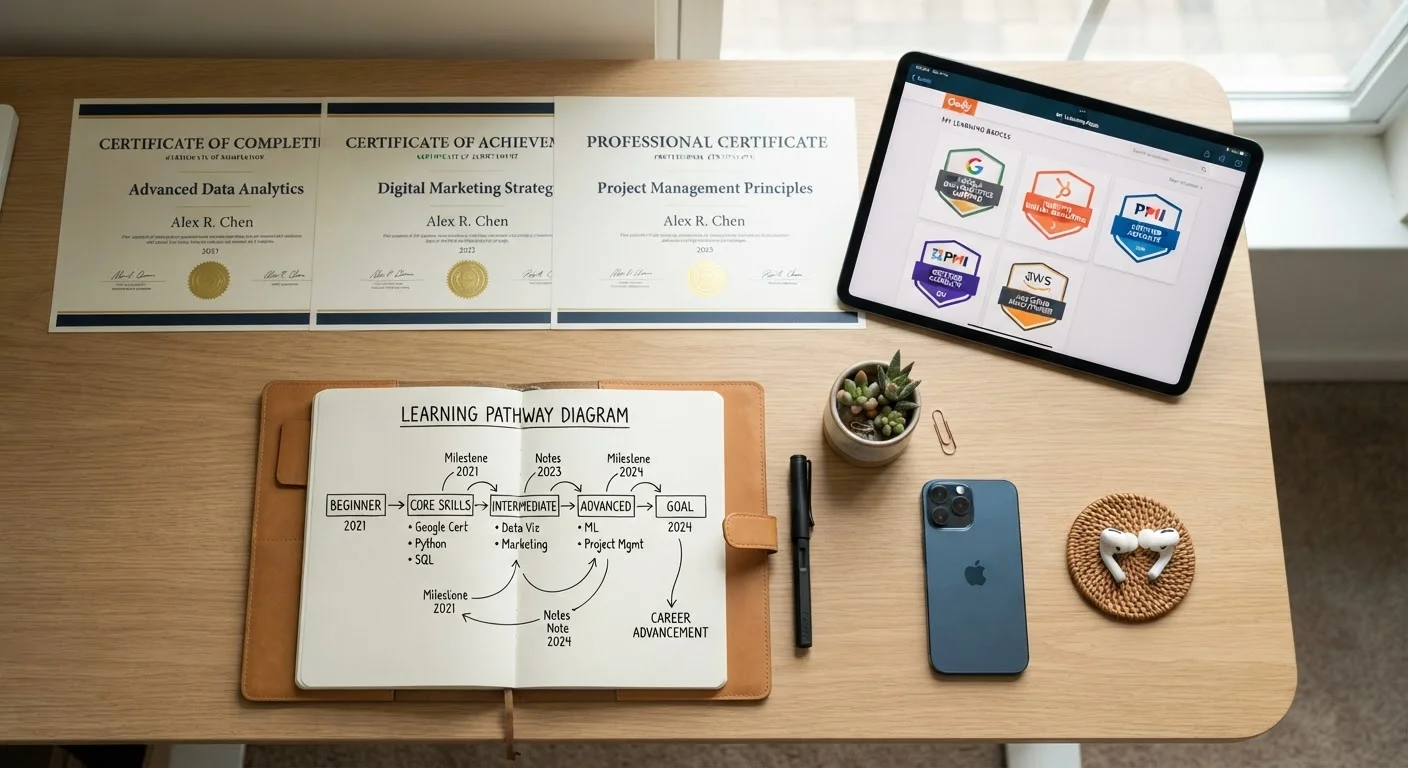
Stackable certifications are a series of credentials designed to build on one another, allowing learners to earn smaller qualifications that accumulate over time toward a larger credential, degree, or career goal. Each certificate represents a distinct, recognized level of skill, and completing one creates a foundation for the next. The approach lets learners enter or re-enter education incrementally, rather than committing to a full degree program upfront.
In formal education frameworks, stackable credentials are often articulated through credit-transfer agreements, meaning credits earned at one level may apply toward a higher-level program at a participating institution.
How Stackable Certifications Work
The defining feature of a stackable certification system is intentional sequencing. Programs are designed so that an entry-level certificate provides genuine, job-relevant skills - but also maps clearly onto the next credential in the series. Think of it as a structured ladder rather than a single long climb.
A typical pathway might begin with a foundational certificate covering core concepts, follow with an intermediate credential that adds technical depth, and progress to an advanced certificate or associate degree. At each stage, the learner can step into the workforce, then return to continue building when the time is right.
This design addresses one of the most common barriers to continuing education: the all-or-nothing commitment of a traditional degree. Stackable pathways acknowledge that adults have jobs, families, and financial constraints that make multi-year programs difficult to sustain.
Accreditation Matters for Transfer and Recognition
Not all certificate programs are accredited, and accreditation type affects both employer recognition and academic transfer eligibility. Regional accreditation is generally the most widely accepted standard for academic credit transfer in the US. National accreditation and industry-body accreditation serve different purposes and may not transfer to regionally accredited degree programs. Always check which accreditation a program holds before enrolling.
For a broader look at how certifications compare to other credential types, see our breakdown of degree, bootcamp, and certification pathways.
Portability: What It Means for Your Credential
The word "stackable" implies portability - the idea that your credential travels with you and builds toward something larger. But portability has two distinct dimensions that learners should understand before enrolling.
Labor market portability refers to whether employers in your field recognize and value the credential. This is strongest in industries with established credentialing standards, such as information technology, nursing support roles, construction trades, and early childhood education.
Academic portability refers to whether credits can transfer toward a higher qualification at a college or university. This depends entirely on articulation agreements - formal arrangements between the issuing institution and degree-granting schools. These agreements vary widely, so it is worth confirming transfer policies directly with any institution you are considering.
~40%
US adults with some college but no degree
The National Student Clearinghouse Research Center has documented that roughly 40 million US adults have completed some college coursework without earning a degree, a population that stackable pathways are specifically designed to re-engage.
1-3 years
Typical time to complete a full stackable pathway
Depending on field and pace of study, learners moving through an entry-to-advanced stackable sequence generally complete the full pathway within one to three years, compared to four years or more for a traditional bachelor's degree.
47 states
States with formal stackable credential frameworks
According to the Education Commission of the States, the vast majority of US states have developed or are developing formal stackable credential frameworks, though the depth and consistency of these systems varies significantly by state.
Understanding which credential types carry weight in a given sector is equally important. Our article on certificates, micro-credentials, and digital badges explains the distinctions clearly.
Where Stackable Pathways Are Most Well-Defined
Not every industry has developed clear, recognized stackable pathways. In some fields, credential ladders are formalized and widely understood by employers; in others, the landscape is more fragmented.
Fields with relatively well-defined stackable structures include:
- Healthcare support roles - pathways from certified nursing assistant (CNA) to licensed practical nurse (LPN) to registered nurse (RN) are documented and widely recognized.
- Information technology - vendor-neutral and vendor-specific certifications often build explicitly on one another, with clear progressions in networking, cybersecurity, and cloud computing.
- Skilled trades and manufacturing - apprenticeship and certificate systems in fields like electrical work and HVAC follow structured progressions tied to licensing requirements.
- Early childhood education - many states have tiered credential systems that connect directly to degree programs at community colleges.
For a closer look at which fields offer the most predictable credential-to-career outcomes, see our coverage of fields where structured learning paths have the clearest ROI.
Making the Most of a Stackable Pathway
Choosing to pursue a stackable pathway requires the same due diligence as any educational investment. A few practical considerations help learners get genuine value from the approach.
Verify accreditation before enrolling. Credentials from regionally accredited institutions or recognized industry bodies carry more weight with employers and are more likely to transfer academically. An unaccredited certificate may teach real skills but may not be recognized beyond the program itself.
Map the full pathway before starting. Knowing where the entry-level credential leads - and what the requirements are for each subsequent step - helps you make an informed decision about whether the full ladder aligns with your career goals.
Talk to employers in your target field. Hiring managers and professional associations can tell you which credentials they actually look for, which is more reliable than assuming recognition based on program marketing.
Stackable certifications complement the broader practice of layering competencies over time. Our article on skill stacking and professional growth explores that concept in depth. It is also worth reviewing common myths about online credentials to separate fact from assumption before making any enrollment decisions.