

| Typical passenger car PSI range | 32-36 PSI (Vehicle door jamb sticker is the authoritative source) |
| When to check pressure | Cold tires - parked 3+ hours |
| TPMS alert threshold | 25% below recommended PSI (U.S. TPMS federal requirement) |
| Recommended check frequency | Once per month |
| Pressure location on vehicle | Driver's door jamb sticker (Not the tire sidewall maximum) |
Tire Pressure: The Numbers You Need
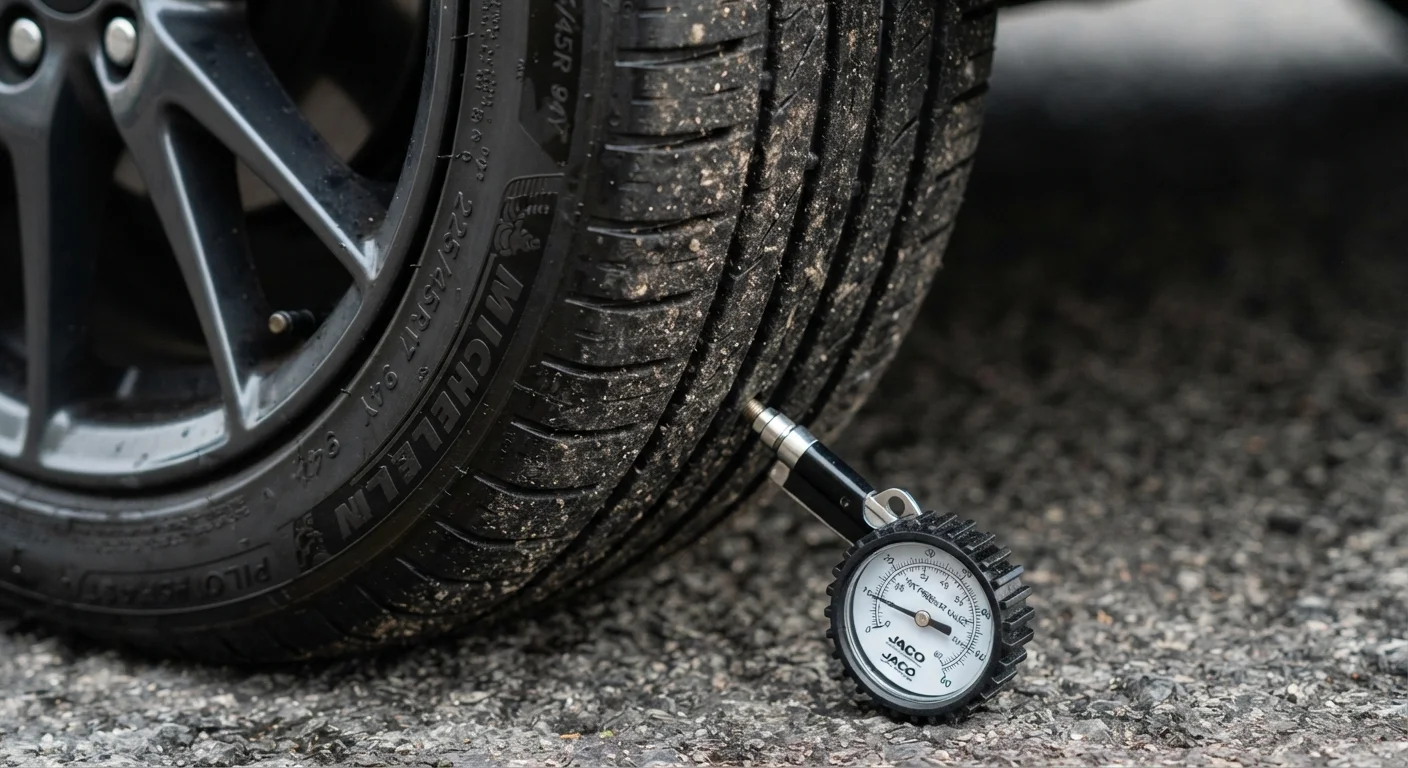
Correct tire pressure is one of the most important - and most overlooked - aspects of vehicle maintenance. Driving on under-inflated tires increases rolling resistance, reduces fuel economy, causes uneven wear, and can contribute to blowouts at highway speeds.
| Typical passenger car PSI range | 32-36 PSI (Vehicle door jamb sticker is the authoritative source) |
| When to check pressure | Cold tires - parked 3+ hours |
| TPMS alert threshold | 25% below recommended PSI (U.S. TPMS federal requirement) |
| Recommended check frequency | Once per month |
| Pressure location on vehicle | Driver's door jamb sticker (Not the tire sidewall maximum) |
Your vehicle's recommended tire pressure is printed on a sticker inside the driver's door jamb (or sometimes the fuel door or glovebox). This is your target - not the maximum pressure molded into the tire sidewall, which is a structural limit, not a driving recommendation. Most passenger vehicles fall in the 32-36 PSI range, though trucks and SUVs often run higher.
Check pressure when tires are cold - meaning the car has been parked for at least three hours, or driven fewer than a mile. Driving warms the air inside tires and temporarily raises PSI readings by 4-8 points. For hands-on inspection guidance, see how to check your own tire tread and pressure safely.
Most tire pressure monitoring systems (TPMS) alert drivers when pressure drops 25% or more below the recommended level - but that threshold is well past the point where fuel economy and handling have already degraded. Monthly manual checks remain the most reliable habit.
Tread Depth: Reading the Warning Signs
Tire tread channels water away from the contact patch, maintaining grip on wet roads. As tread wears down, stopping distances increase and hydroplaning risk rises significantly.
2/32"
Legal minimum tread depth (most U.S. states)
Below this threshold, tires fail most state safety inspections.
4/32"
Recommended replacement threshold for wet conditions
Wet-road stopping distances increase noticeably before the legal minimum is reached.
5,000-7,500 mi
Typical tire rotation interval
Consult your owner's manual for the manufacturer's specific recommendation.
The legal minimum tread depth in most U.S. states is 2/32 of an inch. However, many tire safety experts recommend replacing tires at 4/32 inch, particularly if you drive in rain or snow regularly - wet-road performance deteriorates measurably before the legal limit is reached.
A quick field check: insert a quarter into a tread groove with Washington's head pointing down. If you can see the top of his head, tread is at or below 4/32 inch. The penny test (Lincoln's head visible) signals you're at the 2/32 legal threshold. Built-in tread wear indicators - small rubber bars running across the grooves - become flush with the surface at 2/32 inch.
Inspect tread across the full width of each tire, not just the center. Wear concentrated on one edge typically signals an alignment or inflation issue, not just normal aging. For a deeper look at when tire condition becomes a safety concern, tire safety and when to replace provides a useful reference.
PSI (pounds per square inch)
The unit used to measure tire inflation pressure in the U.S. Your vehicle's recommended PSI is found on the door jamb sticker, not the tire sidewall.
TPMS (Tire Pressure Monitoring System)
A federally mandated sensor system on vehicles sold in the U.S. after 2007 that alerts the driver when one or more tires drops significantly below recommended pressure.
Tread wear indicator
Raised rubber bars molded into the tire's grooves that become flush with the tread surface at 2/32 inch, signaling the legal wear limit has been reached.
Hydroplaning
When a layer of water builds up between the tire and road surface faster than it can be displaced, causing a loss of traction and steering control.
Directional tire
A tire with a tread pattern optimized to rotate in one direction only, indicated by an arrow on the sidewall. These tires can only be rotated front-to-back on the same side of the vehicle.
Cold inflation pressure
Tire pressure measured after the vehicle has been parked for at least three hours or driven less than one mile. This is the standard for accurate PSI readings.
Rotation Intervals and Patterns
Rotating tires moves each one to a different position on the vehicle at set intervals, evening out wear patterns. Front tires on front-wheel-drive vehicles carry the engine load and handle steering, so they wear faster than rears. Without rotation, you'd replace two tires at a time instead of all four.
The general recommendation is rotation every 5,000-7,500 miles, though your owner's manual is the authoritative source. Many drivers time rotation with oil changes - a practical habit if your oil change interval aligns. For a broader look at how tire rotation fits into your full service schedule, see your car's maintenance schedule explained.
Common rotation patterns include:
- Forward cross - front tires move straight back; rear tires cross to the opposite front. Common on front-wheel-drive vehicles.
- Rearward cross - rear tires move straight forward; front tires cross to the opposite rear. Typical for rear- and all-wheel-drive vehicles.
- X-pattern - all four tires cross diagonally. Used when wear is uneven.
Directional tires (with a tread pattern designed to rotate one way) can only move front-to-back on the same side. Staggered fitments - where rear tires are wider than fronts - may not be rotatable at all without dismounting and remounting tires on different wheels. Check your tire sidewall or owner's manual if you're unsure which applies to your vehicle.
Keeping tires properly inflated, monitoring tread depth regularly, and rotating on schedule are foundational habits that reduce ownership costs and improve safety. They also connect directly to other systems: car maintenance from the ground up covers how tires fit into your vehicle's broader upkeep picture.