

Key Takeaways
- A maintenance log creates a verifiable paper trail that can protect your warranty and support resale value.
- Mechanics can diagnose problems faster and more accurately when they have a complete service history.
- Digital apps and simple spreadsheets both work - consistency matters more than the format.
- Missing or incomplete records can complicate warranty claims and reduce buyer confidence at resale.
- Logging DIY work carries the same value as shop receipts, provided details are thorough.
Supports warranty claims with documented proof
Manufacturers can deny warranty coverage if required maintenance wasn't performed on schedule. A log with dated, mileage-stamped entries provides a defensible record if a claim is ever challenged.
Speeds up mechanic diagnosis
A complete service history lets a technician quickly identify patterns - such as recurring issues or overdue services - reducing diagnostic time and the guesswork that drives up labor costs.
Strengthens resale value and buyer confidence
Private buyers and dealers alike pay more attention to vehicles with documented histories. A thorough log signals that the car was cared for, which can justify a higher asking price.
Helps owners track upcoming service needs
When you can see the last transmission fluid change was 40,000 miles ago, scheduling the next one becomes straightforward rather than a matter of guessing or relying on memory.
Validates DIY work as legitimate maintenance
Self-performed services are perfectly valid when properly documented with parts specs, quantities, and dates - giving them the same informational value as professional shop receipts.
Requires consistent effort to be useful
A log with significant gaps can raise more red flags than having no log at all. Maintaining it reliably demands a habit that many owners start but don't sustain.
Past history may be permanently unavailable
For used vehicles or owners who didn't start logging early, there's no way to reconstruct missing records accurately, leaving the early ownership period undocumented.
Doesn't guarantee quality, only occurrence
A log entry confirms that a service happened but says nothing about whether it was done correctly or with appropriate parts - which is a real limitation when evaluating a vehicle's true condition.
Learning curve for what to include
New owners often log only the most obvious tasks and miss others - like differential fluid changes or cabin air filter replacements - that are equally important to a complete history.
Our Verdict
Keeping a maintenance log is a low-effort habit with outsized long-term benefits. It costs nothing but a few minutes per service visit, yet it strengthens your warranty position, gives mechanics a diagnostic shortcut, and adds measurable credibility when you sell. The main downsides - time, discipline, and incomplete past records - are minor compared to the risks of operating without any documented history.
Any car owner who plans to keep their vehicle for more than two years, tackle DIY maintenance, or eventually sell privately will benefit most from maintaining a thorough service log.
What a Maintenance Log Actually Is
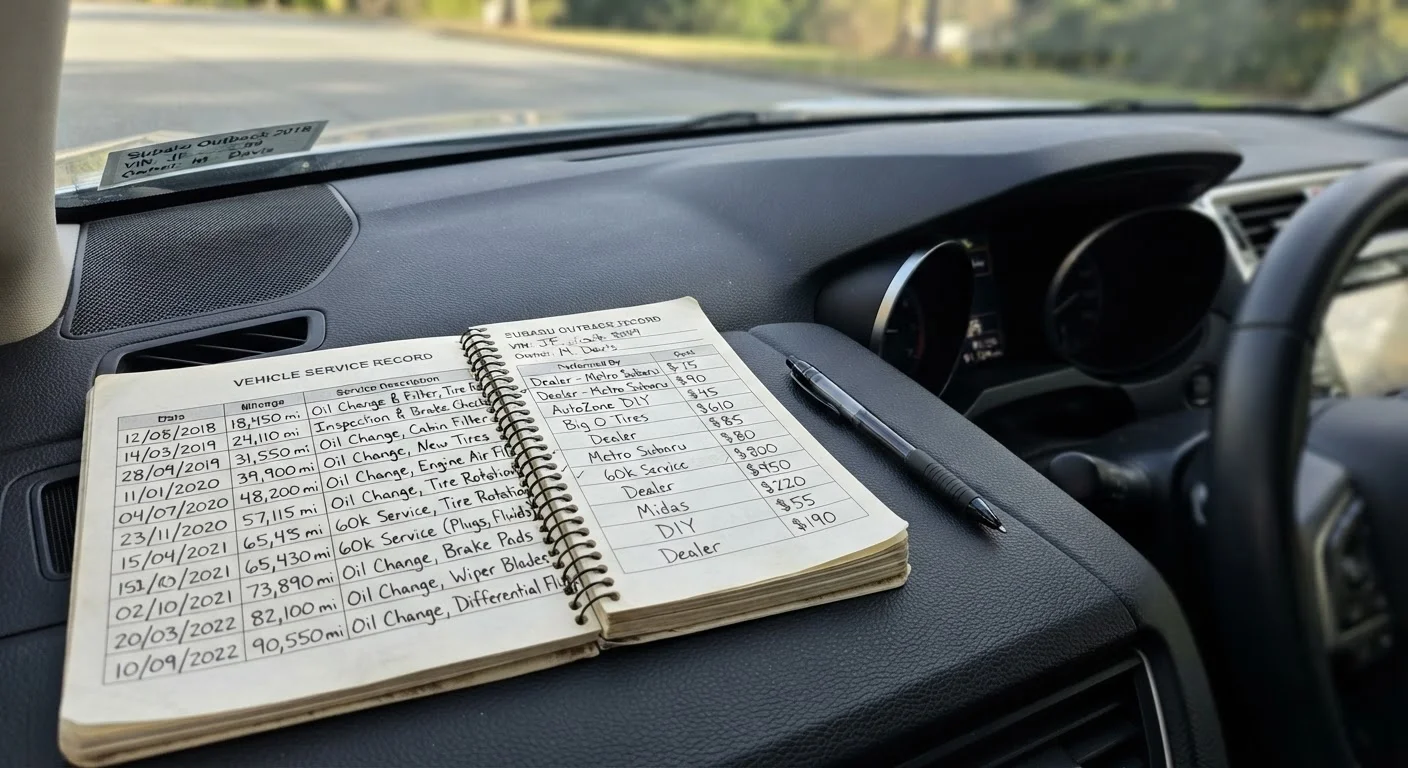
A vehicle maintenance log is a running record of every service event your car has gone through - oil changes, tire rotations, brake inspections, fluid top-ups, filter replacements, and any repairs. It captures the date, mileage at the time, work performed, parts used, and who did the work (you, a shop, or a dealership).
The format is flexible. Some owners keep a small notebook in the glove compartment. Others use a spreadsheet, a dedicated app, or scan and store shop receipts digitally. What matters is that the record is complete, consistent, and accessible. Part of the broader framework covered in comprehensive car maintenance, a service log ties every individual task into a coherent ownership history.
The Real Advantages of Keeping Records
The benefits of a well-maintained log extend well beyond personal organization.
Supports warranty claims with documented proof
Manufacturers can deny warranty coverage if required maintenance wasn't performed on schedule. A log with dated, mileage-stamped entries provides a defensible record if a claim is ever challenged.
Speeds up mechanic diagnosis
A complete service history lets a technician quickly identify patterns - such as recurring issues or overdue services - reducing diagnostic time and the guesswork that drives up labor costs.
Strengthens resale value and buyer confidence
Private buyers and dealers alike pay more attention to vehicles with documented histories. A thorough log signals that the car was cared for, which can justify a higher asking price.
Helps owners track upcoming service needs
When you can see the last transmission fluid change was 40,000 miles ago, scheduling the next one becomes straightforward rather than a matter of guessing or relying on memory.
Validates DIY work as legitimate maintenance
Self-performed services are perfectly valid when properly documented with parts specs, quantities, and dates - giving them the same informational value as professional shop receipts.
~$500-$1,500
Potential resale premium for documented service history
Industry estimates from used vehicle appraisers suggest well-documented service histories can support meaningfully higher asking prices in private-party sales, though exact figures vary by vehicle age and market.
30%+
Diagnostic time potentially saved with full service history
Automotive service advisors commonly note that access to a vehicle's complete maintenance history can significantly reduce time spent identifying the root cause of recurring or complex issues.
When a mechanic can see that your coolant was last flushed 60,000 miles ago or that a noise started after a specific repair, diagnostic time drops significantly. That efficiency can translate to lower labor charges. Similarly, brake wear and deferred service issues are far easier to catch when a technician can see the interval history at a glance rather than guessing.
At resale, a documented service record is one of the few things a private seller can offer that directly influences buyer confidence - and potentially the final price. From a warranty standpoint, manufacturers generally require that maintenance be performed at specified intervals; a log helps demonstrate compliance if a claim is ever disputed.
Where a Maintenance Log Falls Short
No system is without drawbacks, and a maintenance log is no exception.
Requires consistent effort to be useful
A log with significant gaps can raise more red flags than having no log at all. Maintaining it reliably demands a habit that many owners start but don't sustain.
Past history may be permanently unavailable
For used vehicles or owners who didn't start logging early, there's no way to reconstruct missing records accurately, leaving the early ownership period undocumented.
Doesn't guarantee quality, only occurrence
A log entry confirms that a service happened but says nothing about whether it was done correctly or with appropriate parts - which is a real limitation when evaluating a vehicle's true condition.
Learning curve for what to include
New owners often log only the most obvious tasks and miss others - like differential fluid changes or cabin air filter replacements - that are equally important to a complete history.
The most common failure point is consistency. A log kept sporadically - missing six months here, a major service there - can actually create confusion rather than clarity. Gaps raise questions a buyer or mechanic will want answered. There's also a learning curve to knowing what to record: some owners log only oil changes and miss transmission services or cabin air filter replacements that matter just as much. For those who've owned a vehicle for years without keeping records, starting mid-ownership means the early history is simply gone.
It's also worth noting that a log, by itself, doesn't prove quality workmanship - only that service occurred. Whether decisions like DIY work versus shop visits are recorded correctly is entirely the owner's responsibility.
How to Build a Log That Actually Holds Up
Effective logs share a few common traits. Record every service event within a day or two of it happening - memory fades quickly. Include mileage, not just dates, since manufacturers typically define service intervals by miles driven. For DIY work, note the brand and specification of any parts or fluids used; this matters if a warranty question ever arises.
What to Include for DIY Services
When logging work you performed yourself, record the product name, specification (such as oil viscosity or filter part number), quantity used, mileage, and date. This level of detail matters most if a parts-related warranty question ever comes up. Keep any receipts from auto parts stores alongside your log as supporting documentation.
If you're starting from scratch on an older vehicle, request service records from your mechanic or dealership - many shops retain digital histories. Pair your log habit with awareness of broader car ownership costs: knowing what you've already spent on maintenance helps you plan for what's coming next. Avoid the common maintenance myths that lead owners to skip services they believe are unnecessary.