

Key Takeaways
- Brake wear is gradual and easy to ignore until warning signs become impossible to miss.
- Deferred brake service routinely turns a $200-$300 pad replacement into a $600-$900 rotor job.
- Driving habits, terrain, and vehicle weight all affect how quickly brake components wear.
- A qualified mechanic should inspect brakes at least once a year or every 12,000 miles.
Why Brakes Are the Maintenance Item Drivers Put Off
Brakes don't announce their decline on a fixed schedule. Unlike an oil change reminder on your dashboard, brake wear is gradual, largely hidden behind your wheel, and easy to rationalize away. A squeak heard once gets dismissed as road noise. A slightly longer stopping distance goes unnoticed because it creeps up slowly. This is why brake maintenance sits near the top of the list of deferred repairs - not because drivers don't care about safety, but because the feedback loop is subtle until it isn't.
The financial logic compounds the problem. When nothing feels dramatically wrong, spending $250 on brake service feels optional. But when metal-on-metal grinding finally forces the issue, that number frequently climbs past $700 once rotor replacement and labor are factored in. Understanding why this cycle happens is the first step to breaking it. For a broader look at how deferred service accumulates into larger repair bills, see why skipping routine maintenance is often the most expensive decision.
$300-$700+
Typical cost jump from pad-only to rotor replacement
Industry repair data consistently shows that delaying pad replacement until rotor damage occurs roughly doubles or triples the total service cost.
25-70%
Variation in brake pad lifespan by driving style
Automotive engineers note that aggressive urban driving can shorten pad life by more than half compared with steady highway use on the same vehicle.
The Most Common Brake Maintenance Mistakes
These are the errors that consistently turn manageable brake wear into costly repairs - and, in serious cases, safety hazards.
Dismissing brake squealing as temporary or environmental.
Why it happens: Brakes do sometimes squeal briefly in damp or cold conditions, which trains drivers to tune out the sound as normal.
Skipping brake inspections because no warning light is on.
Why it happens: Many drivers treat the dashboard as their primary maintenance signal, but most vehicles only trigger a brake warning light when pad wear is already severe or hydraulic pressure has dropped.
Assuming brake service follows a universal mileage interval.
Why it happens: Drivers often apply a single rule - "brakes last 50,000 miles" - without accounting for how driving style, load, terrain, and vehicle weight dramatically change that figure.
Ignoring brake pedal feel changes until the problem becomes obvious.
Why it happens: A pedal that pulses, sinks slightly lower, or requires more pressure to stop develops gradually, making it easy to normalize the change over weeks or months.
Delaying service because the vehicle "stops fine."
Why it happens: Stopping distance increases incrementally as pads wear, so the vehicle continues to feel functional right up until hardware contact begins.
What Deferred Brake Service Actually Costs
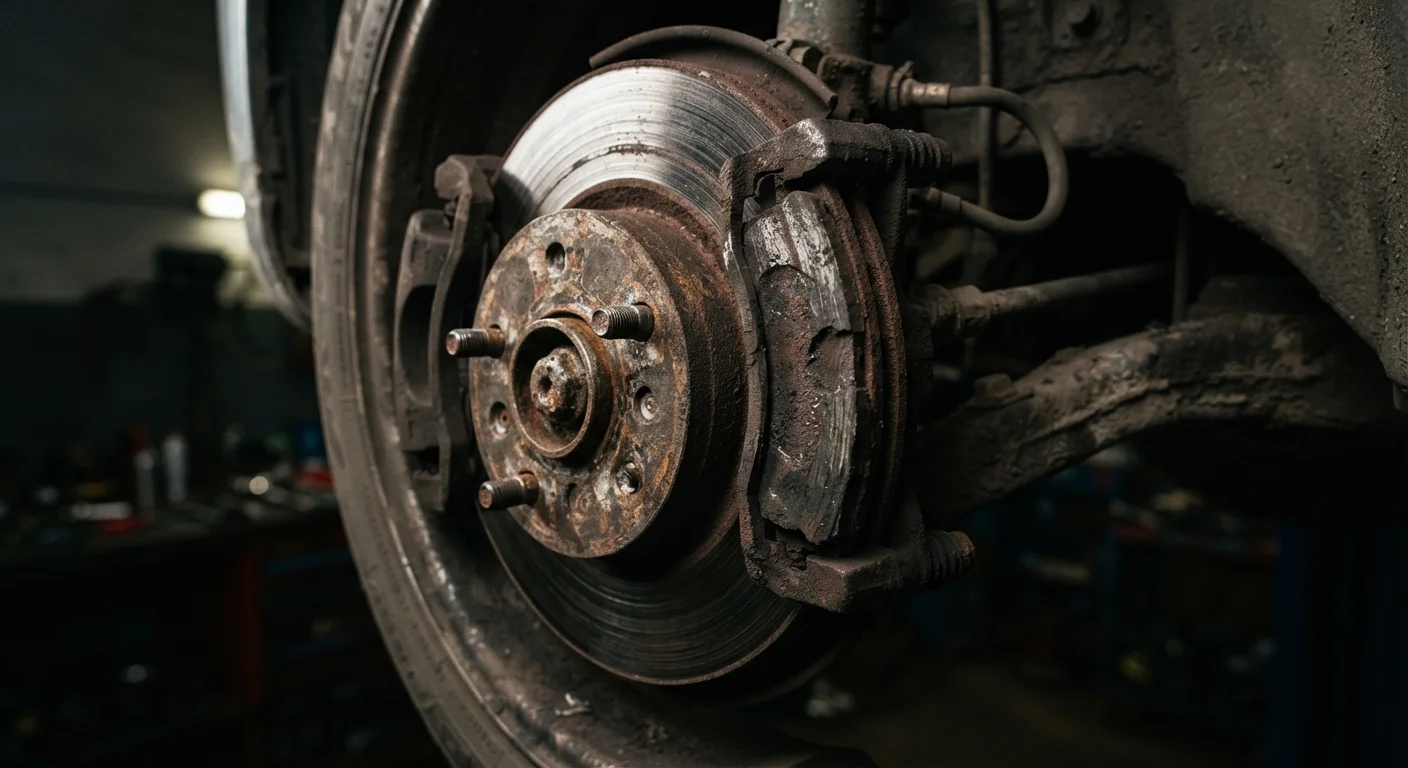
Brake pads are wear items designed to be replaced before they reach metal backing plates. When that replacement is postponed, the hardened steel backer contacts the rotor - a much more expensive part. Rotors that could have lasted another full pad cycle now need to be resurfaced or replaced entirely. In many cases, both front rotors and pads need replacement simultaneously, which can push a repair into four-figure territory.
Beyond the direct cost, neglected brakes raise safety questions that affect everyone in the vehicle. Stopping distances increase measurably as pad material wears down. Brake fade - where heat-saturated pads lose friction - becomes more likely under heavy braking. Neither condition shows up as a dashboard warning until hardware is involved.
Grinding Noise Means Act Now
Metal-on-metal grinding while braking is not a "monitor and wait" situation. At this stage, brake pads have worn through completely and rotor damage is actively occurring with every stop. Continuing to drive risks further damage to calipers and, in severe cases, compromised braking ability. Have the vehicle inspected by a qualified mechanic as soon as possible.
Staying ahead of brake wear is also a matter of documentation. A consistent service history protects resale value and can simplify warranty claims. Our guide to keeping a maintenance log explains how a simple record protects your investment over time. For a full-system view of what your vehicle needs and when, Car Maintenance from the Ground Up is a useful starting point.