

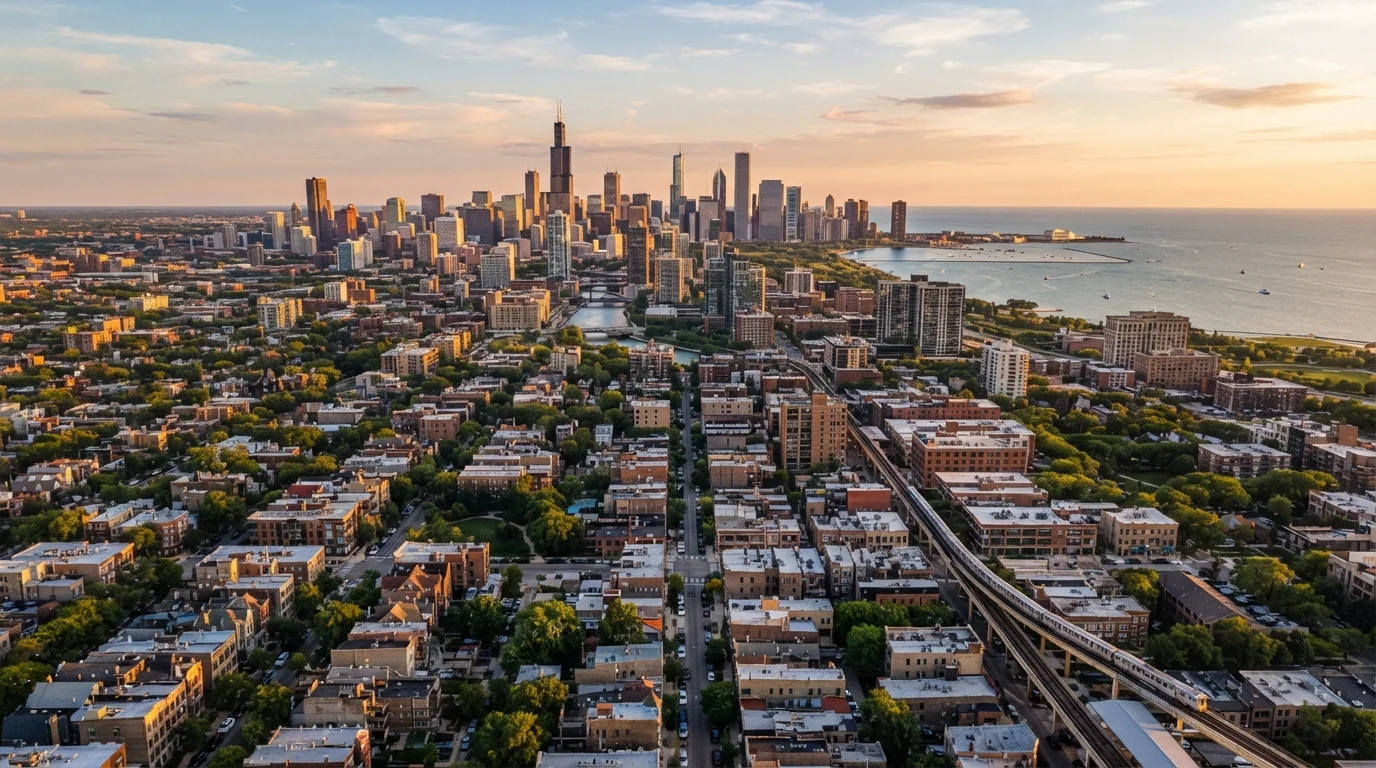
How Chicago's Neighborhoods Are Organized
Chicago is officially divided into 77 community areas, though locals and visitors typically navigate the city through a smaller set of well-known neighborhood names. The city follows a rough grid anchored by the Loop—downtown's central business core—with neighborhoods radiating north, south, and west along major arterials and the elevated rail system known as the 'L.'
Understanding a few geographic anchors helps orient any visit. The lakefront runs the full eastern edge of the city, providing green park space throughout. The North Side generally skews residential and is home to many visitor-friendly commercial strips. The South Side encompasses historic working-class and cultural communities with deep roots in African American and immigrant history. The West Side includes some of Chicago's most architecturally interesting and rapidly changing neighborhoods.
For travelers accustomed to tightly compact cities, Chicago's scale can be a surprise. Many neighborhoods are 20 to 40 minutes apart by public transit, so planning your itinerary around geographic clusters rather than individual attractions typically saves significant time.
North Side Neighborhoods at a Glance
Lincoln Park is one of the city's most visited North Side districts, known for the free Lincoln Park Zoo, the adjacent lakefront conservatory, and a dense concentration of restaurants and bars along Armitage and Halsted Streets. Housing in this area is among the city's most expensive.
Wicker Park and Bucktown sit adjacent to each other and share an identity built around independent boutiques, live music venues, and a long-running arts scene. The area has gentrified considerably over the past two decades but retains a visible creative energy. The Blue Line's Damen stop puts visitors squarely in the commercial center.
Andersonville, further north, is a smaller commercial strip with a strong Swedish heritage (now more symbolic than literal) and a well-established LGBTQ+ community presence. It's quieter than Wicker Park and often preferred by visitors looking for a neighborhood-feel dining experience.
Rogers Park, at the city's northern edge, is one of the most ethnically diverse ZIP codes in the United States and offers a more locally-oriented experience with relatively low prices and lakefront access at Loyola Beach.
Downtown, Near North, and the Lakefront Corridor
The Loop is Chicago's central business district and the nucleus of its public transit network. It contains Millennium Park—home to Cloud Gate (the 'Bean') and the Jay Pritzker Pavilion—as well as the Chicago Riverwalk, the Art Institute of Chicago, and a concentrated architectural streetscape that rewards walking. Most first-time visitors spend a significant portion of their trip here.
River North, just north of the Chicago River, is one of the densest concentrations of galleries, cocktail bars, and upscale restaurants in the Midwest. It adjoins the Magnificent Mile (Michigan Avenue's upper commercial stretch), which functions as Chicago's primary luxury retail and hotel corridor.
Streeterville and the Gold Coast flank the Mag Mile to the east and north, respectively, offering lakefront park access, historic mansion architecture, and quieter residential streets away from tourist traffic.
Lakefront Access Is Free and Extensive
Chicago's lakefront park system spans roughly 18 miles and is almost entirely open to the public at no cost. Most neighborhoods on the North and South sides are within a reasonable walk or short transit ride of a lakefront park, beach, or trail. This is worth factoring into your neighborhood selection when choosing where to base your visit — proximity to the lake meaningfully changes the feel of an area.
West Side and South Side: Culture, History, and Architecture
Pilsen, on the lower West Side, is the geographic and cultural center of Chicago's Mexican American community. It's also known for the National Museum of Mexican Art (free admission), murals covering exterior walls throughout the neighborhood, and a restaurant scene that ranges from family-run taquerias to contemporary spots. Pilsen has drawn significant attention from visitors interested in food culture and street art.
Bronzeville, on the South Side, was a hub of the Great Migration and a center of African American intellectual and artistic life in the early-to-mid 20th century. Landmarks include the Chicago Defender building and the Ida B. Wells historic home. The neighborhood is increasingly the focus of heritage tourism.
Hyde Park, further south, is home to the University of Chicago and the Museum of Science and Industry—one of the largest science museums in the Western Hemisphere. The neighborhood's bookstores, cafés, and architecture make it worth the 30-minute ride from downtown. It contrasts sharply with most tourist itineraries and rewards visitors willing to look beyond the North Side and Loop.
For travelers drawn to cities that reward genuine curiosity, Chicago's district-by-district complexity puts it in a category similar to destinations covered in our guide to undervisited American cities — places where the most memorable experiences happen off the primary tourist path. If you're also planning a major urban trip and want a point of comparison, our New York City first-timer's guide covers a similar neighborhood-oriented orientation for that city.