

Key Takeaways
- Power adapters and voltage converters are not the same thing — confusing them can damage your devices.
- Photocopies of your passport and key documents stored separately from originals can be invaluable if things go wrong.
- Local emergency numbers vary by country and are not always 911 — look them up before you land.
- Prescription medications need proper documentation to clear customs in many destinations.
- Notify your bank before departure to avoid having cards blocked abroad.
- A small amount of local currency on arrival prevents friction before you find an ATM.
The gaps most US travelers don't notice until it's too late
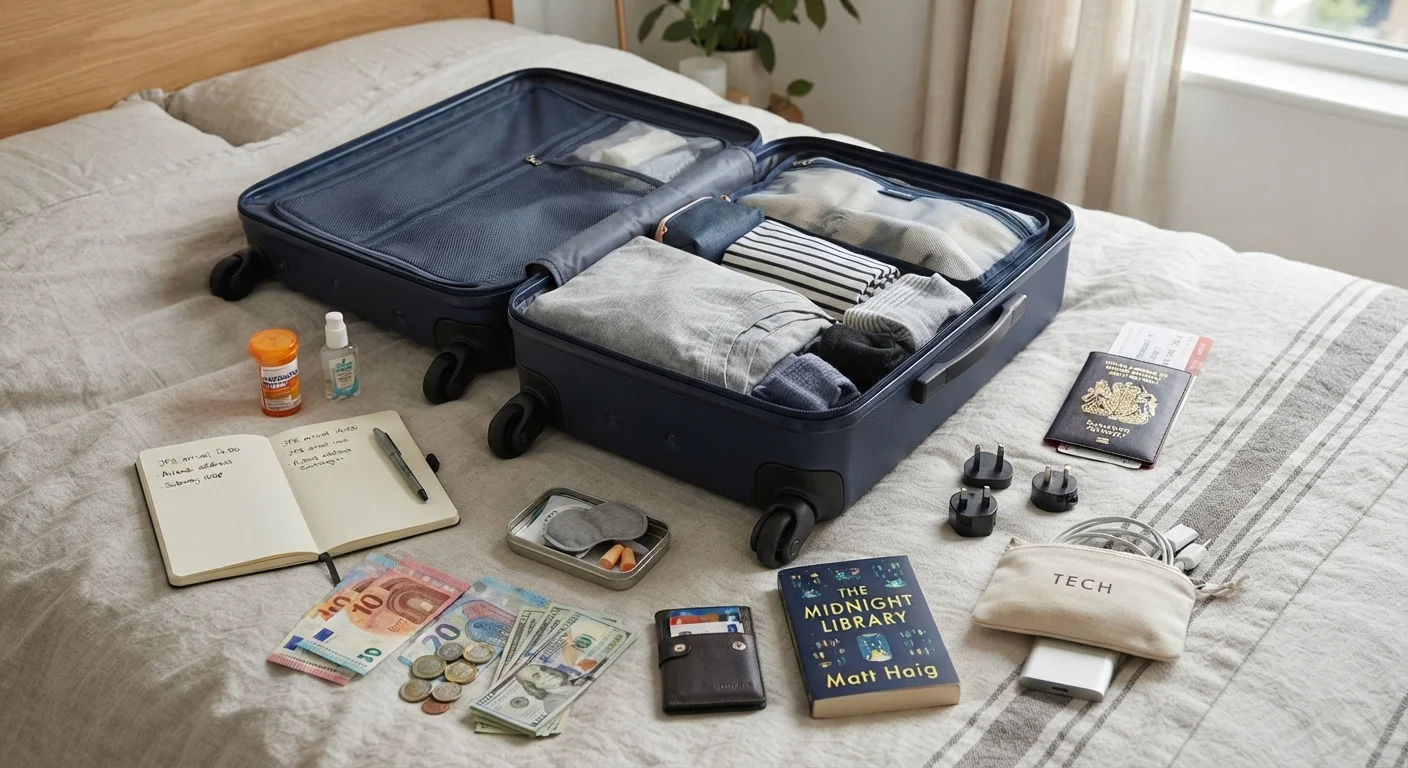
Americans traveling internationally for the first time — or even the fifth — tend to focus heavily on what to wear and what entertainment to pack, while quietly skipping a handful of logistics that have a reliable way of becoming urgent problems mid-trip. The oversights aren't exotic; they're mundane and entirely preventable. See our packing frameworks for different trip types for broader preparation strategies. Below are the most commonly missed essentials, with enough context to understand why each one matters.
The right power adapter — and knowing whether you need a converter too
The US uses Type A plugs and runs on 120V/60Hz. Much of Europe runs on 230V/50Hz with Types C, E, or F sockets; the UK uses Type G. An adapter changes the plug shape so it physically fits the socket — it does not change the voltage. Most modern electronics (laptops, phones, cameras) are dual-voltage, meaning they handle 100–240V automatically — check the fine print on the charger brick. But older or single-voltage devices like some hair dryers and electric shavers can be damaged or destroyed by European current without a voltage converter. Knowing the difference before you pack is essential.
An adapter changes plug shape — it does not protect single-voltage devices from foreign current.
Photocopies of your passport and key documents
Store physical copies of your passport photo page, visa, travel insurance policy, and emergency contacts in a separate bag from your originals. Also email scanned copies to yourself or save them in secure cloud storage. If your passport is lost or stolen abroad, a US embassy or consulate will typically require proof of identity and citizenship to issue an emergency travel document — having those copies dramatically speeds up the process. Some countries also require you to carry ID at all times; a certified copy can satisfy that requirement while your original stays in the hotel safe.
A lost passport is far less catastrophic when photocopies are stored separately from the original.
Local emergency numbers for your destination
911 is a US-specific number. In most of Europe the general emergency number is 112, but local police, ambulance, and fire lines differ by country — and in some destinations, 112 connects to a dispatcher who may not speak English fluently. Research the medical emergency number, police non-emergency line, and your destination's poison control equivalent before you land. Write them on a card that stays in your wallet. The US State Department also maintains 24-hour emergency lines for American citizens abroad — that number is worth saving too.
911 doesn't work internationally — research your destination's emergency numbers before you arrive.
Prescription medications with proper documentation
Many countries have strict rules about importing controlled substances, certain pain medications, and even some common prescriptions that are freely available in the US. Carry medications in their original labeled pharmacy bottles, bring a letter from your prescribing physician stating the diagnosis and dosage, and check the destination country's customs rules ahead of time. Some medications legal in the US are classified as controlled or even illegal in certain destinations. Running out mid-trip or having a medication confiscated at customs are scenarios that are straightforward to avoid with a small amount of advance research.
Note: This is general travel preparation information, not medical advice. Consult your healthcare provider before traveling with any prescription medication.
Some US prescriptions are controlled or prohibited in other countries — verify before you pack them.
A bank notification — and a backup payment method
US banks routinely flag international transactions as potentially fraudulent and freeze cards without warning. A quick call or in-app notification to your bank and credit card issuers before departure prevents this. Equally important: bring at least two payment methods stored separately. If one card is frozen, lost, or swallowed by a foreign ATM, having a backup in a different bag means the situation is an inconvenience rather than a crisis. Look for cards with no foreign transaction fees — a charge of 1–3% per transaction adds up quickly over a two-week trip.
A single card blocked abroad can halt a trip — always carry a backup stored separately.
A small amount of local currency before you land
Airport ATMs and currency exchange desks are available at most international airports, but they're not always reliable — machines run out of cash, queues are long, and fees at airport exchange counters tend to be high. Arriving with the equivalent of $50–$100 USD in local currency covers a taxi, transit fare, or a meal while you get oriented. For connectivity on arrival, see our guide on international phone plans, SIM cards, and eSIMs — some airports sell local SIM cards only at booths that require cash.
Arriving with some local currency avoids being stranded if airport ATMs are unavailable or out of cash.
A written itinerary and offline maps
Relying entirely on a live internet connection for navigation abroad is a common vulnerability. Roaming data can be unreliable, local SIM activation takes time, and free Wi-Fi is not always available when you need it most. Download offline maps of your destination city before departure — several mapping applications allow this. Also carry a printed or hand-written summary of hotel addresses, confirmation numbers, and day-by-day plans. Foreign hotel addresses written in the local script can be shown to drivers who don't read English. For broader planning gaps that create mid-trip problems, see overlooked planning details that cause real problems mid-trip.
Offline maps and a printed itinerary function when roaming data doesn't — always have both.
A little preparation goes a long way abroad
None of these oversights require significant effort to address — most take minutes at home and hours to resolve abroad. If you're still working through your pre-departure checklist, our international travel checklist for US citizens covers documents, health prep, and emergency contacts in detail. For entry-specific requirements that vary by destination, see entry requirements Americans should always verify before finalizing any international trip.
Build your packing list at least one week out
Leaving packing to the night before a departure almost guarantees something important gets left behind. Starting a running list a week in advance lets you add items as you think of them and gives you time to order anything you're missing. Cross-reference it against your destination's climate, voltage standards, and entry requirements before you close the suitcase.