

Key Takeaways
- Shifting your sleep schedule before departure meaningfully reduces jet lag severity on arrival.
- Hydration and movement during the flight protect both comfort and circulation health.
- Seat selection, lighting management, and meal timing are controllable variables most travelers ignore.
- Arriving prepared with the right carry-on essentials reduces mid-flight decision fatigue.
- Syncing to local time immediately upon arrival — including meal and sleep times — accelerates adjustment.
Why Long-Haul Flights Are a Different Category of Travel
A ten-hour flight isn't simply a longer version of a domestic hop. The physiological demands — sustained low humidity, cabin pressure equivalent to roughly 6,000–8,000 feet of altitude, time zone displacement, and restricted movement — compound across hours in ways that genuinely affect how you feel and function at your destination. For US travelers heading to Europe, East Asia, or southern Africa, understanding these mechanics is the starting point for managing them.
The good news: most of the variables are within your control. Seat selection, hydration, movement timing, light exposure, and pre-departure sleep shifting are all levers experienced travelers pull deliberately. Before you even think about the flight itself, make sure your broader pre-departure planning is solid — our international travel checklist for US citizens covers documents, health prep, and logistics that should be settled before you get to the airport.
10–20%
Typical cabin humidity on commercial aircraft
Compared to roughly 30–50% in most indoor environments, this dryness is a primary driver of in-flight fatigue and discomfort.
3–5 days
Average jet lag recovery time per direction
Travel medicine research suggests the body adjusts approximately one time zone per day, meaning a six-hour difference can take nearly a week to resolve without mitigation strategies.
8+ hours
Flight duration that meaningfully elevates DVT risk
The World Health Organization notes that prolonged immobility on flights longer than eight hours is associated with increased risk of blood clots in susceptible travelers.
Evidence-Informed Practices for the Flight Itself
Experienced international travelers don't wing it. The habits below represent what frequent long-haul fliers actually do — not aspirational advice, but practical routines that hold up across routes and itineraries.
Shift your sleep schedule two to three days before departure to align with your destination's time zone.
Circadian rhythm adjustment doesn't happen instantly — your body needs gradual cues. Moving bedtime and wake time earlier (for eastward flights) or later (for westward flights) by one to two hours daily primes your internal clock before you ever board. This reduces the severity and duration of jet lag on arrival.
Select your seat strategically based on your sleep priority and mobility needs.
Window seats offer a wall to lean against and control over the window shade — both meaningful for sleep quality. Aisle seats allow easier movement without disturbing neighbors, which matters on 12-plus hour flights. Bulkhead and exit-row seats offer legroom but sometimes lack underseat storage. Choosing before check-in, when inventory is widest, is almost always worth the effort.
Drink water consistently throughout the flight — roughly 8 ounces per hour of flying time as a general benchmark.
Cabin humidity on commercial aircraft typically runs between 10–20%, far drier than most indoor environments. Dehydration compounds fatigue, increases headache frequency, and makes jet lag symptoms feel worse. Alcohol and excessive caffeine accelerate fluid loss at altitude and are worth limiting on very long flights.
Get up and move deliberately every 90 minutes to two hours during the flight.
Prolonged immobility in a pressurized cabin raises the risk of deep vein thrombosis (DVT), particularly on flights longer than eight hours. Even brief aisle walks or standing stretches at the galley maintain circulation. Compression socks provide additional protection and are widely recommended by travel medicine practitioners for long-haul flights.
Manage light exposure deliberately to reinforce your target time zone.
Light is the most powerful external cue for circadian rhythm. Seeking bright light upon arrival in the morning destination time — and avoiding screens and bright overhead lights during what would be nighttime at your destination — accelerates clock adjustment. On the plane, use your window shade and eye mask accordingly.
Pack a dedicated comfort kit in your personal item — not checked luggage — with sleep and hygiene essentials.
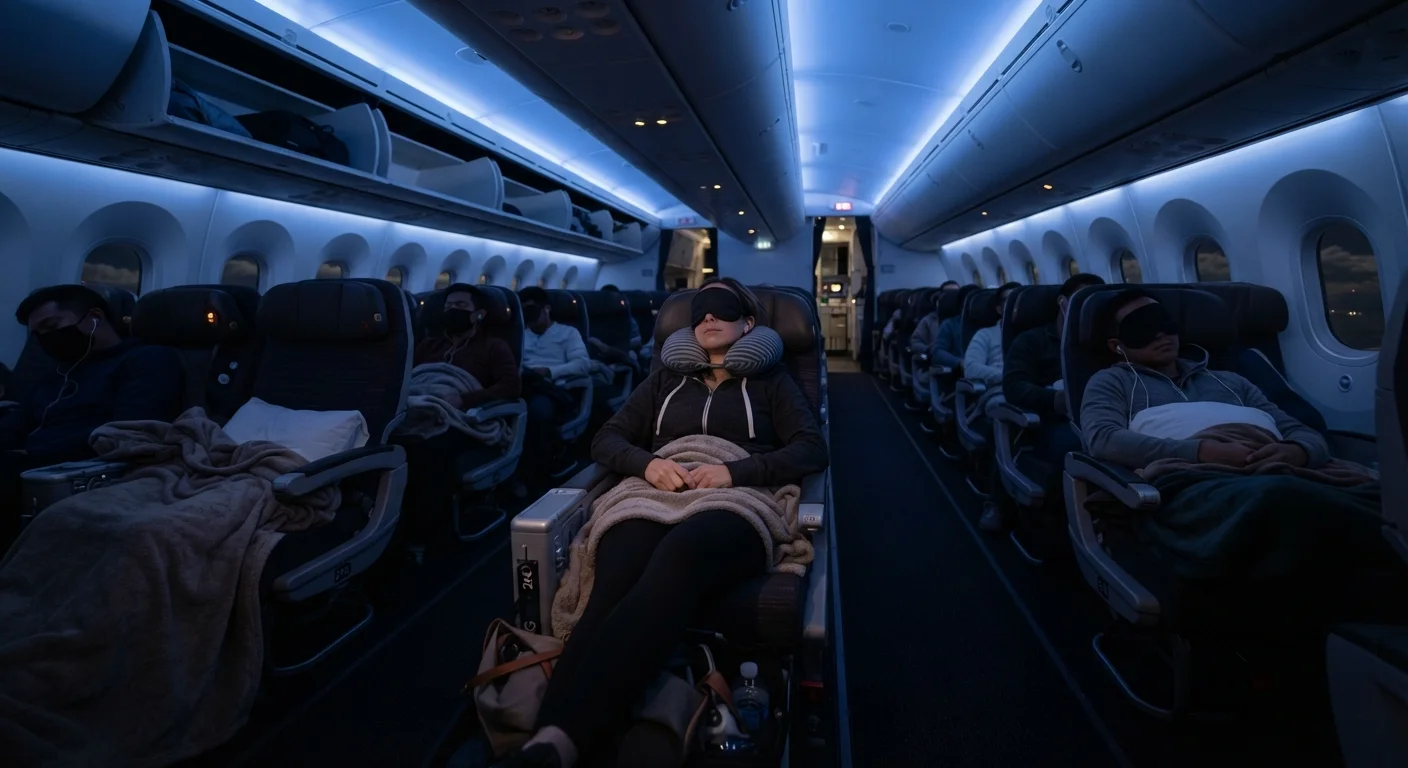
Long-haul comfort depends on items you can access without overhead bins: a quality neck pillow, earplugs or noise-canceling headphones, an eye mask, lip balm, a toothbrush, and a light layer for temperature changes. Packing these together in a small pouch eliminates the mid-flight scramble when the cabin dims and everyone wants the same thing at once.
Time Your In-Flight Meals to Your Destination
Airline meal timing is designed around departure airport schedules, not your destination's clock. If the cabin serves dinner during what would be 3 a.m. at your destination, eating a full meal works against circadian adjustment. Consider declining or eating lightly during misaligned service windows, and eating normally when the meal aligns with destination mealtimes.
Immediate Actions You Can Take Before Your Next Flight
You don't need to overhaul your travel approach all at once. Several of these practices can be adopted immediately, with meaningful payoff on your next international departure. The planning groundwork matters too — common oversights like misread connection times and documentation gaps tend to surface at the worst possible moments, and our article on overlooked planning details that cause real problems mid-trip is worth reviewing alongside your flight prep.
For what to bring on board, the packing strategies that hold up across different trip types offers frameworks that extend from domestic trips to multi-week international itineraries — including what belongs in your carry-on versus checked luggage.
A Note on Individual Health Differences
Long-haul flight physiology varies by age, health status, and underlying conditions. Travelers with cardiovascular concerns, clotting risk factors, or chronic conditions should consult a physician before flying for extended durations. This article provides general information, not medical advice. See our guide on traveling with medical conditions for deeper preparation guidance.