

Key Takeaways
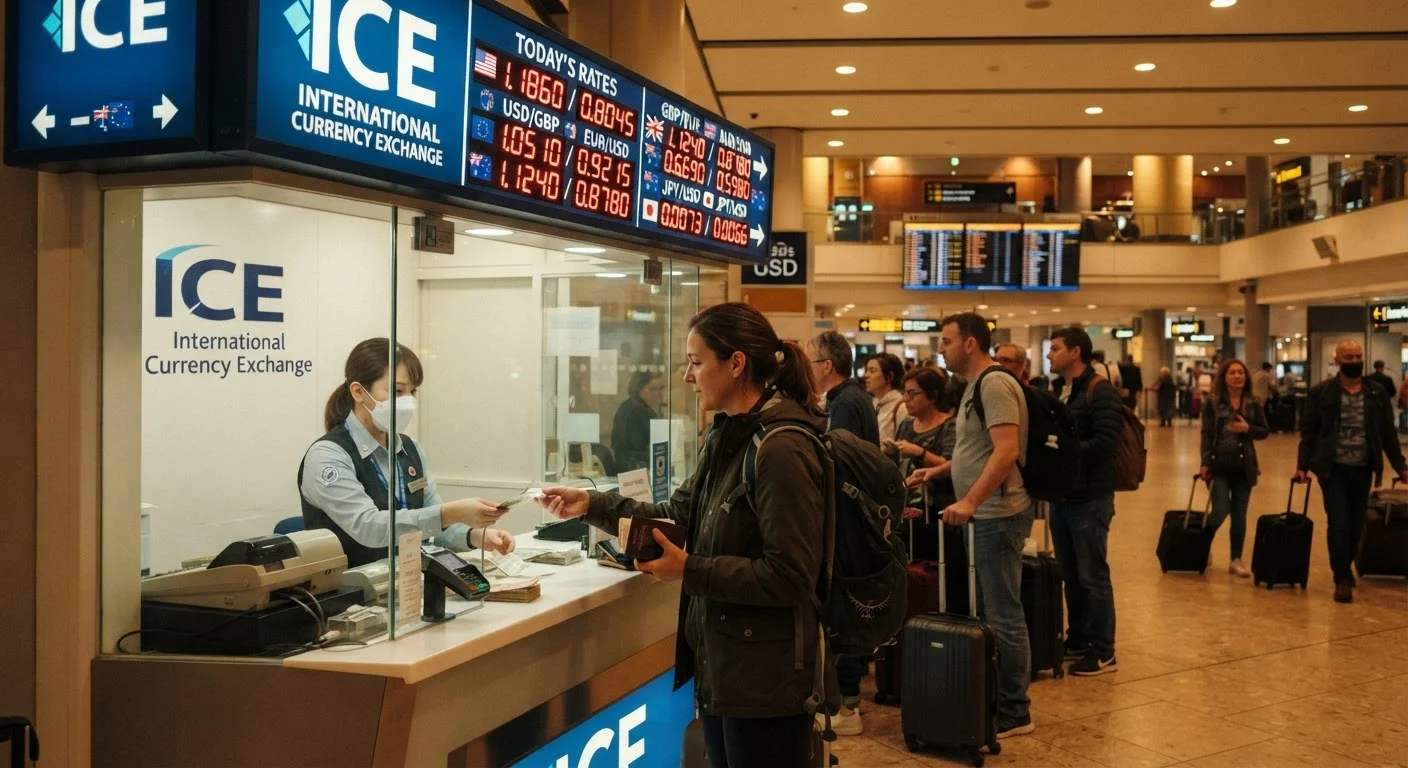
- Airport currency exchange kiosks typically offer the least favorable rates due to high overhead and captive audiences.
- ATMs abroad often provide rates closer to the interbank rate, but foreign transaction and ATM fees still apply.
- Your home bank or credit union may offer currency orders with more transparent fee structures.
- Dynamic Currency Conversion (DCC) at point-of-sale terminals usually costs more — always pay in the local currency.
- Exchange rates fluctuate daily, so the rate you see today may differ from what you receive at travel time.
- Carrying some local cash is still advisable even in card-friendly destinations for small vendors and emergencies.
Foreign Currency Exchange
Foreign currency exchange is the process of converting money from one country's currency into another. When Americans travel internationally, they swap US dollars for the local currency at a rate called the exchange rate — the price of one currency expressed in terms of another. This rate fluctuates constantly based on global financial markets.
The interbank exchange rate — the rate banks use when trading with each other — is typically more favorable than any rate available to retail consumers. The spread between the interbank rate and the rate you're offered represents the provider's margin.
How Exchange Rates Actually Work
Every time you convert dollars into euros, yen, or pesos, you're participating in the foreign exchange market — the largest financial market in the world. The rate you receive reflects the current relative value of two currencies, but that number isn't fixed. It shifts continuously based on economic data, interest rates, political developments, and market sentiment.
The rate you see advertised at an exchange booth or on a travel app is rarely the interbank rate — the benchmark rate banks use among themselves. Providers add a margin (sometimes called a spread) on top of that baseline, and that margin is where much of their revenue comes from. Understanding this gap is the foundation of navigating currency exchange intelligently.
For a broader look at managing money across borders, see our guide on currency, cards, and cash.
8–15%
Typical airport kiosk margin above interbank rate
Industry estimates and consumer finance reporting consistently place airport and hotel exchange kiosk margins well above those of ATMs or bank-ordered currency.
1–3%
Foreign transaction fee on many US credit cards
Many standard US-issued credit cards charge a foreign transaction fee on purchases made in foreign currencies or processed through foreign banking systems.
$0
Foreign transaction fees on select travel cards
A number of travel-oriented US credit cards waive foreign transaction fees entirely, making them cost-effective for international spending — check your card's terms before travel.
Comparing Your Exchange Options
Americans traveling internationally have several ways to access foreign currency, each with different cost structures and convenience trade-offs.
Airport and Hotel Exchange Kiosks
These are the most accessible — and most expensive — options. High operating costs and a captive audience allow providers to apply wide margins. They're reasonable for exchanging a small amount upon arrival to cover a taxi or meal, but shouldn't be your primary source.
ATMs Abroad
Using an ATM in your destination country generally delivers a rate close to the interbank rate because the conversion happens through card network infrastructure. The catch is fees: your US bank may charge an international withdrawal fee, and the foreign ATM operator may levy its own charge. Using ATMs affiliated with major banking networks and withdrawing larger amounts less frequently can reduce per-dollar costs.
Your Home Bank or Credit Union
Many US banks allow you to order foreign currency in advance for home or branch pickup. Rates vary, but the fee structure is usually transparent, and you'll arrive with cash in hand. This works best for widely traded currencies like euros, British pounds, or Japanese yen — less common currencies may be unavailable or carry higher margins.
Credit and Debit Cards
Cards with no foreign transaction fees and strong network coverage (Visa and Mastercard are widely accepted globally) are often the most cost-effective for larger purchases. Always confirm whether your card charges foreign transaction fees before departing. If you're planning your first international trip, our primer on everything to know before your first international trip covers this alongside passports and customs essentials.
Set Up a Travel Notification Before You Fly
Most major US banks allow you to flag upcoming international travel through their mobile app or website. This prevents your card from being flagged for suspicious activity and blocked mid-trip. It takes less than five minutes and can save significant hassle if your card is your primary payment method abroad.
The Dynamic Currency Conversion Trap
One of the most common — and avoidable — currency mistakes Americans make abroad is accepting Dynamic Currency Conversion (DCC). When you insert your card at a foreign terminal, the machine may ask: "Would you like to pay in USD?" It seems helpful, but the exchange rate embedded in that conversion is set by the merchant's payment processor and is almost universally worse than what your card's network would apply.
The answer, every time, is to pay in local currency and let your card handle the conversion. This one habit can save a meaningful percentage across a trip's worth of transactions. It's one of the specific things Americans commonly get wrong about international travel that can quietly erode a travel budget.
Practical Preparation Before You Depart
Knowing the mechanics of exchange is useful; putting that knowledge into a pre-trip checklist is where it pays off. Before leaving the US, consider taking these steps:
- Check your card's foreign transaction fee and whether it charges fees for ATM withdrawals abroad.
- Notify your bank and card issuer of your travel dates and destination to prevent fraud blocks.
- Research ATM availability at your destination — some countries are predominantly cash-based, others are highly card-friendly.
- Order a modest amount of local currency from your bank for immediate arrival needs if your destination is cash-heavy or ATM access is uncertain.
- Save the interbank rate for your destination currency as a reference point — apps like Google or XE.com display it — so you can gauge how close any offered rate actually is.
Entry logistics — including documentation, visa requirements, and what customs officials may ask — are equally important to sort before departure. Our article on entry requirements Americans should verify walks through what to confirm with official sources.
Currency strategy is just one dimension of international travel readiness. Understanding local customs — including whether tipping is expected or unusual, and how to handle cash in markets — rounds out the picture. See our guide on cultural missteps Americans often make overseas for context on adapting to local norms.