

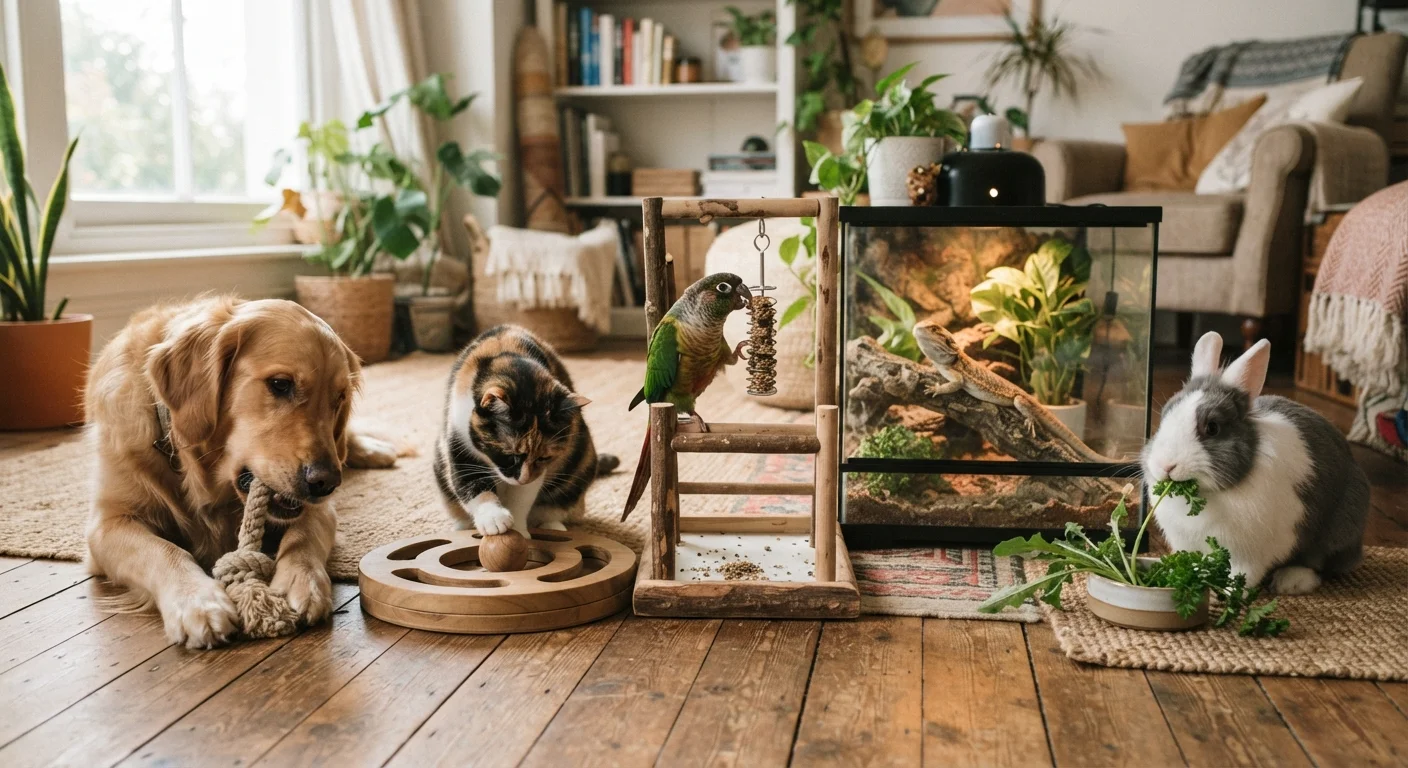
Key Takeaways
- Enrichment is not a luxury — it's a daily necessity that supports both mental and physical health across all pet types.
- Dogs, cats, birds, reptiles, and small mammals each have distinct stimulation needs rooted in their natural behaviors.
- Boredom-related behavior problems in pets are often a sign of unmet enrichment needs, not willful misbehavior.
- Even small, consistent daily interactions can meaningfully improve a pet's quality of life.
- Tailoring enrichment to your specific animal's species, age, and personality yields the best results.
Why Daily Enrichment Matters for Every Pet
When we think about caring for a pet, feeding and veterinary visits often come to mind first. But daily enrichment — the combination of mental stimulation, physical activity, and social interaction that matches an animal's natural drives — is equally foundational to their wellbeing. Without it, even the healthiest-fed pet can develop anxiety, destructive habits, or withdrawn behavior.
The challenge is that enrichment isn't one-size-fits-all. A puzzle feeder that delights your dog may be meaningless to your leopard gecko. Understanding what each species actually needs, grounded in their natural history and behavioral biology, is what separates adequate care from genuinely good care. If you're just getting started, our first-time pet owner's foundation offers a broader overview of daily care essentials.
The five animal types covered below — dogs, cats, birds, reptiles, and small mammals — represent the most common household pets in the US, each with meaningfully different enrichment requirements.
Dogs: Structured Activity and Nose Work
Dogs are social, cognitively flexible animals whose ancestors spent most of their time foraging, problem-solving, and working in groups. Modern domestic dogs retain those drives even when living comfortably in an apartment. Daily enrichment for dogs should address three categories: physical exercise, mental challenge, and social connection.
Physical exercise needs vary widely by breed, age, and health status — a senior Basset Hound and a young Border Collie have dramatically different requirements. That said, a daily walk that allows for sniffing and exploration (rather than a brisk, leash-tight trot) offers both physical and olfactory stimulation. Scent work and nose games — hiding treats, using snuffle mats, or exploring new environments — engage a dog's most powerful sense and can be genuinely tiring in a satisfying way.
Mental enrichment through training sessions, even just 5–10 minutes of reinforcing known cues or learning new ones, provides purpose and strengthens the bond between dog and owner. Puzzle feeders or food-dispensing toys at mealtimes add a problem-solving layer to an otherwise passive activity.
A walk that allows sniffing offers more enrichment than a brisk, nose-forward trot around the block.
Cats: Predatory Play and Vertical Space
Cats are solitary hunters by nature, and their enrichment needs reflect that. Unlike dogs, cats don't need constant social interaction — but they do need daily opportunities to express predatory behavior: stalking, pouncing, batting, and catching. Without this outlet, indoor cats in particular can become under-stimulated, which often manifests as aggression, excessive grooming, or destructive scratching.
Interactive play sessions using wand or feather toys that mimic prey movement are among the most effective enrichment tools for cats. Sessions of 10–15 minutes, ideally twice daily, can satisfy hunting instincts in a way that solo toys often can't. Allowing the cat to "catch" and "kill" the toy at the end of a session is important — abruptly ending play without a resolution can leave them frustrated.
Environmental enrichment is equally vital. Vertical space in the form of cat trees, shelves, or window perches allows cats to survey their territory and feel secure. Window feeders that attract birds provide hours of passive visual stimulation. For a deeper look at how the indoor environment shapes feline wellbeing, see our article on indoor vs. outdoor living for cats.
Allowing a cat to 'catch' the toy at the end of play is a small step that prevents frustration and stress.
Birds: Social Engagement and Foraging Opportunities
Pet birds — particularly parrots, cockatiels, and conures — are among the most cognitively demanding animals kept as companions. Most are flock animals in the wild, meaning isolation without adequate interaction can cause significant psychological distress. Screaming, feather-destructive behavior, and repetitive movements are often behavioral signals of an under-enriched bird.
Daily interaction with their human flock is essential. This doesn't always mean hands-on handling; simply being present in the same room, talking, or engaging with the bird during normal household activities can meet social needs. Training sessions using positive reinforcement are excellent for both mental stimulation and bonding.
Foraging enrichment — hiding food inside paper rolls, wrapping treats in leaves, or using multi-compartment foraging toys — taps into the hours birds would naturally spend searching for food. Rotating perches, toys, and cage arrangements every few days also prevents habituation. Species with particularly high intelligence, like African grey parrots or cockatoos, may need several hours of active enrichment daily; consultation with an avian veterinarian is worthwhile for owners of these birds.
Foraging enrichment — hiding food in toys or wrapping — mirrors the hours wild birds spend actively searching to eat.
Reptiles: Habitat Complexity and Sensory Stimulation
Reptile enrichment is frequently underestimated, partly because reptiles are less overtly expressive than mammals. But research in zoo and companion animal contexts increasingly supports that reptiles benefit from environmental complexity and novel stimuli. A barren enclosure — even one with perfect temperature and humidity — doesn't meet a reptile's full behavioral needs.
Habitat enrichment is the primary vehicle for reptile stimulation. This includes providing multiple hides (not just one), varied substrate textures for tactile exploration, branches and rocks for climbing or basking, and occasional novel objects introduced temporarily. For active species like blue-tongued skinks or bearded dragons, supervised time outside the enclosure in a safe, warm space can provide valuable sensory input.
Feeding enrichment matters too. Rather than always presenting food in the same spot the same way, varying feeding locations or offering prey items that require some engagement (for insectivores, a slow-moving insect rather than a dead one) can stimulate natural foraging behaviors. Always verify what's safe for your specific species — an exotic vet or herpetological society resource is the most reliable guide.
A barren enclosure with perfect temperature still fails a reptile if it lacks hides, textures, and sensory variety.
Small Mammals: Tunneling, Foraging, and Safe Exploration
Rabbits, guinea pigs, hamsters, gerbils, and rats each have distinct enrichment profiles, but most share a few common threads: they are prey animals, they have strong instincts to burrow or tunnel, and they benefit enormously from safe exploration of space beyond their primary enclosure.
Rabbits are particularly active and social — they need several hours of supervised free-roaming time daily in a rabbit-proofed space, along with companions (rabbits are social animals and often do better in bonded pairs), opportunities to dig, and a diet that involves some foraging effort (scattering hay or hiding leafy greens). Guinea pigs similarly thrive with floor time, gentle handling, and the companionship of their own kind.
Hamsters and gerbils are burrowers; providing deep bedding they can actually dig through is one of the most impactful enrichment steps an owner can take. Hamsters are also primarily nocturnal — scheduling interaction and exploration time during their active hours, rather than disrupting daytime sleep, respects their natural rhythm. Rats are highly social and intelligent; they need daily handling, social companionship, and problem-solving opportunities like rope mazes or treat puzzles to stay behaviorally healthy.
Providing burrowing-depth bedding for hamsters and gerbils satisfies one of their strongest instinctual drives.
Building a Sustainable Enrichment Practice
Effective enrichment doesn't require expensive equipment or hours of free time. What matters most is consistency and relevance — small, species-appropriate interactions woven into your existing daily routine. Rotating activities prevents habituation, where an animal stops responding to a stimulus because it's become too predictable.
Rotate to Prevent Habituation
Animals become accustomed to the same enrichment items over time, reducing their stimulating effect. Try cycling through a small collection of toys or activities on a weekly basis rather than offering everything at once. Even rearranging furniture in a cat's environment or moving a bird's perch can reset novelty. Small changes cost nothing but can meaningfully reset an animal's curiosity and engagement.
For households with multiple animals, enrichment planning becomes even more nuanced. Our guide on introducing a new pet to a multi-animal home addresses how social dynamics affect stimulation needs. You can also explore building a weekly pet care routine to organize enrichment tasks by species and frequency. For pet-specific training that reinforces enrichment, the Pet Training hub is a reliable starting point.
This article is for general informational and educational purposes only. For concerns about your pet's health or behavior, consult a licensed veterinarian or certified animal behaviorist.