
Dollar-Cost Averaging vs. Lump-Sum Investing: Two Approaches to Long-Term Wealth

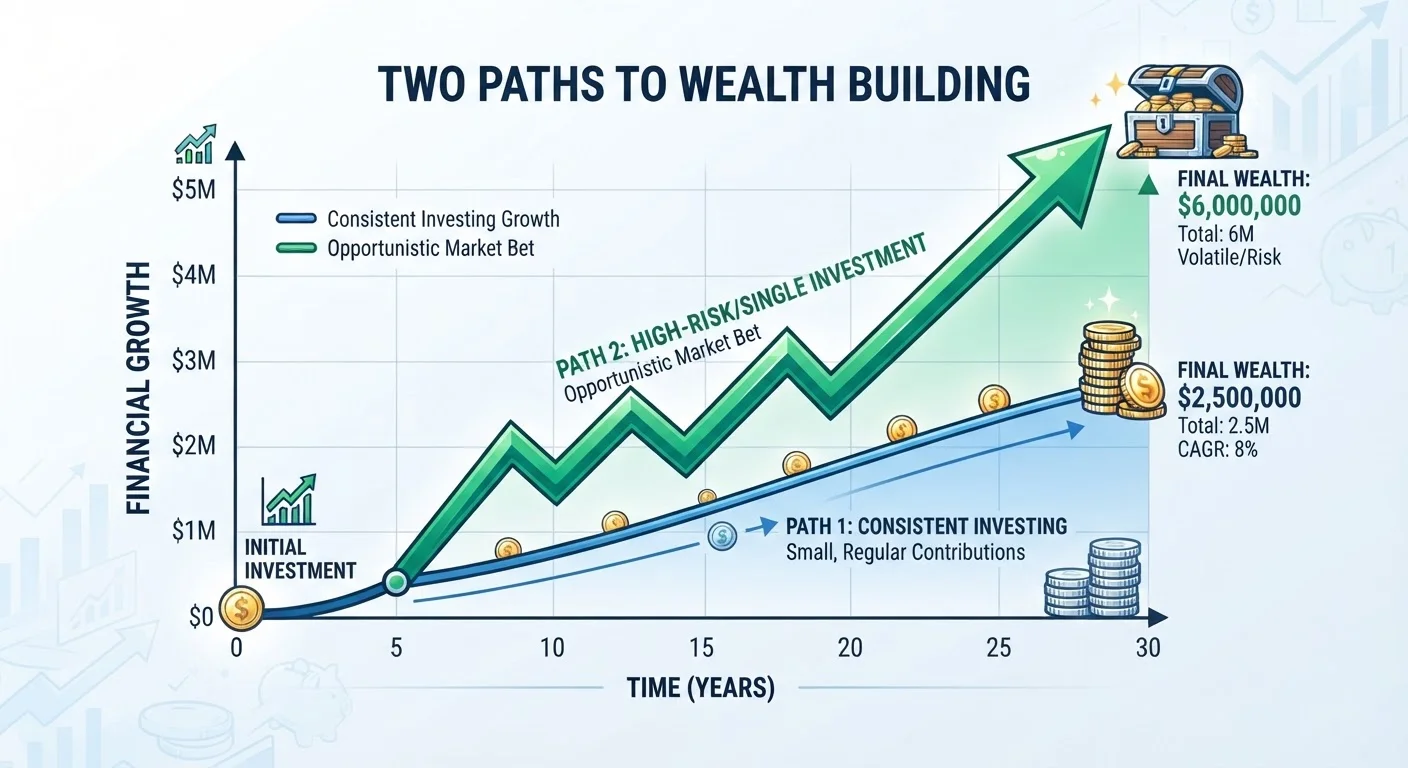
Key Takeaways
- Lump-sum investing deploys all available capital at once, while dollar-cost averaging spreads purchases over time.
- Research generally shows lump-sum investing outperforms dollar-cost averaging in rising markets over the long run.
- Dollar-cost averaging can reduce the emotional difficulty of investing during market uncertainty.
- The right approach often depends on how the money became available and your personal risk tolerance.
- Neither strategy guarantees returns — both carry market risk and are subject to individual circumstances.
Our Verdict
Neither dollar-cost averaging nor lump-sum investing is universally superior. Lump-sum investing has historically produced stronger long-term results in markets that trend upward over time, but dollar-cost averaging offers a structured, lower-stress entry point for those managing irregular cash flow or behavioral risk. The most important factor is consistent, long-term participation in the market rather than the precise timing of contributions.
| Best for | Recommended |
|---|---|
| Those who receive a windfall or have idle cash ready to invest | Lump-Sum Investing |
| Those who invest from regular income or want to reduce timing anxiety | Dollar-Cost Averaging |
| Those with high sensitivity to short-term portfolio volatility | Dollar-Cost Averaging |
| Those building a long-term plan with a single large capital event | Lump-Sum Investing |
What Each Strategy Actually Means
Dollar-cost averaging (DCA) means investing a fixed dollar amount at regular intervals — say, $300 every month into a diversified fund — regardless of what the market is doing. Because the price fluctuates, you automatically buy more shares when prices are low and fewer when they're high.
Lump-sum investing means deploying all available capital in a single transaction. Rather than spreading $3,600 over 12 months, you invest it all at once and let time in the market do the work.
Both approaches are grounded in long-term investing principles and are distinct from market timing, which attempts to predict highs and lows — a strategy widely considered unreliable for everyday investors. For broader context on building a durable financial foundation, see Building a Financial Plan That Holds Up Over Time.
How They Perform in Different Market Conditions
The performance comparison between these two strategies is well-studied. A Vanguard analysis found that, historically, lump-sum investing outperformed dollar-cost averaging approximately two-thirds of the time across U.S., U.K., and Australian markets over rolling 10-year periods. The reason is straightforward: markets have generally trended upward over long time horizons, so money invested earlier has more time to grow.
However, that advantage narrows or reverses in declining or sideways markets. When prices fall after a lump-sum investment, the investor absorbs the full drawdown immediately. With DCA, later purchases at lower prices reduce the average cost per share, softening the impact of a downturn.
~2 in 3
Rolling periods where lump sum outperformed DCA
A Vanguard research analysis found lump-sum investing outperformed dollar-cost averaging roughly two-thirds of the time across major markets over 10-year rolling periods.
~1.5%
Average performance advantage of lump sum over DCA
The same Vanguard study estimated lump-sum investing outperformed DCA by approximately 1.5 percentage points on average in the studied markets and periods.
It's also worth noting that for most people, the choice is not purely theoretical — it's often dictated by circumstances. Someone investing from a paycheck every two weeks is already dollar-cost averaging by default. Someone who inherits money or sells a property faces a genuine lump-sum decision.
The Behavioral Dimension
Raw performance data doesn't capture the full picture. Behavioral finance research consistently shows that investor behavior — specifically, the tendency to panic-sell during downturns — is one of the biggest drags on real-world returns. This is where DCA has a practical edge.
By spreading investments over time, DCA lowers the psychological stakes of any single decision. Investors who might hesitate to commit a large sum all at once are more likely to start and stay invested with a smaller, recurring contribution. Consistent participation often matters more than optimal entry timing.
Make DCA Automatic to Stay Consistent
Setting up automatic recurring contributions removes the temptation to pause during market dips — precisely when continued investing can be most beneficial. Many employer-sponsored retirement plans already use this mechanism. For taxable accounts, most brokerage platforms allow you to schedule fixed purchases on a weekly or monthly basis with minimal effort.
Automating contributions is one of the most reliable ways to maintain a DCA strategy without relying on willpower. See Automating Your Savings for practical methods to keep contributions on schedule.
Key Differences at a Glance
The table below summarizes how these two approaches compare across practical considerations.
| Dollar-Cost Averaging | Lump-Sum Investing | |
|---|---|---|
| Capital deployment | Spread over regular intervals | All at once |
| Historical performance (rising markets) | Generally lower long-term returns | Generally higher long-term returns |
| Downside protection | Reduces exposure to single-entry timing risk | Full exposure to immediate market drops |
| Behavioral ease | Lower psychological barrier to start | Requires committing full amount upfront |
| Best suited for | Regular income investors | Lump-sum recipients (windfall, sale proceeds) |
| Complexity | Low — can be automated easily | Low — single transaction |
As with any financial decision, individual circumstances matter greatly. Your cash flow structure, investment timeline, and comfort with volatility should all inform which approach fits your situation. For help understanding how regular expenses affect how much you can invest each month, understanding your fixed vs. variable expenses is a useful starting point.
This article is for general informational and educational purposes only. It does not constitute personalized financial, investment, tax, or legal advice. Please consult a qualified financial adviser before making investment decisions suited to your individual circumstances.