

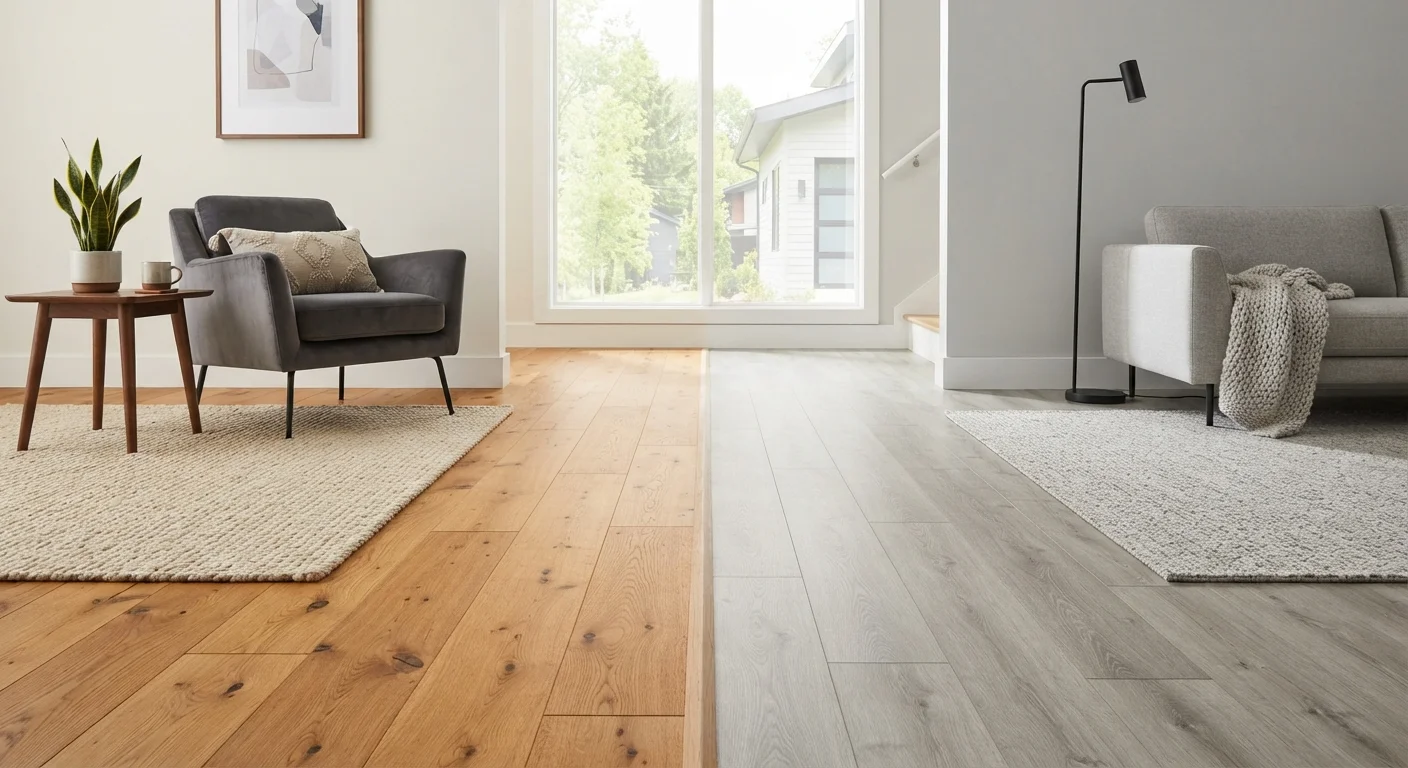
Key Takeaways
- Hardwood can be sanded and refinished multiple times, extending its lifespan by decades.
- Luxury vinyl plank is fully waterproof, making it suitable for kitchens, bathrooms, and basements.
- LVP typically costs less per square foot for both material and installation than solid hardwood.
- Hardwood adds more resale value to a home according to most real estate research.
- LVP is easier for DIY installation thanks to click-lock systems that don't require adhesive or nailing.
- Neither flooring type suits all rooms — the right choice depends heavily on moisture and traffic levels.
Option A
Hardwood Flooring
The time-tested, refinishable classic with lasting appeal.
Best for: Dry living areas where long-term home value and the ability to sand and refinish are priorities.
Option B
Luxury Vinyl Plank (LVP)
The waterproof, budget-conscious modern alternative.
Best for: Moisture-prone spaces, busy households, or homeowners seeking easier DIY installation.
If you want a floor that lasts 50+ years and adds resale value
Hardwood Flooring
Solid hardwood can be refinished as it wears, effectively resetting its surface. Real estate professionals consistently cite hardwood as a buyer-preferred feature.
If you're flooring a basement, bathroom, or kitchen
Luxury Vinyl Plank (LVP)
LVP's 100% waterproof core means spills and humidity won't cause swelling, warping, or mold growth — issues that make solid hardwood a poor choice below grade or in wet areas.
If you're a renter or plan to move within 5–7 years
Luxury Vinyl Plank (LVP)
Lower upfront cost and a faster DIY install make LVP more financially sensible when long-term ownership equity isn't a primary factor.
If you have pets or heavy foot traffic throughout the home
Luxury Vinyl Plank (LVP)
High-quality LVP with a thick wear layer resists scratches from pet claws and daily foot traffic better than many hardwood species, particularly softer woods like pine.
If authenticity and long-term home investment matter most
Hardwood Flooring
No vinyl product fully replicates the texture and warmth of genuine wood grain, and hardwood's ability to be refinished means it can outlast several vinyl floor replacements.
Understanding the Core Differences
Hardwood flooring is milled from solid timber — species like oak, maple, and hickory — and has been a residential standard for well over a century. Luxury vinyl plank (LVP), by contrast, is a multi-layer synthetic product engineered to mimic wood's appearance while offering performance properties that natural wood cannot match.
The key structural difference is how each material responds to its environment. Solid hardwood expands and contracts with changes in humidity and temperature, which is why it has traditionally been avoided in basements, bathrooms, and below-grade installations. LVP's rigid or semi-rigid core is dimensionally stable and fully waterproof, making it viable in virtually any room of the home.
Both products have matured significantly. Modern LVP uses photographic and embossing technology to closely replicate wood grain and texture, while hardwood remains available in engineered forms (a plywood-core layer under a real wood veneer) that offer more moisture tolerance than solid planks alone.
| Criterion | Hardwood Flooring | Luxury Vinyl Plank (LVP) |
|---|---|---|
| Waterproof | No — moisture causes warping | Yes — 100% waterproof core |
| Typical material cost (per sq ft) | $5–$15+ | $2–$7 |
| DIY-friendly installation | Moderate to difficult | Easier — click-lock systems |
| Refinishable | Yes — multiple times | No — must replace when worn |
| Typical lifespan | 50–100+ years (with care) | 15–25 years |
| Resale value impact | Generally higher | Moderate |
| Scratch resistance | Varies by species | High (thick wear layer) |
| Suitable for basements | No (solid); limited (engineered) | Yes |
Installation, Cost, and Maintenance
Installation complexity and cost are major deciding factors for many homeowners. Solid hardwood typically requires nailing or stapling to a wood subfloor, and most manufacturers recommend professional installation to protect the warranty. Material costs for solid hardwood commonly range from roughly $5 to $15 per square foot before labor, which can add another $3 to $8 per square foot depending on your region and subfloor condition.
LVP installation is generally more DIY-friendly. Most products use a floating click-lock system requiring no adhesive or fasteners, and they can be installed over most existing smooth, level subfloors — including concrete. Material costs typically range from $2 to $7 per square foot for mid-range to premium LVP, with labor running comparably lower due to simpler prep work.
54%
Home buyers who prefer hardwood floors
According to the National Association of Realtors, a majority of buyers consider hardwood flooring a desirable feature when purchasing a home.
3–5x
Longer lifespan of hardwood vs. LVP
Properly maintained solid hardwood floors can last well beyond 50 years; most LVP products carry warranties of 15–25 years under normal residential use.
On the maintenance side, hardwood requires periodic refinishing — typically every 7 to 15 years depending on traffic and wear layer thickness. LVP, while easier to clean and highly scratch-resistant, cannot be refinished. Once the wear layer is compromised, replacement is the only remedy. For homeowners weighing similar long-term decisions in renovation materials, our look at pressure-treated vs. composite decking explores comparable trade-offs between a traditional and a synthetic material.
Engineered Hardwood: A Middle Ground
Engineered hardwood features a real wood veneer bonded to a plywood core, giving it more moisture tolerance than solid hardwood while retaining the authentic wood surface. It can typically be refinished once or twice depending on veneer thickness. For rooms where solid hardwood isn't recommended but you want a genuine wood look, engineered hardwood is worth evaluating alongside LVP.
Which Floor Fits Your Home?
The right choice comes down to three practical questions: Where in the home is the floor going? How much maintenance are you willing to perform over time? And what is your budget — upfront and long-term?
For main living areas and bedrooms in a dry climate with a controlled HVAC system, hardwood is a sound investment that can appreciate with the home. For bathrooms, kitchens, laundry rooms, finished basements, or any space that sees consistent moisture exposure, LVP is the more practical choice.
Households with young children, dogs, or renters may also find LVP's scratch resistance and ease of spot cleaning a meaningful everyday advantage — even if they accept that the floor may need full replacement rather than refinishing in 20 to 25 years. Hardwood's long-term cost can be lower if it's refinished regularly rather than replaced, making it the more economical option over a 40-year horizon in the right conditions.
Neither option is universally superior. A thoughtful homeowner might install hardwood in formal living and dining areas while choosing LVP for the mudroom, basement, or a kid's bathroom — using each material where it performs best.