

Key Takeaways
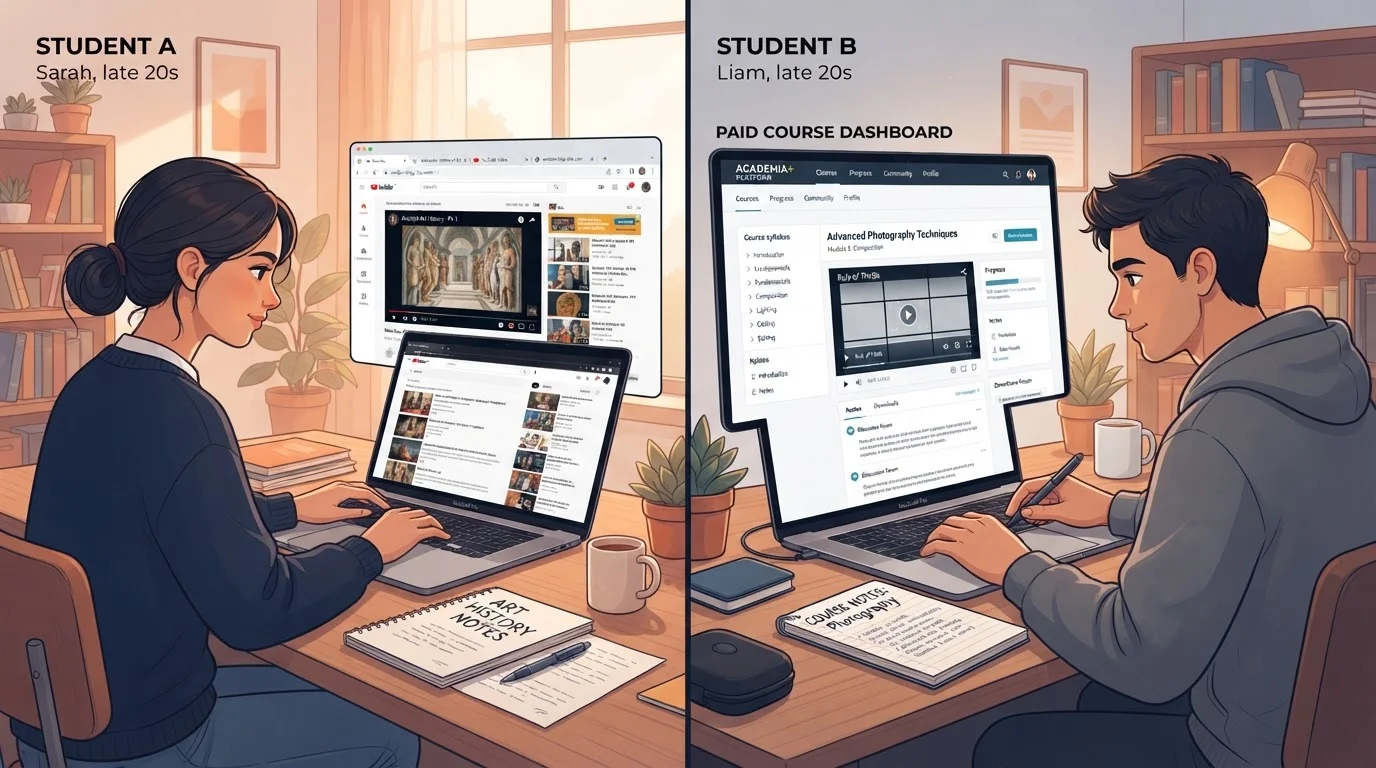
- Free courses offer broad access to content but rarely include graded feedback, credentials, or instructor support.
- Paid courses typically provide structured curricula, verified certificates, and accountability features that improve completion rates.
- The right choice depends on your specific goal: exploration favors free options, while career advancement often warrants paid ones.
- Neither option guarantees learning outcomes - engagement and consistent practice matter most.
- Some platforms offer both free auditing and paid certificate tracks, giving learners a middle-ground option.
Our Verdict
Free courses are a practical entry point for curiosity-driven exploration and skill sampling, but they generally fall short when credentials, structured feedback, or community support are essential. Paid courses provide a more complete learning environment, though the added cost is only justified when the learning goal is clear and the format matches how you actually learn best. Neither option is universally superior - the decision hinges on your goal, timeline, and how you stay accountable.
| Best for | Recommended |
|---|---|
| Exploring a new subject or testing interest before committing | Free courses |
| Building a verifiable credential for a job application or career change | Paid courses |
| Supplementing existing knowledge at no cost | Free courses |
| Learners who need structured deadlines and instructor feedback | Paid courses |
What You Actually Get With Free Online Courses
Free online courses - offered through platforms, university open courseware, and video libraries - have made knowledge dramatically more accessible. You can learn calculus, programming fundamentals, or business writing without spending a dollar. That's a genuine educational achievement.
However, access to content and access to a learning experience are two different things. Most free courses provide video lectures and readings, but limit or entirely omit:
- Graded assignments with instructor feedback - assessments, if present, are typically auto-graded quizzes
- Verified certificates - completion badges from free tracks are rarely recognized by employers the same way paid credentials are
- Community and peer interaction - discussion forums may exist but are often inactive on older or self-paced free offerings
- Structured progression - without deadlines, most learners stall; research consistently shows free open courses have completion rates well below 15%
For someone exploring whether a subject interests them, or filling a specific knowledge gap, these limitations may not matter at all. Free courses excel as a low-risk starting point. See also how format affects outcomes in our look at self-paced vs. instructor-led course research.
Where Paid Courses Add Measurable Value
Paid online courses - whether individual course purchases or platform subscriptions - generally invest more in the learning environment, not just the content itself. Key differences include:
| Feature | Free Courses | Paid Courses | |
|---|---|---|---|
| Content access | Videos and readings only | Full curriculum with structured modules | |
| Graded feedback | Auto-graded quizzes at best | Instructor or peer-reviewed assignments | |
| Verified certificate | Rarely included or unrecognized | Typically included, employer-recognized | |
| Instructor support | None or limited forum access | Q&A, office hours, or TA access | |
| Completion accountability | Self-directed, no deadlines | Deadlines, cohorts, or milestones | |
| Cost | No financial commitment | One-time fee or subscription required |
Structured curricula, regular deadlines, and access to instructors or teaching assistants all address the completion and retention problems that plague self-directed free learning. The financial commitment also functions as a behavioral nudge: people who pay for something are more likely to engage with it consistently.
Certificates from paid tracks on established platforms carry more weight in hiring contexts because they typically require demonstrated performance - passing graded projects or exams - rather than simply logging hours. That said, certificate value varies widely by field, employer, and the issuing institution's reputation. No online certificate is a substitute for hands-on experience or a regionally accredited degree where those are required.
Try the Audit Option First
If a platform offers a free audit track alongside a paid certificate option, start there. Spend one to two weeks with the free content to assess the teaching style, pacing, and content depth. If the course genuinely fits your learning goal, upgrading to the paid track is a more informed decision - and you avoid paying for something that doesn't suit you.
For a broader view of how digital learning fits into longer educational pathways, explore the full map of online learning options.
How to Match the Format to Your Actual Goal
The most important question isn't "which is better" - it's "better for what." Consider these scenarios:
- Curiosity or hobby learning: Free courses are usually sufficient. You don't need a credential; you need good content.
- Career pivoting or upskilling: Paid courses with verifiable outcomes offer more return on investment, especially when the certificate is recognized in your target field.
- Supplementing a degree or existing job: A free course filling a specific knowledge gap (a particular programming language, a finance concept) can be highly effective without any added cost.
- Building a portfolio: Paid courses with project-based assessments give you documented, graded work to show. Free courses rarely provide this.
Many platforms now offer a hybrid model: audit the course for free, pay only if you want the graded track and certificate. This lets you evaluate content quality before committing money - a practical approach worth considering.
It's also worth recognizing that online learning of either kind has real limitations. Our analysis of what online learning platforms can and cannot replace covers where digital formats tend to fall short, regardless of cost.
Finally, if you're weighing digital learning against traditional classroom settings, online vs. in-person program trade-offs is worth reading before you decide.
This article is for general informational and educational purposes only. Individual learning outcomes vary based on personal effort, prior knowledge, and the specific platform or course chosen.