

Key Takeaways
- Children should stay rear-facing until they reach the maximum height or weight limit of their specific seat.
- Forward-facing seats with a harness should be used as long as the child fits within the seat's limits.
- Booster seats are required until a vehicle seat belt fits the child properly, typically around 4'9" in height.
- Incorrect installation - not the seat itself - is the leading cause of reduced crash protection.
- All car seats should be registered with the manufacturer to receive safety recall notifications.
Why Car Seat Safety Matters
Motor vehicle crashes remain a leading cause of death for children in the United States. According to the Centers for Disease Control and Prevention (CDC), car seats reduce the risk of death by roughly 71% for infants and 54% for toddlers in passenger vehicles compared with seat belt use alone. Despite these figures, research consistently shows that a significant portion of car seats are used incorrectly - reducing their effectiveness substantially.
Understanding which seat type is appropriate for your child's age, weight, and height - and how to install it correctly - is one of the most consequential vehicle safety decisions a parent or caregiver makes. This guide walks through every stage, from newborn to adolescent, drawing on guidelines from the American Academy of Pediatrics (AAP) and the National Highway Traffic Safety Administration (NHTSA). For a broader look at how passive and active vehicle safety systems work together, see our overview of modern car safety systems.
71%
Reduction in infant crash fatality risk
According to the CDC, properly used car seats reduce the risk of death for infants by approximately 71% compared with seat belt use alone.
54%
Reduction in toddler crash fatality risk
The CDC reports that car seats reduce the risk of death for toddlers (ages 1-4) by around 54% in passenger vehicle crashes.
~46%
Car seats used incorrectly
NHTSA inspection data has consistently found that a large share of car seats are misused in ways that can reduce crash protection.
Rear-Facing Car Seats: The Starting Point
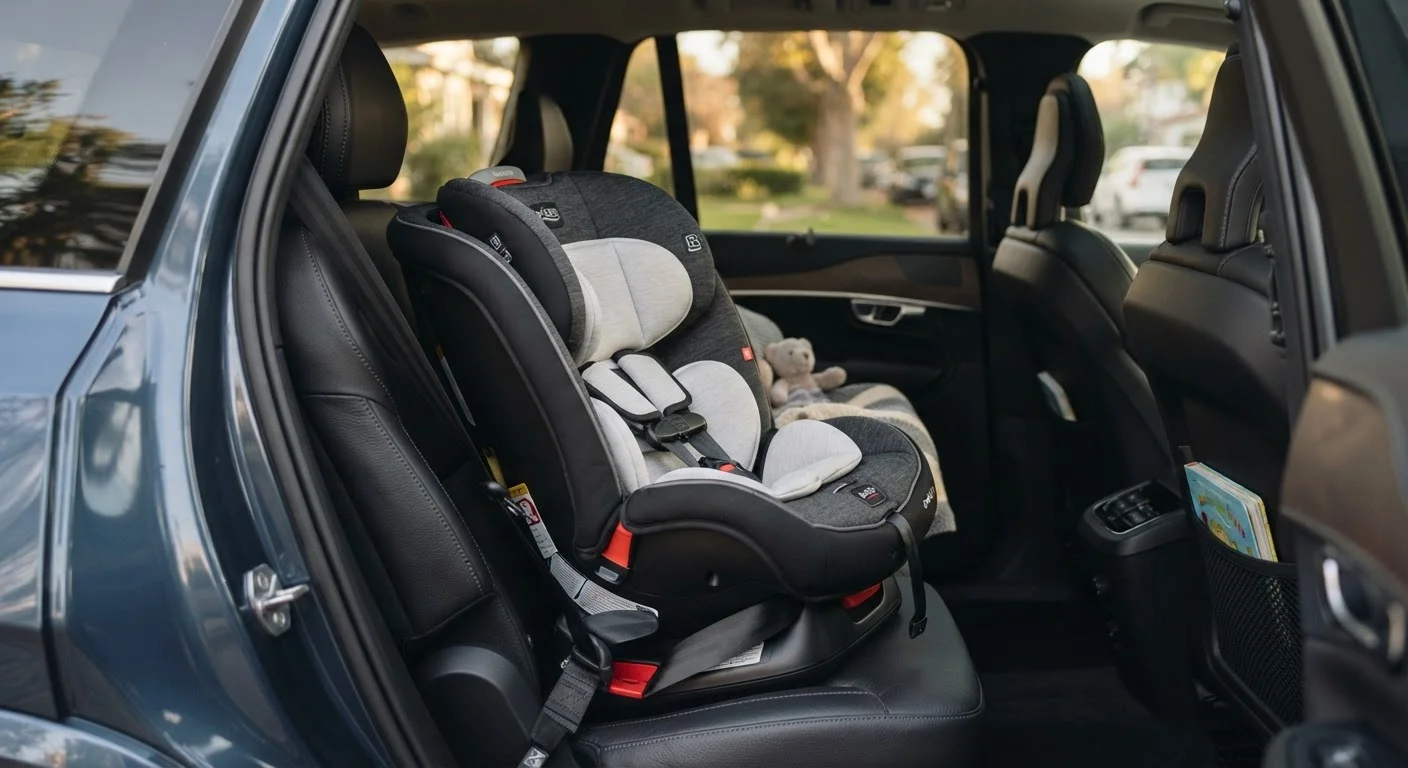
Rear-facing seats cradle an infant's head, neck, and spine during a frontal crash - the most common crash type - by distributing impact forces across the entire back of the body rather than concentrating them on developing skeletal structures. This makes rear-facing the safest orientation for young children.
There are two main rear-facing options:
- Infant-only seats: Designed exclusively for rear-facing use, typically accommodating children up to 22-35 lbs depending on the model. They include a handle for carrying and often pair with compatible stroller frames.
- Convertible seats: Can be used rear-facing and later converted to forward-facing, generally accommodating rear-facing children up to 40-50 lbs.
The AAP recommends keeping children rear-facing until they reach the maximum height or weight limit specified by the seat's manufacturer - not until a fixed birthday. Many children can safely remain rear-facing well past age two. Check your seat's manual for its specific limits, as they vary by model.
Never rely solely on a birthday or a rough age guideline to move a child to the next seat stage - always check the specific height and weight limits printed in your seat's manual and on its label.
Seat limits vary meaningfully by model, and transitioning too early removes the enhanced protection of the current seat type before the child's body is ready for the next one.
When purchasing a used car seat, verify its manufacture date (printed on the label), confirm it has never been in a crash, and check it against NHTSA's recall database before use.
Most manufacturers recommend replacing seats six to ten years from manufacture. A seat involved in a moderate or severe crash may have structural damage invisible to the eye.
Forward-Facing Car Seats: The Next Stage
Once a child exceeds the rear-facing limits of their seat, a forward-facing car seat with an internal five-point harness is the next step. The harness distributes crash forces across the strongest parts of the body - the shoulders, hips, and between the legs - and prevents the child from being thrown forward.
Forward-facing seats are typically rated for children weighing 40-65 lbs, though some high-weight harness seats accommodate children up to 90 lbs. As with rear-facing seats, children should use a forward-facing harness until they reach that seat's stated maximum, not simply when they hit a certain age.
Key installation and use points:
- The harness chest clip should sit at armpit level - not on the stomach or neck.
- Harness straps should be threaded through slots at or above the child's shoulders.
- The harness should be snug enough that you cannot pinch excess webbing between two fingers at the collarbone.
Booster Seats: Bridging the Gap
When a child outgrows the harness limits of a forward-facing seat, a booster seat positions the vehicle's own seat belt correctly across the child's body. Boosters come in two forms:
- High-back boosters: Provide head and neck support and are appropriate for vehicles without headrests or with low seat backs.
- Backless boosters: Suitable when the vehicle seat provides adequate head support; generally lighter and easier to move between vehicles.
The goal of a booster is to ensure the shoulder belt lies across the middle of the chest and shoulder - not the neck - and that the lap belt rests low across the upper thighs, not the soft abdomen. Children should remain in a booster until the vehicle belt fits properly, which NHTSA associates with reaching approximately 4 feet 9 inches tall and being between 8 and 12 years old.
Avoid Aftermarket Accessories and Add-Ons
Products not included with or specifically approved by the car seat manufacturer - such as aftermarket head supports, strap covers, and seat protectors placed under the seat - have not been crash-tested with that seat and can interfere with its performance. Using unapproved accessories may also void the seat's warranty and, in a crash, could reduce the restraint's effectiveness or create new hazards.
Seat Belt Graduation and Fit
A child is ready to use the vehicle seat belt alone when all five of the following conditions are met (often called the 5-Step Test):
- The child sits with their back fully against the vehicle seat back.
- Knees bend comfortably at the edge of the seat cushion.
- Feet rest flat on the floor.
- The shoulder belt crosses the middle of the shoulder and chest.
- The lap belt lies low across the thighs, not the abdomen.
If any condition is not met, the child needs to continue using a booster. Even after graduation, children under 13 should ride in the back seat whenever possible - airbag deployment in the front seat poses injury risk for smaller occupants. This principle of graduated protection parallels how we think about graduated risk for teen drivers: matching the protection level to the developmental stage.
Installation Essentials and Common Mistakes
Even a high-quality car seat provides diminished protection when installed incorrectly. NHTSA estimates that a large proportion of car seats are misused in ways that could reduce their effectiveness in a crash. The most common errors include:
- Excessive seat movement: A correctly installed seat should move no more than one inch side-to-side or front-to-back when gripped at the belt path.
- Wrong recline angle: Rear-facing seats must be reclined at the angle specified in the manual - too upright can cause the infant's head to fall forward, compromising the airway and crash protection.
- Loose harness straps: Bulky coats and snowsuits compress in a crash; dress children in thin layers and place blankets over the harness after buckling.
- Skipping registration: Register your seat with the manufacturer so you receive recall notices promptly.
NHTSA operates a network of certified Child Passenger Safety (CPS) technicians who inspect seat installations at no cost. Locating a CPS technician through NHTSA's website is a reliable way to confirm your installation is correct. For a full picture of your vehicle's safety ecosystem, the car maintenance hub covers the regular upkeep that keeps every safety system working as designed.
This article provides general educational information about child passenger safety and does not constitute legal or medical advice. Always consult your car seat's owner manual and refer to current guidelines from NHTSA and the American Academy of Pediatrics for recommendations specific to your child's needs.