

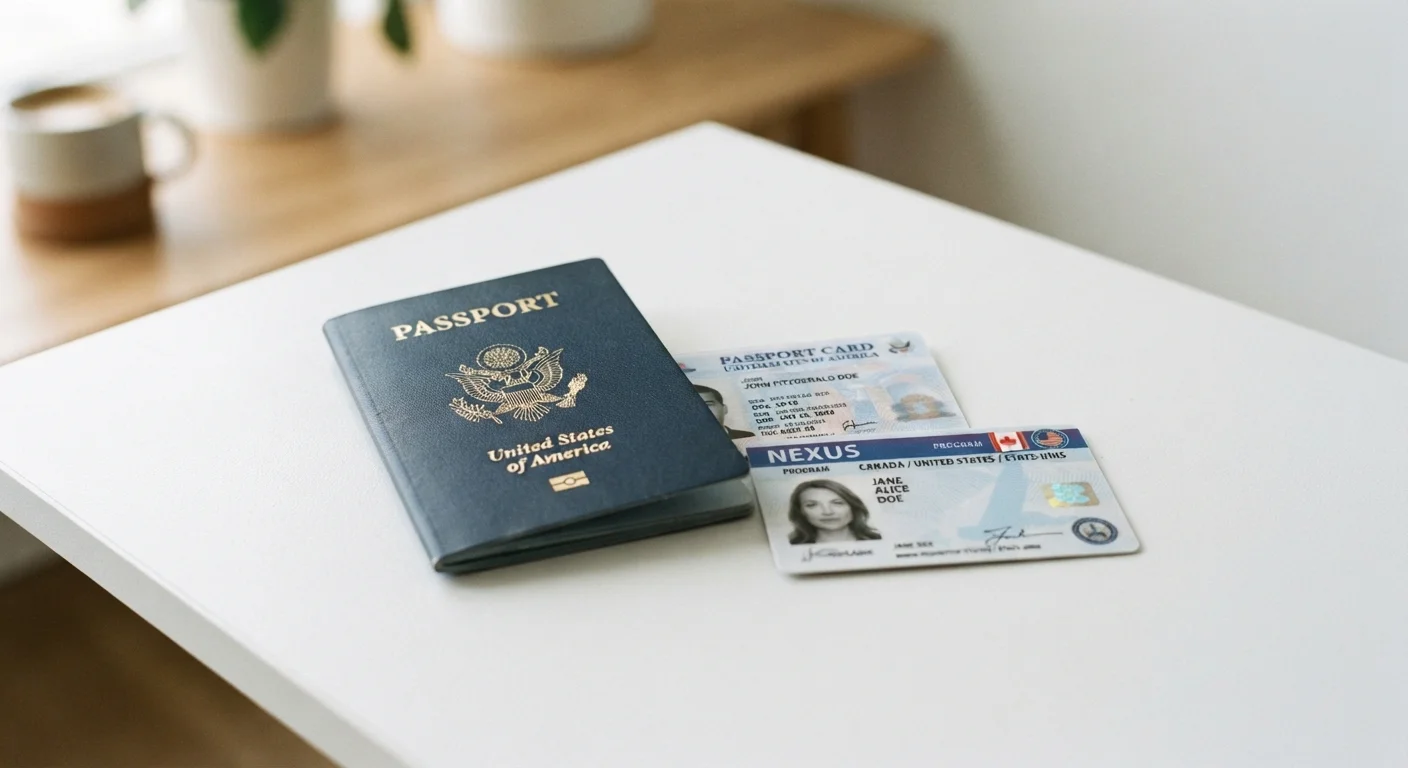
Key Takeaways
- The standard US passport book is the only document accepted for all international air travel.
- The passport card is a low-cost alternative, but its use is limited to land and sea crossings with Canada, Mexico, the Caribbean, and Bermuda.
- NEXUS is a trusted traveler program providing expedited entry between the US and Canada, not a standalone travel document.
- Many travelers benefit from carrying more than one document, depending on how and where they travel.
- Always verify current entry requirements with official government sources before departure.
Our Verdict
No single document works for every traveler. The passport book remains the universal standard and the only option for most international trips. The passport card makes practical sense as a backup or for frequent land-border crossers. NEXUS delivers genuine time savings at US-Canada crossings but requires eligibility and approval — it complements rather than replaces a passport.
| Best for | Recommended |
|---|---|
| Travelers flying internationally to any destination | US Passport Book |
| Frequent land or sea crossers to Canada, Mexico, or the Caribbean | Passport Card |
| Regular US-Canada commuters or frequent flyers through Canadian airports | NEXUS |
| Most international travelers wanting maximum flexibility | Passport Book + Passport Card or NEXUS |
What Each Document Actually Is
US citizens have access to three distinct travel documents issued or recognized at the federal level, and they are not interchangeable. Knowing what each one is designed to do is the first step in making the right choice.
The US Passport Book is the standard internationally recognized travel document, valid for 10 years for adults and 5 years for minors. It is accepted for air, land, and sea travel to virtually every country in the world and is required for all international commercial flights departing the US.
The US Passport Card is a wallet-sized document issued by the State Department. It is a legitimate proof of citizenship and identity, but its acceptance is deliberately narrow — it is valid only for land border crossings and sea travel between the US and Canada, Mexico, the Caribbean, and Bermuda. It cannot be used to board international flights.
NEXUS is a trusted traveler program jointly administered by US Customs and Border Protection (CBP) and the Canada Border Services Agency (CBSA). Approved members enjoy expedited processing at designated land, air, and marine ports of entry between the US and Canada. Crucially, NEXUS is a program membership card, not a stand-alone travel document — you still need a valid passport or other accepted ID to cross the border.
Before any international trip, it is worth reviewing entry requirements Americans should verify, since document rules can change.
Where Each Document Is and Isn't Accepted
| Passport Book | Passport Card | NEXUS Card | |
|---|---|---|---|
| International air travel | ✓ Accepted worldwide | ✗ Not accepted | ✗ Not accepted (supplement only) |
| US-Canada land/sea border | ✓ Accepted | ✓ Accepted | ✓ Accepted at designated ports |
| US-Mexico land/sea border | ✓ Accepted | ✓ Accepted | ✗ Not accepted |
| Caribbean & Bermuda cruises | ✓ Accepted | ✓ Accepted | ✗ Not accepted |
| Typical validity period | 10 years (adults) | 10 years (adults) | 5 years |
| Approximate cost (adult) | Higher (book + acceptance fee) | Lower (add-on option) | ~$50 membership fee |
| Background check required | Standard identity check | Standard identity check | Full vetting + interview |
The acceptance gap between the passport book and the other two documents is significant. A passport card holder who arrives at an international airport expecting to board a flight to Europe or Asia will be turned away — the card simply is not valid for that purpose. Similarly, a NEXUS card alone at a non-designated port of entry will not substitute for a passport.
For travelers heading to Western Europe, Asia, Africa, South America, or any destination requiring a visa, the passport book is non-negotiable. For those whose travel is concentrated at the US-Canada or US-Mexico land border — commuters, snowbirds driving to Mexico, or those taking cruises through the Caribbean — the passport card provides a convenient, cost-effective option.
See the full guide to visa requirements and entry rules for a destination-by-destination breakdown of what documentation is needed beyond your primary travel document.
Cost, Eligibility, and Application Process
Cost and administrative burden differ considerably across the three documents.
- Passport Book: First-time adult applicants pay a government application fee plus an acceptance fee at an authorized facility. Renewal is done by mail. Standard processing takes several weeks; expedited service is faster at an additional cost. Fees and timelines are published by the State Department and change periodically — always confirm current rates at travel.state.gov.
- Passport Card: Significantly less expensive than the book; it can be applied for simultaneously with the book at no extra acceptance fee. Many travelers apply for both at once to keep the marginal cost low.
- NEXUS: The application fee is low relative to a passport — typically around $50 for a 5-year membership. Applicants must pass a background check, provide biometric information, and attend an in-person interview at an enrollment center. Citizens or permanent residents of the US or Canada are eligible to apply. Approval is not guaranteed; those with certain immigration violations or criminal history will be denied.
Apply for Both Book and Card Together
If you apply for a passport book and passport card at the same time, you pay only one acceptance fee instead of two. For travelers who occasionally cross land borders into Canada or Mexico, the marginal cost of adding the card is modest. Keep the card in your wallet as an everyday backup in case your passport book is lost or stolen while abroad.
NEXUS members gain access to CBP's Global Entry program for expedited US Customs processing upon return from international trips — effectively a two-for-one benefit that frequent international travelers often find valuable.
How to Decide What You Need
The right combination of documents depends on where you travel, how often, and by what means. Consider the following scenarios:
- You fly internationally at least once a year to destinations outside the NEXUS or passport-card zone: a current passport book is essential, and NEXUS is worth the investment if Canada is a regular stop.
- You rarely fly internationally but frequently cross into Canada or Mexico by car, or take Caribbean cruises: a passport card may be sufficient for most trips, with a full book kept current as backup for emergencies or unexpected itinerary changes.
- You commute or travel frequently between the US and Canada by land or air: NEXUS significantly reduces wait times and is widely regarded as worthwhile by regular cross-border travelers.
- You are planning a first international trip or are unsure of future travel plans: apply for the passport book. Its universal acceptance makes it the safest default.
For a broader pre-departure planning framework, the international travel checklist for US citizens covers documents alongside health prep, money, and connectivity.
Travelers should also be aware that many countries require a passport to be valid for at least six months beyond the intended travel dates. A passport card does not resolve this — only the book satisfies those requirements. Check official government sources or the destination country's embassy website for current rules before booking.
This article provides general informational guidance only. Travel document rules, fees, and processing times are subject to change. Always verify current requirements with the US Department of State and the relevant destination country's official immigration or consular authority before traveling.