

Key Takeaways
- Credit card interest compounds daily on most cards, accelerating the cost of unpaid balances.
- The average credit card APR in the US regularly exceeds 20%, making carried balances expensive quickly.
- Paying only the minimum each month can extend repayment by years and multiply total interest paid.
- Even modest extra payments above the minimum can significantly reduce total interest costs.
- Carrying a balance does not improve your credit score — it only increases what you owe.
Carrying a Credit Card Balance
Carrying a credit card balance means you do not pay off your full statement amount by the due date, leaving a remaining amount that rolls over to the next billing cycle. That unpaid amount is then subject to interest charges, expressed as an Annual Percentage Rate (APR). The longer you carry a balance, the more interest accumulates — often compounding daily — making the original purchase cost meaningfully higher over time.
Most credit card issuers calculate interest using a Daily Periodic Rate (DPR), which is the APR divided by 365. Interest is applied to the average daily balance, so even a partial payment mid-cycle can reduce the charge.
How Interest Charges Actually Accumulate
When a credit card balance is not paid in full by the due date, the issuer begins charging interest on the remaining amount. What makes this costly is not just the rate itself — it is the compounding mechanism beneath it.
Most US credit card issuers compound interest daily. They divide your APR by 365 to get a Daily Periodic Rate (DPR), then apply that rate to your average daily balance throughout the billing cycle. For a card with a 22% APR, the DPR is roughly 0.0603% per day — which sounds small until you apply it to a $3,000 balance over 12 months. In that scenario, you could owe close to $700 in interest alone, assuming no additional charges and only minimum payments made.
This is why the mechanics of minimum payments matter so much: minimum payment structures are typically designed to keep balances alive longer, not to eliminate them efficiently.
20%+
Average US credit card APR on revolving balances
Federal Reserve data on credit card interest rates has consistently shown average APRs on accounts assessed interest exceeding 20% in recent years.
$6,000+
Median credit card balance among US cardholders carrying debt
According to the Federal Reserve's Survey of Consumer Finances, a significant share of US households that carry credit card balances hold amounts in this range or higher.
3–5x
Longer repayment timeline with minimum-only payments
Consumer Financial Protection Bureau (CFPB) analyses have shown that minimum-only payment strategies can extend repayment timelines several times longer than accelerated payment plans.
The Real Price Tag on Everyday Purchases
Carrying a balance changes the effective price of everything you buy on that card. A $500 appliance purchased on a card with a 24% APR, and paid off over 18 months with minimum payments, may ultimately cost $150 or more in interest — a 30% premium on top of the original price.
This effect compounds across multiple balances. A household carrying balances on two or three cards simultaneously can easily pay thousands of dollars per year in interest charges without reducing their principal meaningfully. That money is a direct drain on resources that could otherwise support savings goals or emergency fund contributions.
For context, consider how credit scores interact with borrowing costs more broadly. A weakened credit profile — partly caused by high utilization from carried balances — can also raise rates on other credit products. Our explainer on how credit scores affect car loan rates illustrates how this ripple effect works across different types of debt.
Practical Steps to Reduce What You Owe
Understanding the cost of carrying a balance is the first step; building a plan to reduce it is the next. A few approaches are widely used and grounded in straightforward math.
- Pay more than the minimum. Even an additional $25–$50 per month above the minimum can meaningfully reduce total interest paid and shorten repayment timelines. The earlier you increase payments, the more you save, because interest compounds on a shrinking principal.
- Target the highest-rate balance first. Known as the avalanche method, this approach directs any extra payment capacity toward the card with the highest APR, while making minimums on all others. It minimizes total interest paid over time.
- Avoid adding new charges to cards you are paying down. Continuing to charge purchases on a card you are trying to pay off undermines the principal reduction you are working toward.
It is also worth considering whether carrying balances and building savings can realistically happen in parallel. Our article on paying off debt while saving at the same time explores that trade-off in practical terms.
Track Your Effective Interest Cost Monthly
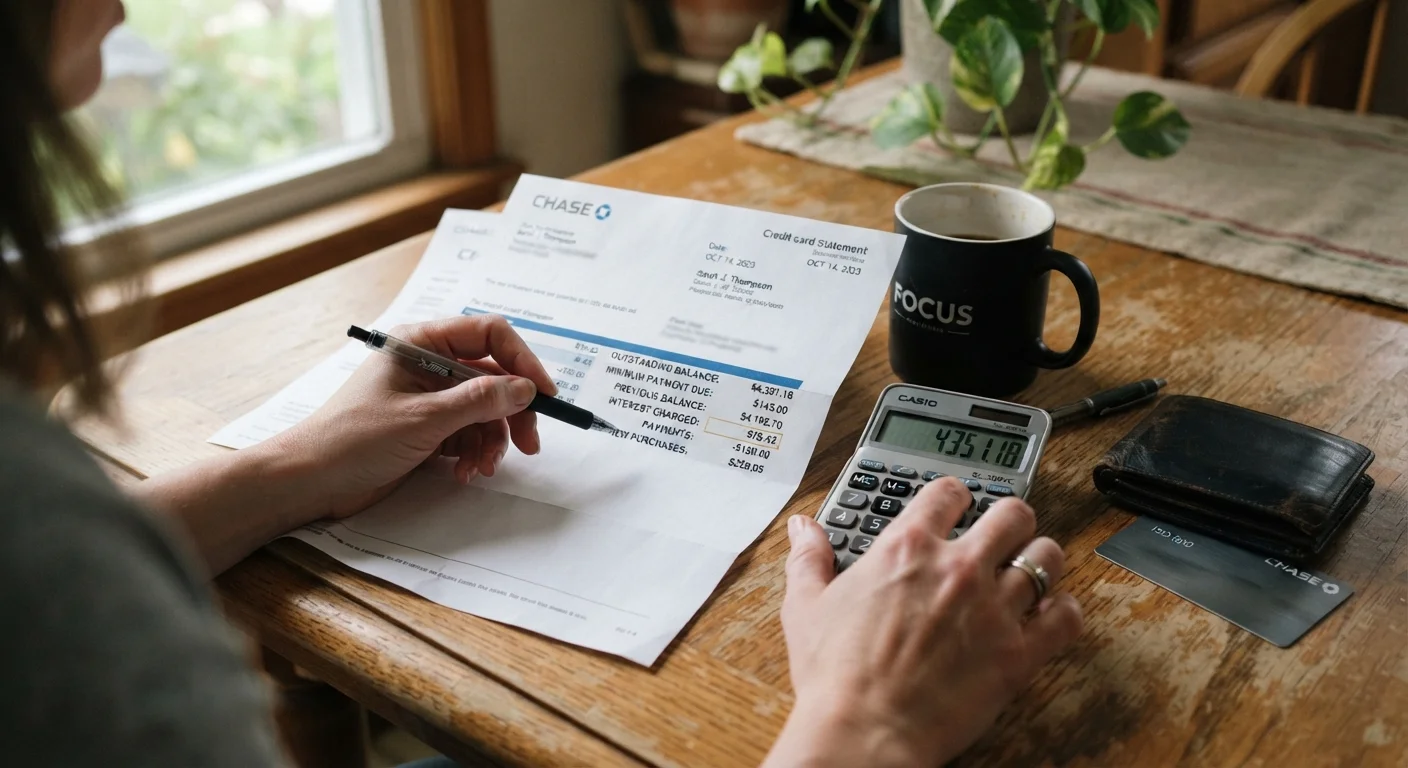
Before your next billing cycle closes, look at the interest charge line on your statement and annualize it: multiply one month's interest by 12. For many households, this number is surprisingly large — and seeing it expressed as an annual figure makes the true cost of carrying a balance more concrete and actionable.
This article provides general financial education and is not personalized financial advice. For guidance specific to your situation, consider consulting a licensed financial professional.