

Key Takeaways
- The avalanche method targets the highest-interest debt first, reducing total interest paid over time.
- The snowball method targets the smallest balance first, generating early psychological wins.
- Neither method is universally superior — consistency matters more than which strategy you choose.
- Both methods require paying at least the minimum on all other debts while focusing extra payments on one.
- Your motivation style and debt mix should guide which approach you adopt.
Option A
Debt Avalanche
The mathematically optimal approach to minimizing interest costs.
Best for: People who are motivated by long-term savings and can stay the course without early wins.
Option B
Debt Snowball
The behaviorally driven method that builds momentum through quick wins.
Best for: People who need visible progress to stay motivated and have multiple smaller debts to clear.
If minimizing total interest paid is your primary goal
Debt Avalanche
By targeting high-interest balances first, the avalanche method reduces the amount of interest that accrues across all your debts — potentially saving a meaningful sum over the repayment period.
If you need early motivation to stay on track
Debt Snowball
Clearing smaller balances quickly provides concrete proof of progress, which research in behavioral economics suggests helps sustain long-term commitment to a payoff plan.
If your debts carry similar interest rates
Debt Snowball
When interest rates are close together, the mathematical advantage of the avalanche narrows significantly, and the motivational edge of the snowball becomes relatively more valuable.
If you have one or two very high-rate debts dominating your balance
Debt Avalanche
High-rate debts compound quickly; targeting them first prevents interest from eroding your repayment efforts before you can make real headway.
How Each Strategy Works
Both the debt avalanche and debt snowball share a common foundation: you continue making the minimum payment on every debt you carry, then direct any extra money each month toward one target debt. The two methods differ only in how they rank that target.
The Debt Avalanche ranks debts by interest rate, highest to lowest. You attack the most expensive debt first. Once it is paid off, you redirect its payment — plus your extra funds — toward the next highest-rate balance. This "avalanche" of freed-up cash accelerates over time.
The Debt Snowball ranks debts by outstanding balance, smallest to largest, regardless of interest rate. You eliminate the smallest debt first, then roll that payment into the next smallest. Each payoff frees up additional cash to apply to the growing "snowball."
Before committing to either path, it is worth mapping exactly what you owe. See our household debt audit guide for a structured framework to take stock of your full debt picture.
| Criterion | Debt Avalanche | Debt Snowball |
|---|---|---|
| Prioritization basis | Highest interest rate first | Smallest balance first |
| Total interest paid | Lower over full payoff | Potentially higher |
| Time to first payoff | Longer (if high-rate debt is large) | Shorter (smallest balance cleared fast) |
| Motivational structure | Long-term savings focus | Early wins, frequent milestones |
| Complexity | Requires tracking APRs | Simple balance ranking |
| Best debt profile | Wide spread in interest rates | Multiple accounts, varied balances |
The Real-World Trade-Off: Math vs. Motivation
In a purely mathematical sense, the avalanche method wins. Paying down high-interest debt first reduces the total interest that accumulates across your accounts. The difference can be hundreds or even thousands of dollars depending on your balances and rates — though the exact figure varies widely by individual situation.
The snowball's advantage is behavioral. Eliminating a debt entirely — even a small one — triggers a sense of accomplishment that can sustain effort over months or years. Research in behavioral economics consistently shows that visible, near-term milestones help people maintain habits, especially during the long middle stretch of a multi-year payoff plan.
~$1,000+
Potential interest savings with avalanche method
Consumer finance educators generally estimate that avalanche-method borrowers can save hundreds to over a thousand dollars on typical multi-debt scenarios, though actual savings depend on balances, rates, and repayment timeline.
Faster
Time to first debt eliminated (snowball)
Because the snowball targets the smallest balance first, most borrowers reach their initial debt-free milestone sooner than with the avalanche — providing an early psychological reward.
Critically, the "best" strategy is often the one you will actually stick with. A plan abandoned halfway through costs more than a slightly less efficient plan completed in full. For insight into why repayment efforts stall, see our article on debt repayment patterns that tend to derail progress.
Choosing the Right Fit for Your Situation
Consider the following when deciding between the two approaches:
- Interest rate spread: If your debts range from 6% to 24% APR, the avalanche offers a meaningful mathematical edge. If rates cluster between 18% and 22%, the spread is narrow and the snowball's motivational benefit may outweigh the small cost difference.
- Number of accounts: Multiple small balances across several accounts can make the snowball especially effective — each closure simplifies your financial picture and reinforces progress.
- Your track record: If you have struggled to maintain momentum on debt payoff before, the snowball's early wins may provide the psychological fuel you need.
- Cash flow stability: Both methods work best when you have a reliable amount of extra money each month to direct toward the target debt. If cash flow is irregular, consider building a small buffer before intensifying payoff efforts.
You may also find it useful to think about saving and debt reduction in parallel. Our guide on paying off debt while saving at the same time explores how to balance both goals without abandoning either.
A Hybrid Approach Is Also Valid
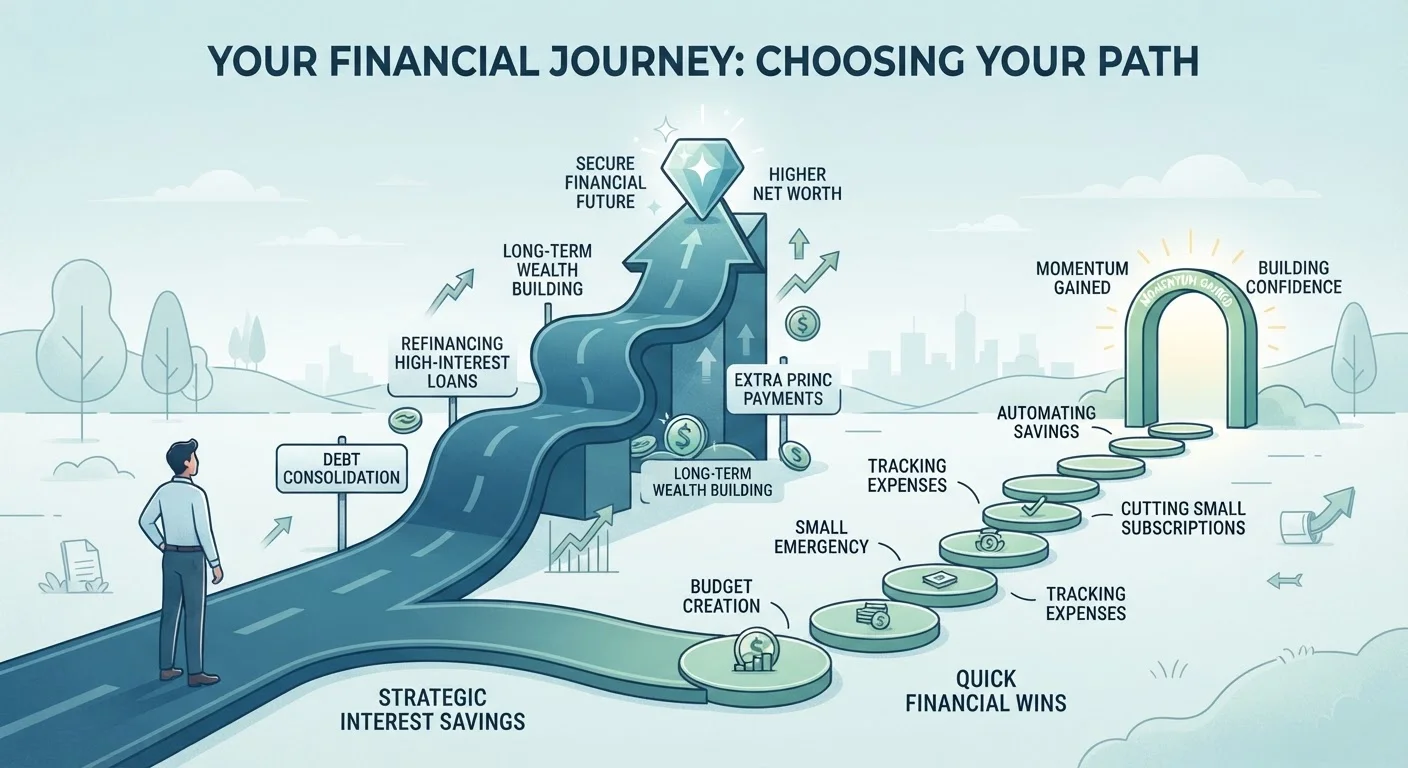
Some borrowers start with the snowball to clear one or two small accounts and build confidence, then switch to the avalanche to target remaining high-interest balances. This hybrid can capture motivational and mathematical benefits simultaneously. Neither method requires rigid adherence — what matters is maintaining consistent extra payments toward your chosen target. For a broader framework that connects payoff strategy to savings goals, see our complete guide to savings and debt reduction.
This article is for general informational and educational purposes only and does not constitute personalized financial or legal advice. Consider consulting a licensed financial professional for guidance tailored to your individual circumstances.