

Key Takeaways
- Compound interest grows your savings by earning returns on both your principal and previously earned interest.
- Starting earlier — even with smaller amounts — generally produces larger outcomes than starting later with larger amounts.
- Compounding frequency (daily, monthly, annually) affects how quickly interest accumulates.
- High-interest debt works against you using the same compounding logic that benefits savers.
- Consistent contributions amplify compounding effects significantly over decades.
Compound Interest
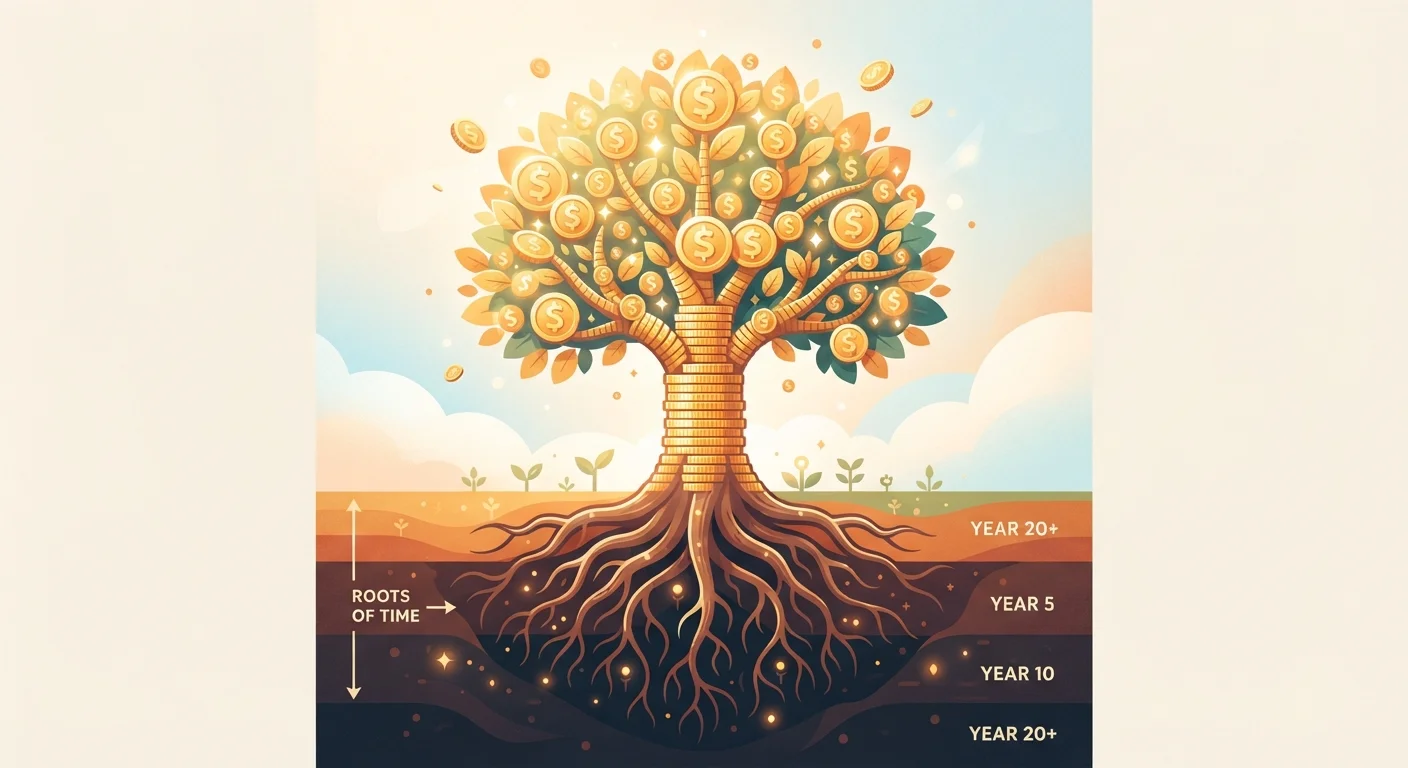
Compound interest is interest calculated not just on the money you originally deposited, but also on the interest that has already accumulated. In other words, your earnings begin to generate their own earnings. This creates a self-reinforcing cycle that can significantly accelerate how quickly a balance grows over time.
The standard compound interest formula is A = P(1 + r/n)^(nt), where P is the principal, r is the annual interest rate, n is the number of compounding periods per year, and t is time in years.
How Compounding Actually Works
The mechanics of compound interest are straightforward once you see them in motion. Imagine you deposit $5,000 into a savings account earning 4% interest, compounded annually. After year one, you earn $200 in interest, bringing your balance to $5,200. In year two, you don't earn interest only on the original $5,000 — you earn it on $5,200. That extra $8 may seem trivial, but apply this pattern across 30 years and the trajectory changes substantially.
At the end of 30 years — making no additional contributions — that $5,000 grows to approximately $16,217, more than triple the original deposit. The final decade alone accounts for a disproportionate share of the growth, which illustrates the exponential nature of compounding: it accelerates over time rather than growing in a straight line.
3x+
Growth of $5,000 over 30 years at 4%
A one-time $5,000 deposit earning 4% compounded annually grows to over $16,000 in 30 years with no additional contributions.
72
Rule of 72 — years to double your money
Divide 72 by your interest rate to estimate how many years it takes to double a balance; at 6%, that's roughly 12 years.
10 yrs
Early contributions can outpace 30 years of later saving
Due to compounding, a decade of early contributions at a consistent return can sometimes produce a larger final balance than three decades of later contributions.
Compounding frequency also plays a role. When interest compounds monthly rather than annually, you're effectively earning interest on interest twelve times a year instead of once. Most banks express this as the Annual Percentage Yield (APY), which reflects the effective annual return after compounding is factored in. Comparing APYs across accounts is the clearest apples-to-apples comparison you can make.
Why Time Is the Most Valuable Variable
Among all the factors in the compound interest equation — principal, rate, and time — time is the one that creates the most dramatic differences in outcomes. Consider two savers: one contributes $3,000 per year starting at age 25 and stops at age 35 (10 years of contributions, $30,000 total). The other starts at age 35 and contributes $3,000 per year until age 65 (30 years of contributions, $90,000 total). Assuming a consistent 6% annual return, the early saver often finishes with a larger balance despite contributing far less — because those first ten years had three additional decades to compound.
“Compound interest is the eighth wonder of the world. He who understands it, earns it; he who doesn't, pays it.”
— Widely attributed to Albert Einstein, This quote, frequently cited in financial education, underscores compounding's outsized long-term impact — though its precise origin is debated by historians.
This dynamic is sometimes called the compounding advantage of time, and it explains why financial educators emphasize starting as early as possible — not because the amounts contributed early are large, but because the compounding clock starts sooner. Even small, regular contributions made consistently can build substantial balances given enough time. For more on building that consistency, see our guide to automating your savings.
The Two-Sided Nature of Compounding
Compound interest is a neutral mechanism — it works the same way whether it's growing your savings or growing your debt. Credit card balances are a clear example: unpaid interest is added to your principal, and the next billing cycle charges interest on that larger amount. A $2,000 balance at 20% APR, carried for five years with minimum payments, can generate thousands of dollars in interest charges — money that could otherwise be building savings.
This is why managing debt and savings simultaneously is a genuinely complex trade-off. High-interest debt compounds against you faster than most savings accounts compound for you. In many cases, paying down high-rate debt first produces a better financial outcome than prioritizing savings — though every situation has its own variables. For a broader framework, explore the complete guide to savings and debt reduction.
Understanding compounding as a force that cuts both ways helps clarify why debt carries real long-term cost — it's not just the rate that matters, but how long that rate has to compound against you.
This article is for general informational and educational purposes only and does not constitute personalized financial, investment, or tax advice. Consult a qualified financial professional before making decisions based on your individual circumstances.