

Key Takeaways
- Traditional IRA contributions may be tax-deductible today; withdrawals are taxed as ordinary income in retirement.
- Roth IRA contributions are made with after-tax dollars, allowing qualified withdrawals to be completely tax-free.
- Both account types share the same annual contribution limit, set by the IRS each year.
- Traditional IRAs require minimum distributions starting at age 73; Roth IRAs have no such requirement during the owner's lifetime.
- Income limits affect Roth IRA eligibility but not the ability to contribute to a traditional IRA.
Option A
Traditional IRA
The tax-deferred retirement account for those who want savings now.
Best for: Earners who expect to be in a lower tax bracket in retirement than they are today.
Option B
Roth IRA
The tax-free growth account for those who want flexibility later.
Best for: Earners who expect to be in the same or higher tax bracket in retirement.
If you want to reduce your taxable income right now
Traditional IRA
Contributions to a traditional IRA may be deductible in the year they are made, lowering your current-year tax bill — particularly valuable during peak earning years.
If you expect your income or tax rate to rise over time
Roth IRA
Paying taxes on contributions now locks in your current, lower rate — and qualified withdrawals in retirement are completely tax-free.
If you want flexibility to access contributions before retirement
Roth IRA
Roth IRA contributions (not earnings) can be withdrawn at any time without taxes or penalties, making it a more flexible vehicle for long-term savers.
If you want to avoid mandatory withdrawals later in life
Roth IRA
Roth IRAs are not subject to required minimum distributions during the account owner's lifetime, giving you more control over when and how you draw down funds.
If your income exceeds Roth IRA eligibility limits
Traditional IRA
There are no income limits preventing contributions to a traditional IRA, making it accessible to higher earners who are phased out of direct Roth contributions.
The Core Difference: When You Pay Taxes
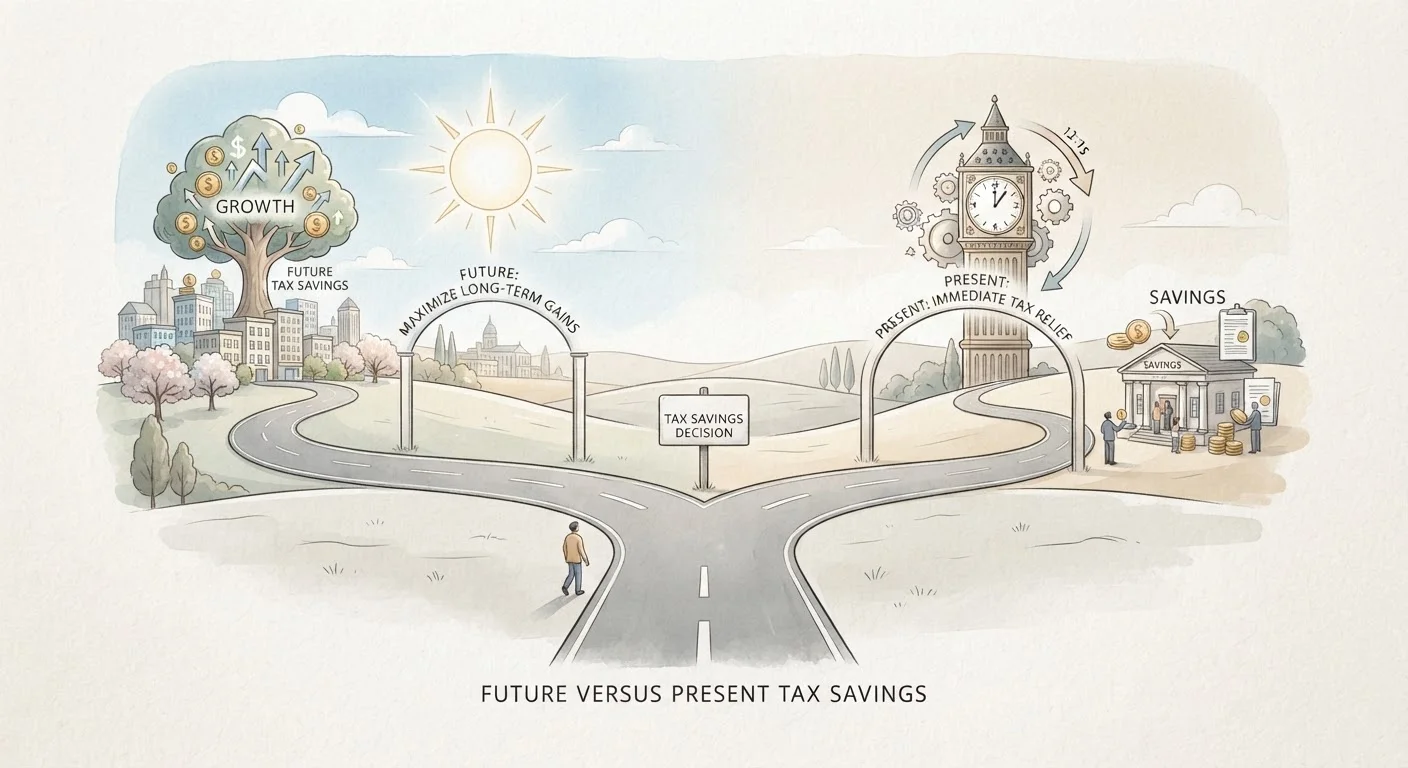
Both traditional and Roth IRAs are individual retirement accounts that allow your investments to grow without being taxed each year. The fundamental distinction is when the IRS takes its share.
With a traditional IRA, you contribute pre-tax or tax-deductible dollars. Your money grows tax-deferred, meaning you pay no income tax on gains until you make withdrawals in retirement — at which point distributions are taxed as ordinary income.
With a Roth IRA, you contribute money you have already paid income tax on. In exchange, qualified withdrawals — including all investment growth — are completely tax-free. A withdrawal is generally considered qualified if the account is at least five years old and you are age 59½ or older.
Neither approach is universally superior. The right choice depends largely on your current tax rate compared to your expected rate in retirement. See our broader guide to retirement accounts for context on how IRAs fit alongside 401(k)s and other vehicles.
| Criterion | Traditional IRA | Roth IRA |
|---|---|---|
| Tax treatment of contributions | May be tax-deductible | After-tax dollars only |
| Tax treatment of withdrawals | Taxed as ordinary income | Tax-free if qualified |
| Income limits to contribute | None (deductibility may be limited) | Yes — phases out at higher incomes |
| Early withdrawal penalty | 10% before age 59½ (exceptions apply) | Contributions: none; Earnings: 10% before 59½ |
| Required minimum distributions | Yes, starting at age 73 | None during owner's lifetime |
| Best tax timing strategy | Tax savings now, pay later | Pay now, tax-free later |
Contribution Rules, Limits, and Eligibility
For both account types, the IRS sets an annual contribution limit that applies in total — not per account. Contributing to both a traditional and a Roth IRA in the same year is allowed, but combined contributions cannot exceed the annual cap. That limit is indexed to inflation and adjusted periodically; check IRS Publication 590-A for the current figure.
Individuals aged 50 and older are permitted to make additional catch-up contributions beyond the standard limit, providing an opportunity to accelerate savings closer to retirement.
Income and Deductibility Considerations
Traditional IRA deductibility depends on whether you or your spouse have access to a workplace retirement plan and your modified adjusted gross income (MAGI). If neither you nor your spouse participates in an employer-sponsored plan, contributions are fully deductible regardless of income. If a plan is available through work, deductibility phases out above certain income thresholds.
Roth IRA eligibility itself phases out at higher income levels. Above specific MAGI thresholds, your ability to contribute directly to a Roth IRA is reduced or eliminated entirely. Higher earners sometimes use a strategy called a backdoor Roth conversion, though this involves additional tax considerations — a qualified tax adviser can help you evaluate whether it is appropriate for your situation.
$7,000
2024 IRA annual contribution limit
According to IRS guidance, the combined contribution limit for traditional and Roth IRAs is $7,000 for 2024, with a $1,000 catch-up for those aged 50 and older.
Age 73
RMD start age for traditional IRAs
The SECURE 2.0 Act raised the required minimum distribution age to 73, giving traditional IRA holders additional years of tax-deferred growth before mandatory withdrawals begin.
5 Years
Roth IRA seasoning rule for tax-free earnings
The IRS requires a Roth IRA to be open for at least five tax years before earnings can be withdrawn tax-free, even after age 59½.
Withdrawals, Penalties, and Required Distributions
Understanding the withdrawal rules is just as important as knowing the contribution mechanics — and this is where the two account types diverge most sharply in practical terms.
Traditional IRA Withdrawals
Distributions from a traditional IRA are taxed as ordinary income in the year you take them. Withdrawing before age 59½ generally triggers a 10% early withdrawal penalty in addition to income tax, unless a specific IRS exception applies (such as a first-home purchase or certain disability conditions). Starting at age 73, the IRS requires you to begin taking required minimum distributions (RMDs), calculated based on your account balance and life expectancy tables.
Roth IRA Withdrawals
Because Roth contributions are made with after-tax dollars, you can withdraw your contributions (not earnings) at any time, for any reason, without taxes or penalties. Earnings follow stricter rules: to withdraw them tax- and penalty-free, the account must be at least five years old and you must be 59½ or older. Crucially, Roth IRAs are not subject to RMDs during the account owner's lifetime, giving long-term savers more control over their assets. This can also make a Roth IRA a useful estate planning tool, since heirs may inherit accounts with significant tax-free growth.
For context on other saving vehicles that complement retirement accounts, our comparison of high-yield and traditional savings accounts covers shorter-term options worth understanding alongside your retirement strategy.
This article is for general informational and educational purposes only and does not constitute personalised tax, legal, or investment advice. Tax rules and contribution limits change periodically. Consult a qualified financial adviser or tax professional regarding decisions specific to your situation.