

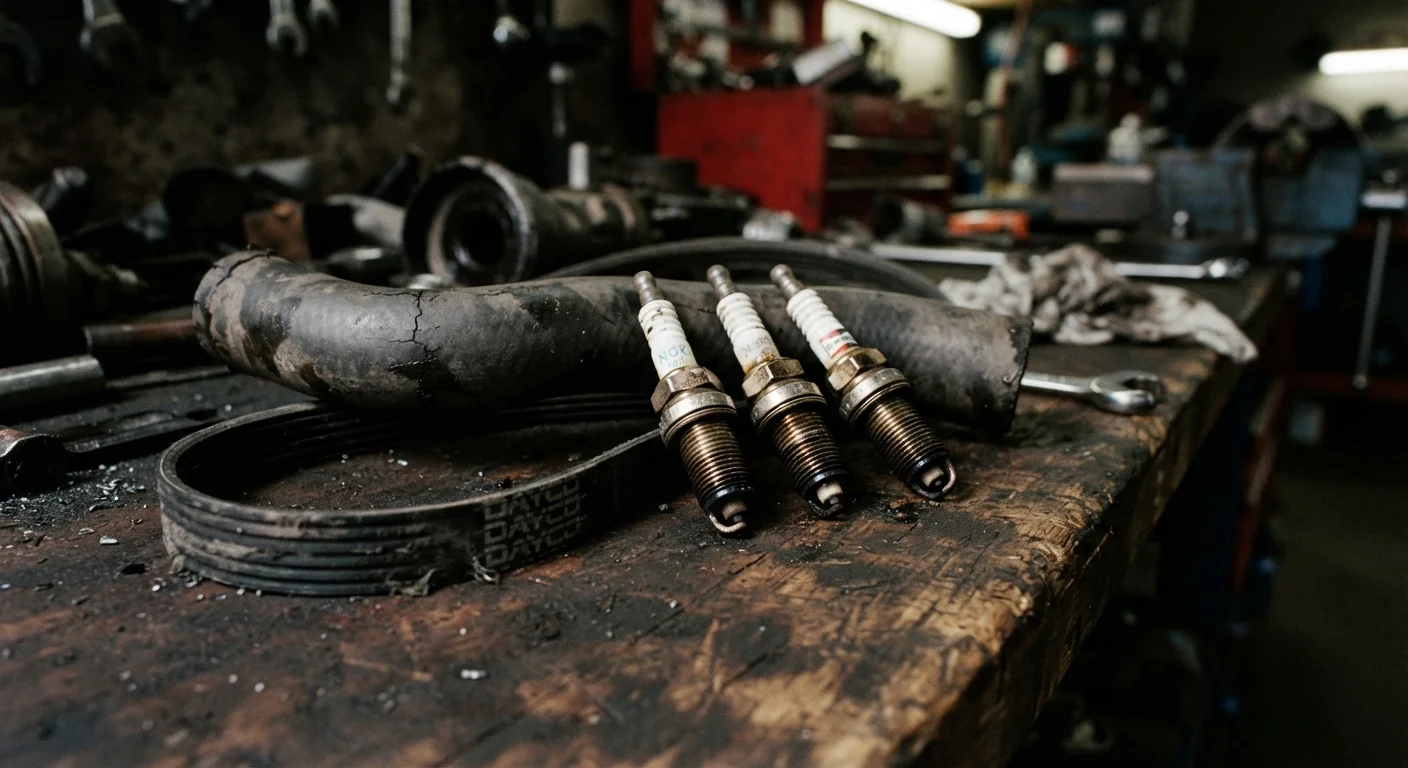
Key Takeaways
- Spark plugs, belts, and hoses have defined service intervals that most drivers don't track.
- Failing to replace these parts on schedule often turns a minor expense into a major repair.
- Visual inspection alone isn't enough - some components look fine right up until they fail.
- Manufacturer service schedules in your owner's manual are the most reliable guide for replacement timing.
- Catching wear early is almost always less expensive than roadside emergency repairs or towing.
The Components That Don't Ask for Attention Until It's Too Late
Most drivers know to change their oil and rotate their tires. Those services come with reminders - stickers on windshields, dashboard alerts, service center calls. But a category of equally critical components operates quietly until they fail catastrophically: spark plugs, drive belts, coolant hoses, and their mechanical neighbors. These parts wear gradually, rarely trigger warning lights, and tend to get skipped or deferred because nothing obviously feels wrong.
The problem is that "nothing feels wrong" describes most failing wear components right up to the moment they give out. A cracked radiator hose won't announce itself before it ruptures. A stretched timing belt won't vibrate or squeal before it snaps. Understanding what these parts do, how long they last, and what happens when they're neglected is one of the most practical things a car owner can know. For a broader picture of what each major system in your vehicle needs, see our comprehensive car maintenance guide.
Spark Plugs
Spark plugs ignite the air-fuel mixture inside each engine cylinder. Every combustion event depends on a plug firing reliably. Conventional copper-core plugs typically need replacement every 30,000 miles; iridium and platinum plugs are often rated for 60,000 to 100,000 miles or more, depending on the vehicle.
When plugs wear out, symptoms include rough idling, sluggish acceleration, reduced fuel economy, and misfires that can trigger the check engine light. Left long enough, worn plugs can damage ignition coils or cause incomplete combustion that fouls other components. Because extended-life plugs last so long, it's easy to lose track of when they were last changed - which is exactly how they get forgotten.
Worn spark plugs can quietly damage ignition coils before a single warning light appears.
Serpentine Belt
The serpentine belt is a single, continuous rubber belt that drives multiple engine accessories at once - the alternator, power steering pump, air conditioning compressor, and water pump, depending on the vehicle. If it fails, those systems stop working immediately. In many vehicles, the water pump is belt-driven, so a broken serpentine belt can trigger rapid engine overheating within minutes.
Most manufacturers recommend inspection every 60,000 to 100,000 miles and replacement based on condition or at defined intervals. Visible cracks, fraying, or glazing are warning signs, but belts can fail internally without obvious surface damage. A belt replacement is a relatively modest service cost; replacing components damaged by a broken belt is not.
A failed serpentine belt can overheat an engine within minutes - replacement is far cheaper.
Timing Belt
Not all engines use a timing belt - many use a timing chain instead, which generally lasts the life of the engine with proper oil maintenance. But vehicles with rubber timing belts carry a firm replacement interval, often between 60,000 and 105,000 miles, and the consequences of missing it are severe.
The timing belt synchronizes the crankshaft and camshaft rotation. If it snaps, the engine can stop instantly - and in interference-type engines, that failure can cause pistons and valves to collide, resulting in internal engine damage that can cost thousands of dollars to repair. Check your owner's manual to confirm whether your engine has a belt or a chain, and if it's a belt, treat that replacement interval as non-negotiable.
A snapped timing belt in an interference engine can cause thousands in internal damage instantly.
Coolant Hoses
Coolant hoses carry pressurized hot coolant between the engine, radiator, and heater core. The upper and lower radiator hoses are the most prominent, but heater hoses and bypass hoses are part of the same system. All are made of reinforced rubber that degrades over time from heat cycling, pressure, and exposure to coolant chemistry.
Externally, hoses may look intact while the inner lining is deteriorating. Squeezing a cold hose can reveal softness or sponginess that signals trouble, but the only reliable way to assess the inside is to drain and inspect or replace based on age and mileage. Hose failure typically means a sudden coolant loss, steam from under the hood, and potential engine overheating. Many mechanics recommend replacement every four to five years or at major coolant service intervals.
Coolant hoses can look fine outside while internally deteriorating - age matters as much as appearance.
PCV Valve
The positive crankcase ventilation (PCV) valve is a small, inexpensive component that routes combustion gases from the crankcase back into the intake manifold to be burned. It prevents pressure buildup and keeps oil vapors out of the atmosphere. When it sticks or clogs, crankcase pressure rises and can force oil past gaskets and seals, leading to leaks and sludge buildup inside the engine.
PCV valves are often overlooked because they're inexpensive and easy to ignore. Replacement intervals vary by vehicle - some manufacturers recommend every 20,000 to 30,000 miles, others less frequently. Symptoms of a failed PCV valve include increased oil consumption, oil leaks, rough idle, and a whistling or hissing noise from the engine. It's a small part that protects far more expensive systems.
A clogged PCV valve can force oil past engine seals - and it costs just a few dollars to replace.
Drive Axle and CV Boots
Constant-velocity (CV) joints transfer engine power to the wheels through a range of steering and suspension motion. Each joint is encased in a rubber boot filled with grease that keeps the joint lubricated and contaminant-free. When a CV boot cracks or tears, the grease escapes and grit enters - leading to rapid joint wear.
A failing CV joint often announces itself with a clicking or popping noise when turning, especially at low speeds with the wheel at full lock. Catching a torn boot early, before the joint is contaminated, means a straightforward boot replacement. Waiting until the joint itself is damaged typically means replacing the entire axle shaft - a significantly more involved and costly repair. Inspecting boots during tire rotations is a simple way to catch damage early.
Catching a torn CV boot early means a simple repair; waiting for joint failure means replacing the whole axle.
Making These Parts Part of Your Regular Routine
The common thread across all of these components is that their failure is almost always preventable - and that prevention is far cheaper than the repair bill that follows neglect. The first step is simple: locate your owner's manual and review the manufacturer's recommended maintenance schedule. Intervals are listed there by mileage and time, and they reflect the engineering realities of each specific vehicle.
If the manual isn't available, a qualified mechanic can inspect these components during a routine service visit and advise on replacement timing based on their condition. Don't rely solely on visual checks, especially for belts and hoses - internal degradation often isn't visible from the outside. It's also worth understanding which common maintenance assumptions are outdated. Our look at car maintenance myths that cost drivers money covers how modern vehicles have changed what "routine service" actually requires. And if you've ever wondered whether deferring scheduled service really saves money, the answer is rarely straightforward - why skipped maintenance is often the most expensive decision breaks down the downstream costs in detail.
Use Your Owner's Manual as a Starting Point
Your vehicle's owner's manual contains manufacturer-recommended service intervals specific to your engine and drivetrain. These intervals are the most accurate guide to when spark plugs, belts, and hoses should be inspected or replaced - not generic rules of thumb. If you've purchased a used vehicle, a pre-purchase inspection or a thorough service history review can help establish what's already been done and what's due.